QUESTION IMAGE
Question
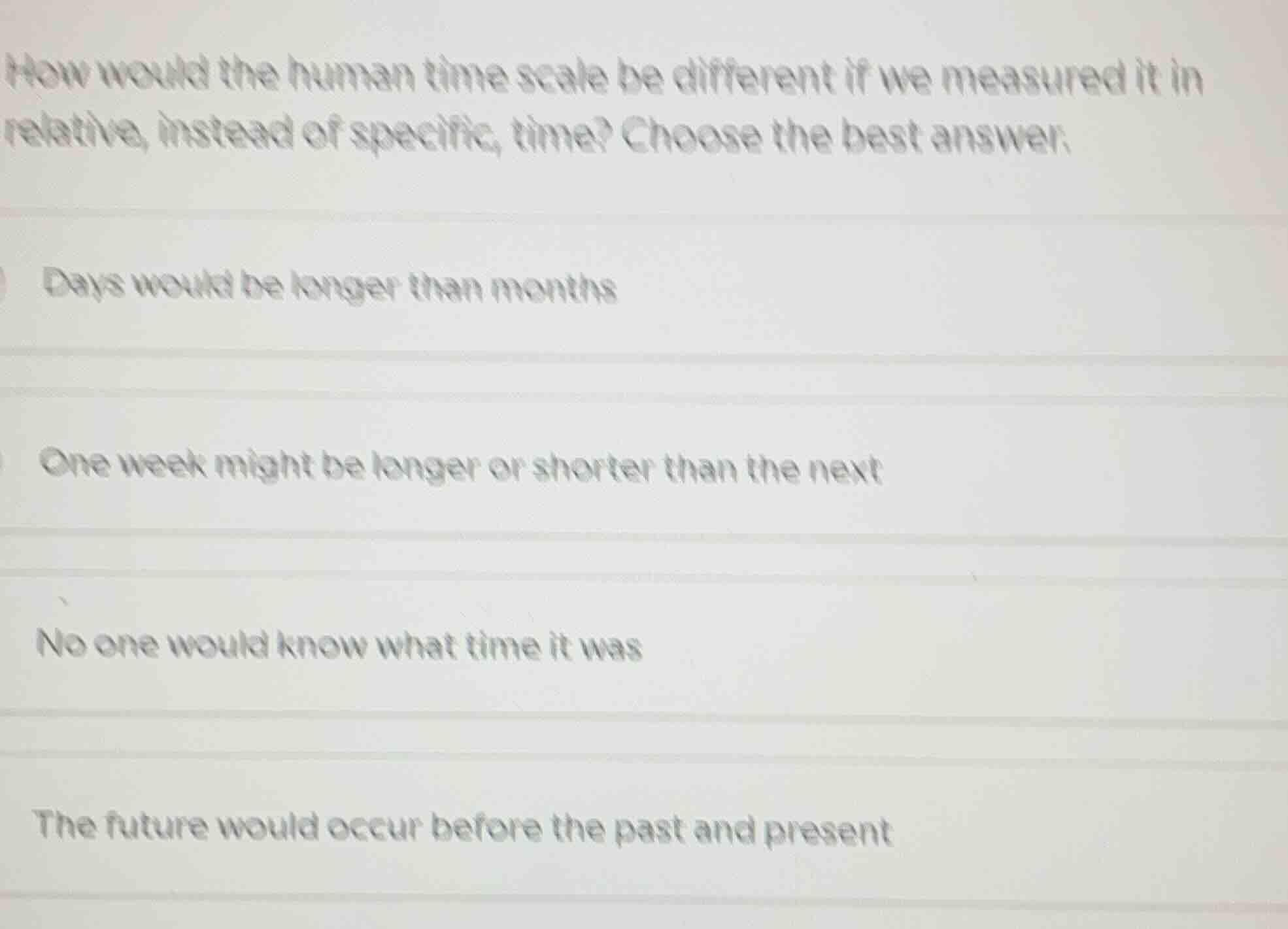
how would the human time scale be different if we measured it in relative, instead of specific, time? choose the best answer: days would be longer than months one week might be longer or shorter than the next no one would know what time it was the future would occur before the past and present
Brief Explanations
- For the option "Days would be longer than months", in normal time measurement, months are longer than days, and relative time measurement doesn't reverse this fundamental length relationship, so this is incorrect.
- For "One week might be longer or shorter than the next", relative time is based on perception or context (e.g., a week with a lot of activities might feel longer, a boring week might feel shorter), while specific time has fixed durations (7 days). So this aligns with how relative time differs from specific time.
- For "No one would know what time it was", relative time doesn't mean time is unknowable, just that its perception is relative, so this is incorrect.
- For "The future would occur before the past and present", relative time doesn't alter the chronological order of past, present, future, so this is incorrect.

Snap & solve any problem in the app
Get step-by-step solutions on Sovi AI
Photo-based solutions with guided steps
Explore more problems and detailed explanations
B. One week might be longer or shorter than the next (assuming the options are labeled A, B, C, D with B being "One week might be longer or shorter than the next" as per the given choices)