QUESTION IMAGE
Question
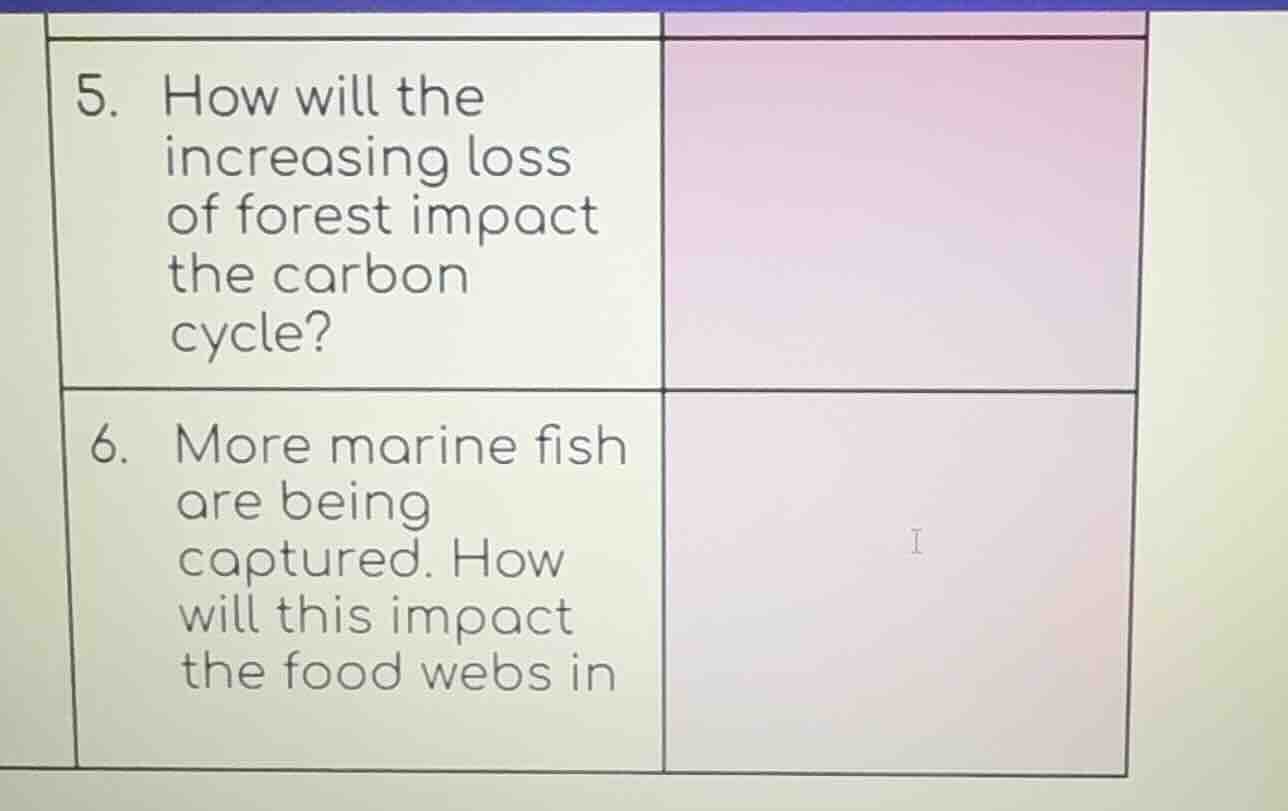
- how will the
increasing loss
of forest impact
the carbon
cycle?
- more marine fish
are being
captured. how
will this impact
the food webs in
For Question 5:
Forests act as carbon sinks, absorbing atmospheric $\text{CO}_2$ via photosynthesis and storing carbon in biomass and soil. When forests are lost, this stored carbon is released into the atmosphere through burning or decomposition of dead vegetation. Additionally, the loss of trees reduces the planet's capacity to remove $\text{CO}_2$ from the air, disrupting the natural balance of the carbon cycle and increasing atmospheric carbon levels.
For Question 6:
Marine fish often occupy middle or upper trophic levels in marine food webs. Over-capturing these fish reduces their population, which removes a key food source for their natural predators, leading to declines in those predator populations. It also allows the prey species of the captured fish to experience population growth due to reduced predation pressure, which can then overconsume their own food sources, creating a ripple effect that destabilizes the structure and balance of the entire marine food web.

Snap & solve any problem in the app
Get step-by-step solutions on Sovi AI
Photo-based solutions with guided steps
Explore more problems and detailed explanations
- Increasing forest loss will release stored carbon into the atmosphere (via burning/decomposition) and reduce the planet's ability to absorb atmospheric $\text{CO}_2$, disrupting the carbon cycle and raising atmospheric carbon concentrations.
- Over-capturing marine fish will create ripple effects in marine food webs: predator species that rely on these fish will decline, while the prey species of the captured fish will overpopulate and potentially overconsume their own food sources, destabilizing the web's balance.