QUESTION IMAGE
Question
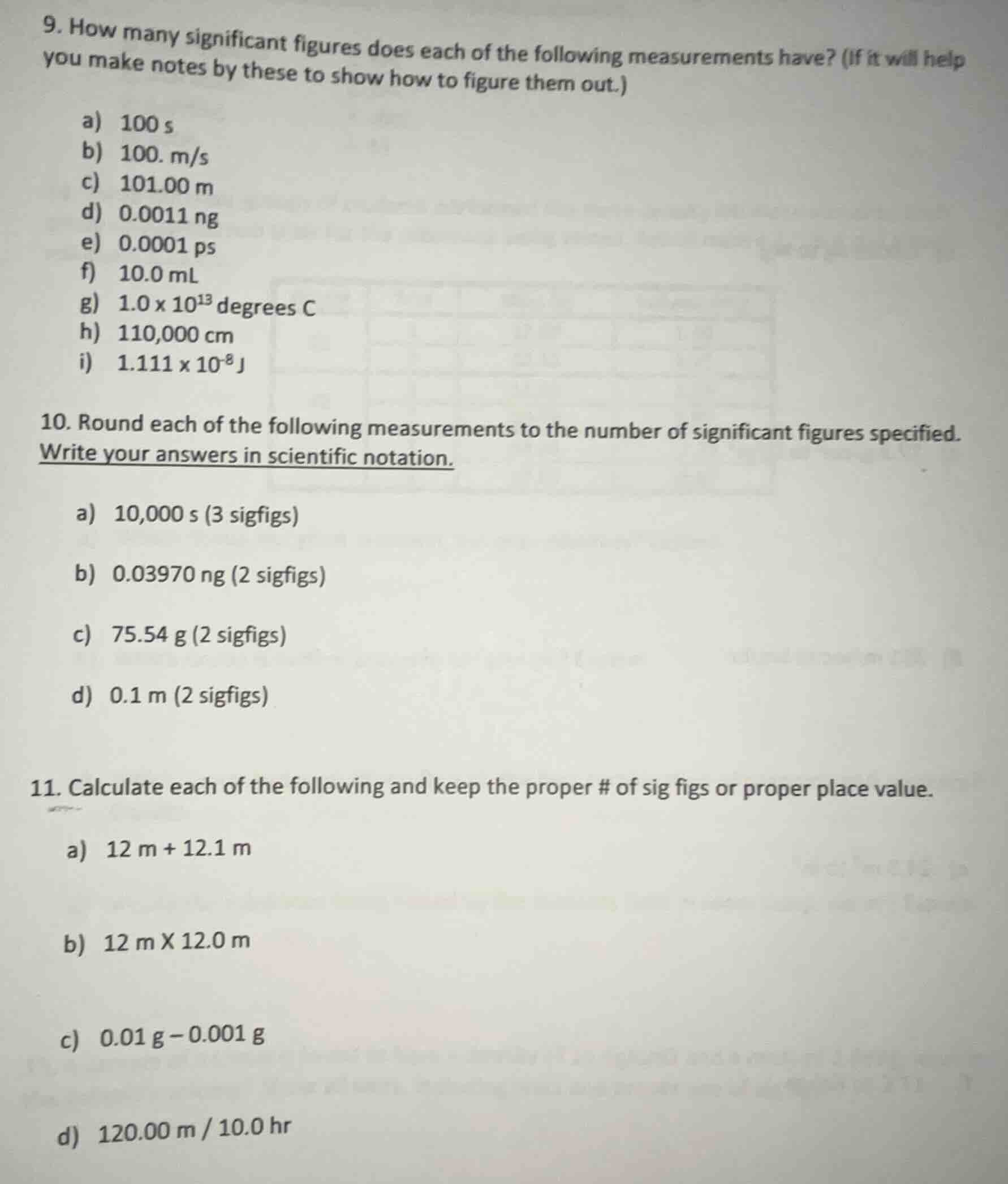
- how many significant figures does each of the following measurements have? (if it will help you make notes by these to show how to figure them out.)
a) 100 s
b) 100. m/s
c) 101.00 m
d) 0.0011 ng
e) 0.0001 ps
f) 10.0 ml
g) 1.0 x 10¹³ degrees c
h) 110,000 cm
i) 1.111 x 10⁻⁸ j
- round each of the following measurements to the number of significant figures specified. write your answers in scientific notation.
a) 10,000 s (3 sigfigs)
b) 0.03970 ng (2 sigfigs)
c) 75.54 g (2 sigfigs)
d) 0.1 m (2 sigfigs)
- calculate each of the following and keep the proper # of sig figs or proper place value.
a) 12 m + 12.1 m
b) 12 m x 12.0 m
c) 0.01 g − 0.001 g
d) 120.00 m / 10.0 hr
Question 9
Step1: Apply sig fig rules to each value
- Trailing zeros without decimal are ambiguous, count non-zeros; trailing zeros after decimal are significant; leading zeros are not; all digits in scientific notation (coefficient) are significant.
Step2: Count significant figures for each
a) $100\ \text{s}$: Trailing zeros no decimal → 1 sig fig
b) $100.\ \text{m/s}$: Decimal present, all digits count → 3 sig figs
c) $101.00\ \text{m}$: Zeros after decimal and between non-zeros count → 5 sig figs
d) $0.0011\ \text{ng}$: Leading zeros ignored, non-zeros count → 2 sig figs
e) $0.0001\ \text{ps}$: Leading zeros ignored, 1 non-zero → 1 sig fig
f) $10.0\ \text{mL}$: Zeros after decimal and between count → 3 sig figs
g) $1.0 \times 10^{13}\ \text{degrees C}$: Coefficient digits count → 2 sig figs
h) $110,000\ \text{cm}$: Trailing zeros no decimal → 2 sig figs
i) $1.111 \times 10^{-8}\ \text{J}$: Coefficient digits count → 4 sig figs
Step1: Round to specified sig figs
Adjust each value to the required number of significant figures, then convert to scientific notation ($a \times 10^n$, $1 \leq a < 10$).
Step2: Convert to scientific notation
a) $10,000\ \text{s}$ (3 sig figs): Round to $1.00 \times 10^4$
b) $0.03970\ \text{ng}$ (2 sig figs): Round to $4.0 \times 10^{-2}$
c) $75.54\ \text{g}$ (2 sig figs): Round to $7.6 \times 10^1$
d) $0.1\ \text{m}$ (2 sig figs): Convert to $1.0 \times 10^{-1}$
Step1: Perform arithmetic operation
a) $12\ \text{m} + 12.1\ \text{m} = 24.1\ \text{m}$; round to least decimal place (12 has 0 decimals)
b) $12\ \text{m} \times 12.0\ \text{m} = 144\ \text{m}^2$; round to least sig figs (12 has 2)
c) $0.01\ \text{g} - 0.001\ \text{g} = 0.009\ \text{g}$; round to least decimal place (0.01 has 2 decimals)
d) $\frac{120.00\ \text{m}}{10.0\ \text{hr}} = 12.000\ \text{m/hr}$; round to least sig figs (10.0 has 3)
Step2: Round to proper sig figs/place
a) Round $24.1$ to 0 decimals → 24
b) Round $144$ to 2 sig figs → 140
c) $0.009$ matches required decimal place
d) Round $12.000$ to 3 sig figs → 12.0

Snap & solve any problem in the app
Get step-by-step solutions on Sovi AI
Photo-based solutions with guided steps
Explore more problems and detailed explanations
a) 1
b) 3
c) 5
d) 2
e) 1
f) 3
g) 2
h) 2
i) 4
---