QUESTION IMAGE
Question
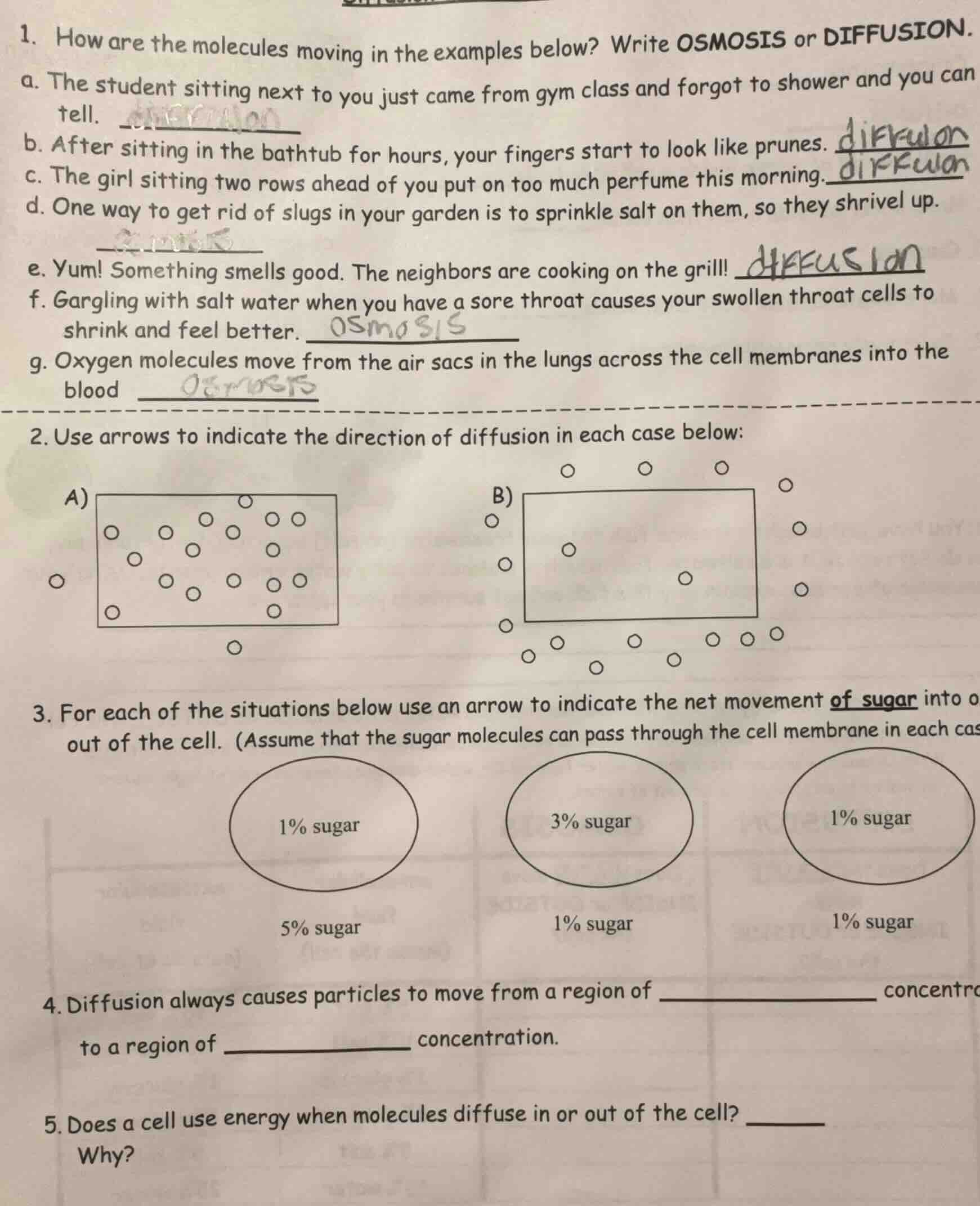
- how are the molecules moving in the examples below? write osmosis or diffusion.
a. the student sitting next to you just came from gym class and forgot to shower and you can tell.
b. after sitting in the bathtub for hours, your fingers start to look like prunes.
c. the girl sitting two rows ahead of you put on too much perfume this morning.
d. one way to get rid of slugs in your garden is to sprinkle salt on them, so they shrivel up.
e. yum! something smells good. the neighbors are cooking on the grill!
f. gargling with salt water when you have a sore throat causes your swollen throat cells to shrink and feel better.
g. oxygen molecules move from the air sacs in the lungs across the cell membranes into the blood
- use arrows to indicate the direction of diffusion in each case below:
- for each of the situations below use an arrow to indicate the net movement of sugar into or out of the cell. (assume that the sugar molecules can pass through the cell membrane in each case)
- diffusion always causes particles to move from a region of _____________ concentration to a region of _____________ concentration.
- does a cell use energy when molecules diffuse in or out of the cell? ______
why?
For Question 1:
- Diffusion is the movement of any particles from high to low concentration across no semipermeable membrane (or freely). Osmosis is the movement of water across a semipermeable membrane from low solute to high solute concentration.
a. Body odor particles spread freely: Diffusion
b. Water moves in/out of skin cells (semipermeable): Osmosis
c. Perfume particles spread freely: Diffusion
d. Water leaves slug cells (semipermeable, salt draws water): Osmosis
e. Food odor particles spread freely: Diffusion
f. Water leaves swollen throat cells (salt draws water, semipermeable): Osmosis
g. Oxygen moves freely across cell membranes: Diffusion
For Question 2:
- Diffusion moves from high to low particle concentration.
A) Particles move out of the box (higher inside)
B) Particles move into the box (higher outside)
For Question 3:
- Sugar moves from high to low concentration across the membrane.
- 1% sugar cell, 5% outside: Arrow into cell
- 3% sugar cell, 1% outside: Arrow out of cell
- 1% sugar cell, 1% outside: No net movement (no arrow)
For Question 4:
- Diffusion follows a concentration gradient from high to low concentration.
For Question 5:
- Diffusion is passive transport, moving down a concentration gradient without energy input.
---

Snap & solve any problem in the app
Get step-by-step solutions on Sovi AI
Photo-based solutions with guided steps
Explore more problems and detailed explanations
1.
a. DIFFUSION
b. OSMOSIS
c. DIFFUSION
d. OSMOSIS
e. DIFFUSION
f. OSMOSIS
g. DIFFUSION
2.
A) Draw arrows pointing out of the rectangular box
B) Draw arrows pointing into the rectangular box
3.
- 1% sugar cell / 5% sugar outside: Arrow pointing into the oval (cell)
- 3% sugar cell / 1% sugar outside: Arrow pointing out of the oval (cell)
- 1% sugar cell / 1% sugar outside: No arrow (no net movement)
4.
high; low
5.
No
Why? Diffusion is passive transport, moving particles down their natural concentration gradient without requiring cellular energy input.