QUESTION IMAGE
Question
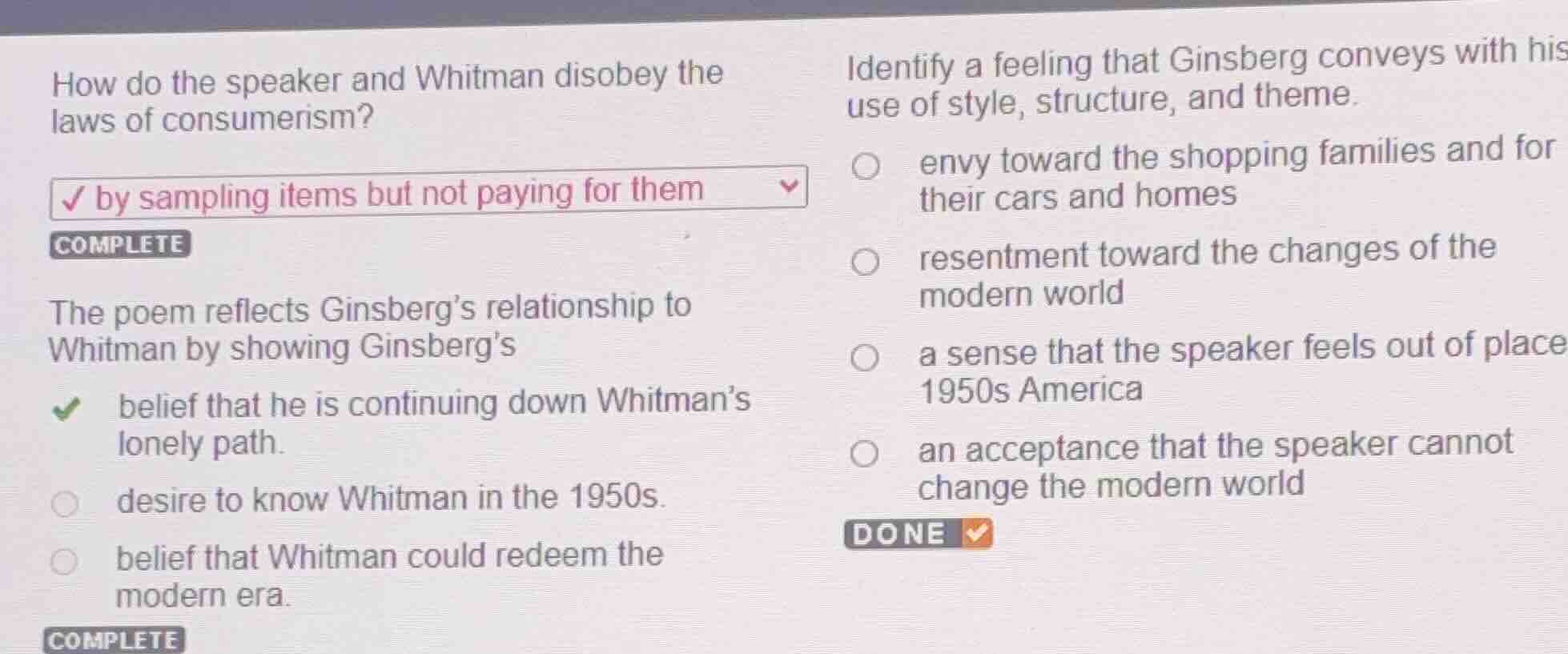
how do the speaker and whitman disobey the laws of consumerism? by sampling items but not paying for them complete the poem reflects ginsberg’s relationship to whitman by showing ginsberg’s belief that he is continuing down whitman’s lonely path. desire to know whitman in the 1950s. belief that whitman could redeem the modern era. complete identify a feeling that ginsberg conveys with his use of style, structure, and theme. envy toward the shopping families and for their cars and homes resentment toward the changes of the modern world a sense that the speaker feels out of place 1950s america an acceptance that the speaker cannot change the modern world done
For the question "Identify a feeling that Ginsberg conveys with his use of style, structure, and theme."
To solve this, we analyze each option:
- Option 1 (envy toward the shopping families...): The poem's focus isn't on envy of material possessions.
- Option 2 (resentment toward the changes...): Ginsberg's work (like "A Supermarket in California") reflects a sense of being out of place in 1950s consumerist America, not just resentment of change.
- Option 3 (a sense that the speaker feels out of place in 1950s America): In "A Supermarket in California," the speaker (Ginsberg) and Whitman navigate a consumerist 1950s America, feeling alienated. The style (free verse, personal reflection), structure (exploring the supermarket as a symbol), and theme (alienation in modern consumerism) convey this out - of - place feeling.
- Option 4 (an acceptance that the speaker cannot change...): The poem shows a sense of alienation, not acceptance of being unable to change the world.
- Option 1 (belief that he is continuing down Whitman’s lonely path): Whitman was a pioneer of free - thinking and non - conformist poetry. Ginsberg, in works like "A Supermarket in California," sees himself as continuing Whitman's legacy of exploring individualism and non - conformity in a changing (consumerist) America, a path that was "lonely" in terms of going against the mainstream.
- Option 2 (desire to know Whitman in the 1950s): The poem is not about a desire to meet Whitman in the 1950s but about the spiritual connection and shared path.
- Option 3 (belief that Whitman could redeem the modern era): The poem doesn't suggest Whitman can redeem the modern era, but rather a shared sense of alienation and non - conformity.

Snap & solve any problem in the app
Get step-by-step solutions on Sovi AI
Photo-based solutions with guided steps
Explore more problems and detailed explanations
C. a sense that the speaker feels out of place in 1950s America (assuming the options are labeled A, B, C, D with this as option C; adjust label based on actual option numbering in the question)