QUESTION IMAGE
Question
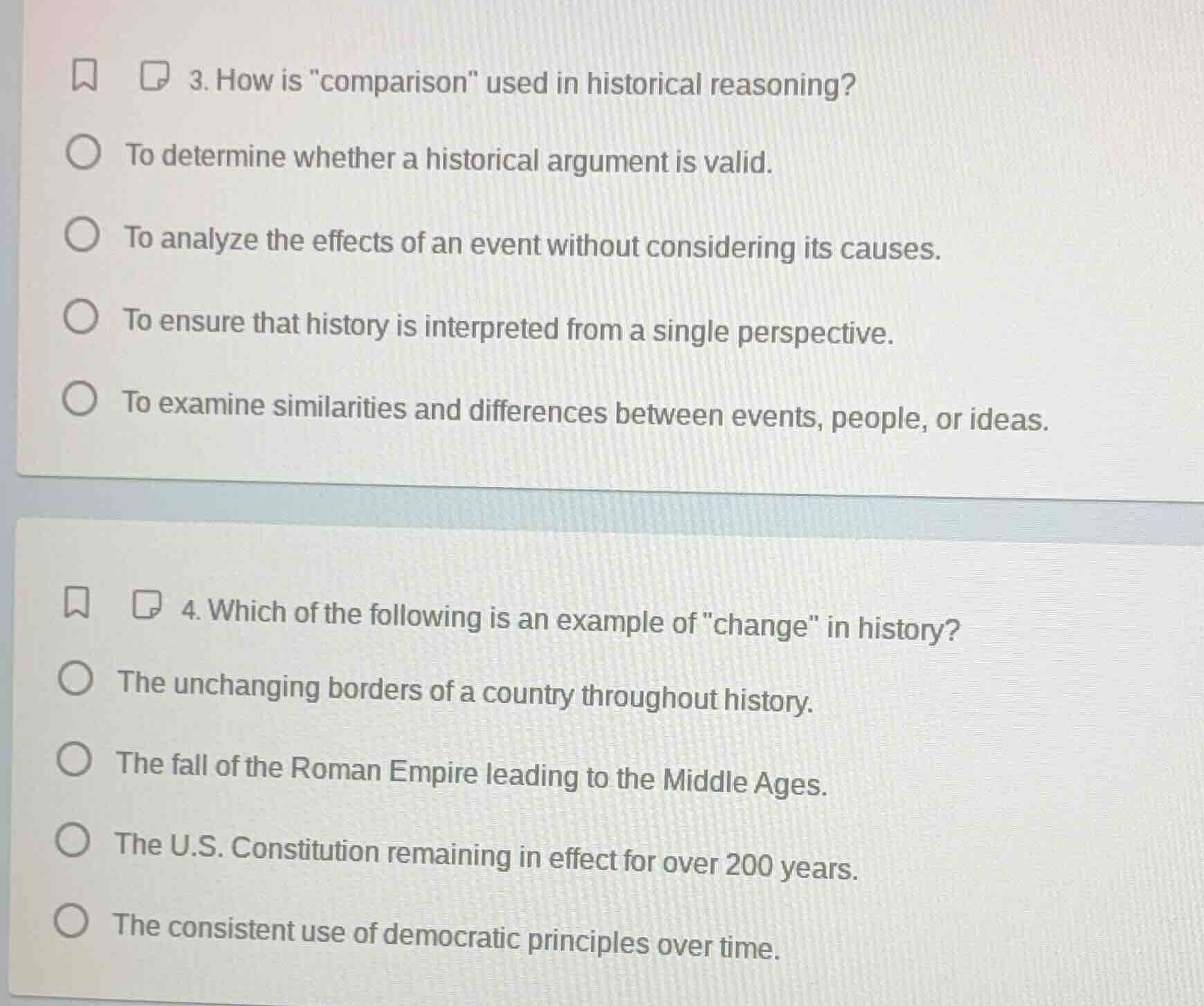
- how is \comparison\ used in historical reasoning?
to determine whether a historical argument is valid.
to analyze the effects of an event without considering its causes.
to ensure that history is interpreted from a single perspective.
to examine similarities and differences between events, people, or ideas.
- which of the following is an example of \change\ in history?
the unchanging borders of a country throughout history.
the fall of the roman empire leading to the middle ages.
the u.s. constitution remaining in effect for over 200 years.
the consistent use of democratic principles over time.
Response
Question 3
Brief Explanations
- Option 1: Determining argument validity uses methods like checking evidence, not comparison.
- Option 2: Analyzing effects without causes is not related to comparison.
- Option 3: Comparison in history encourages multiple perspectives, not single - perspective interpretation.
- Option 4: Comparison in historical reasoning is about looking at similarities and differences between events, people, or ideas.
Brief Explanations
- Option 1: Unchanging borders show no change.
- Option 2: The fall of the Roman Empire leading to the Middle Ages represents a significant historical change in eras and political/social structures.
- Option 3: The U.S. Constitution remaining in effect shows continuity, not change.
- Option 4: Consistent use of democratic principles shows continuity, not change.

Snap & solve any problem in the app
Get step-by-step solutions on Sovi AI
Photo-based solutions with guided steps
Explore more problems and detailed explanations
D. To examine similarities and differences between events, people, or ideas.