QUESTION IMAGE
Question
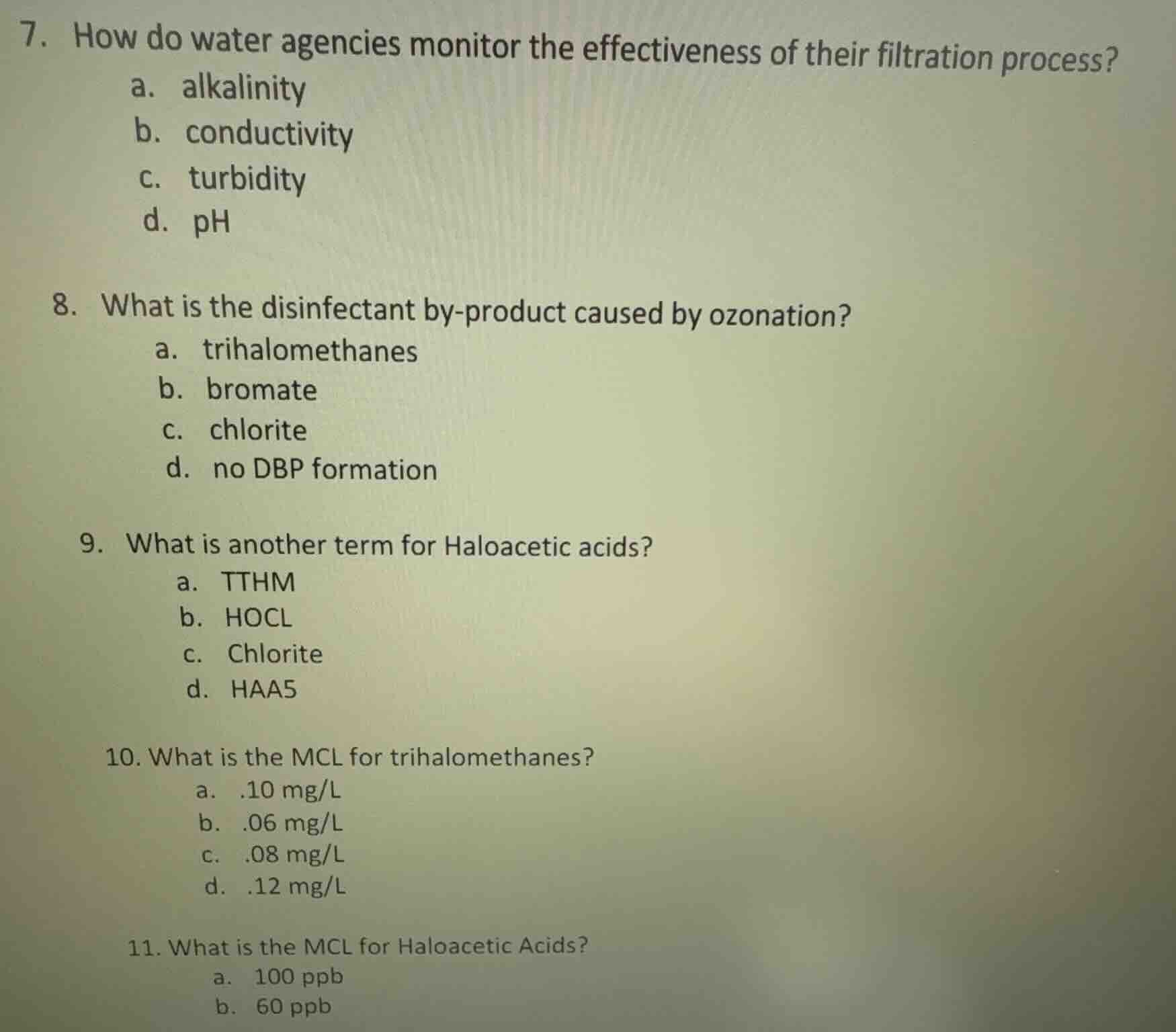
- how do water agencies monitor the effectiveness of their filtration process?
a. alkalinity
b. conductivity
c. turbidity
d. ph
- what is the disinfectant by-product caused by ozonation?
a. trihalomethanes
b. bromate
c. chlorite
d. no dbp formation
- what is another term for haloacetic acids?
a. tthm
b. hocl
c. chlorite
d. haa5
- what is the mcl for trihalomethanes?
a. .10 mg/l
b. .06 mg/l
c. .08 mg/l
d. .12 mg/l
- what is the mcl for haloacetic acids?
a. 100 ppb
b. 60 ppb
Brief Explanations
- Turbidity measures cloudiness from suspended particles, directly indicating filtration success at removing these particles.
- Ozonation reacts with bromide in water to form bromate, a known disinfectant by-product.
- HAA5 (five haloacetic acids) is the standard regulatory term for haloacetic acids in water testing.
- The US EPA's Maximum Contaminant Level (MCL) for trihalomethanes is 0.08 mg/L.
- The US EPA's MCL for haloacetic acids (HAA5) is 60 ppb.

Snap & solve any problem in the app
Get step-by-step solutions on Sovi AI
Photo-based solutions with guided steps
Explore more problems and detailed explanations
- c. turbidity
- b. bromate
- d. HAA5
- c. .08 mg/L
- b. 60 ppb