QUESTION IMAGE
Question
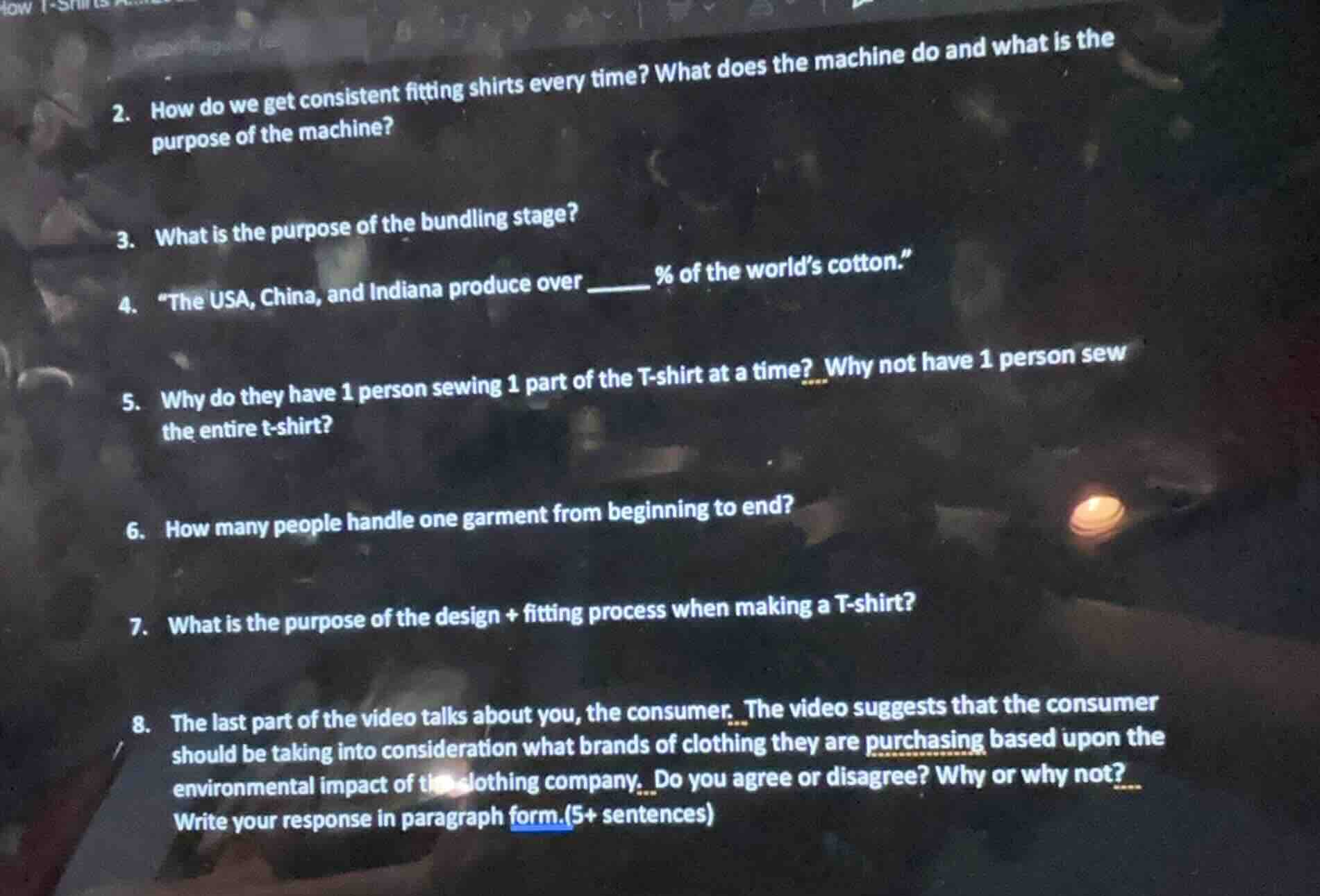
- how do we get consistent fitting shirts every time? what does the machine do and what is the purpose of the machine?
- what is the purpose of the bundling stage?
- \the usa, china, and indiana produce over ______ % of the world’s cotton.\
- why do they have 1 person sewing 1 part of the t - shirt at a time? why not have 1 person sew the entire t - shirt?
- how many people handle one garment from beginning to end?
- what is the purpose of the design + fitting process when making a t - shirt?
- the last part of the video talks about you, the consumer. the video suggests that the consumer should be taking into consideration what brands of clothing they are purchasing based upon the environmental impact of the clothing company. do you agree or disagree? why or why not? write your response in paragraph form.(5 + sentences)
These questions relate to the production process of T - shirts, including aspects like manufacturing steps, cotton production, and consumer considerations regarding clothing brands' environmental impact. Since there are multiple sub - questions covering different aspects (e.g., production process, environmental impact of businesses), we'll address them one by one:
Question 2
To get consistent - fitting shirts, machines (like automated cutting or sewing machines) are used. These machines perform tasks with high precision, repeating the same actions (e.g., cutting fabric to a specific pattern, sewing seams with consistent length and tension) every time. The purpose of such machines is to ensure uniformity in the shirt's dimensions (like chest width, sleeve length) and quality, reducing human error in the production process.
The bundling stage in T - shirt production is mainly for organizing the finished (or semi - finished) T - shirts. It helps in grouping a specific number of T - shirts together, which makes it easier to move them through the production line (for further processing like quality checks, packaging) or to store and ship them. It also ensures that the correct quantity of shirts is prepared for the next stage, whether it's distribution to retailers or storage in a warehouse.
The USA, China, and India (note: likely a typo, should be India instead of Indiana) are major cotton - producing countries. Together, they produce over 50% of the world's cotton. The USA has large - scale cotton farms, China has both large - scale and small - scale production, and India is one of the top cotton - producing nations with a significant area under cotton cultivation.

Snap & solve any problem in the app
Get step-by-step solutions on Sovi AI
Photo-based solutions with guided steps
Explore more problems and detailed explanations
To get consistent - fitting shirts, machines (e.g., automated cutting/sewing machines) are used. Machines perform tasks precisely and repetitively to ensure uniform shirt dimensions/quality, reducing human error.