QUESTION IMAGE
Question
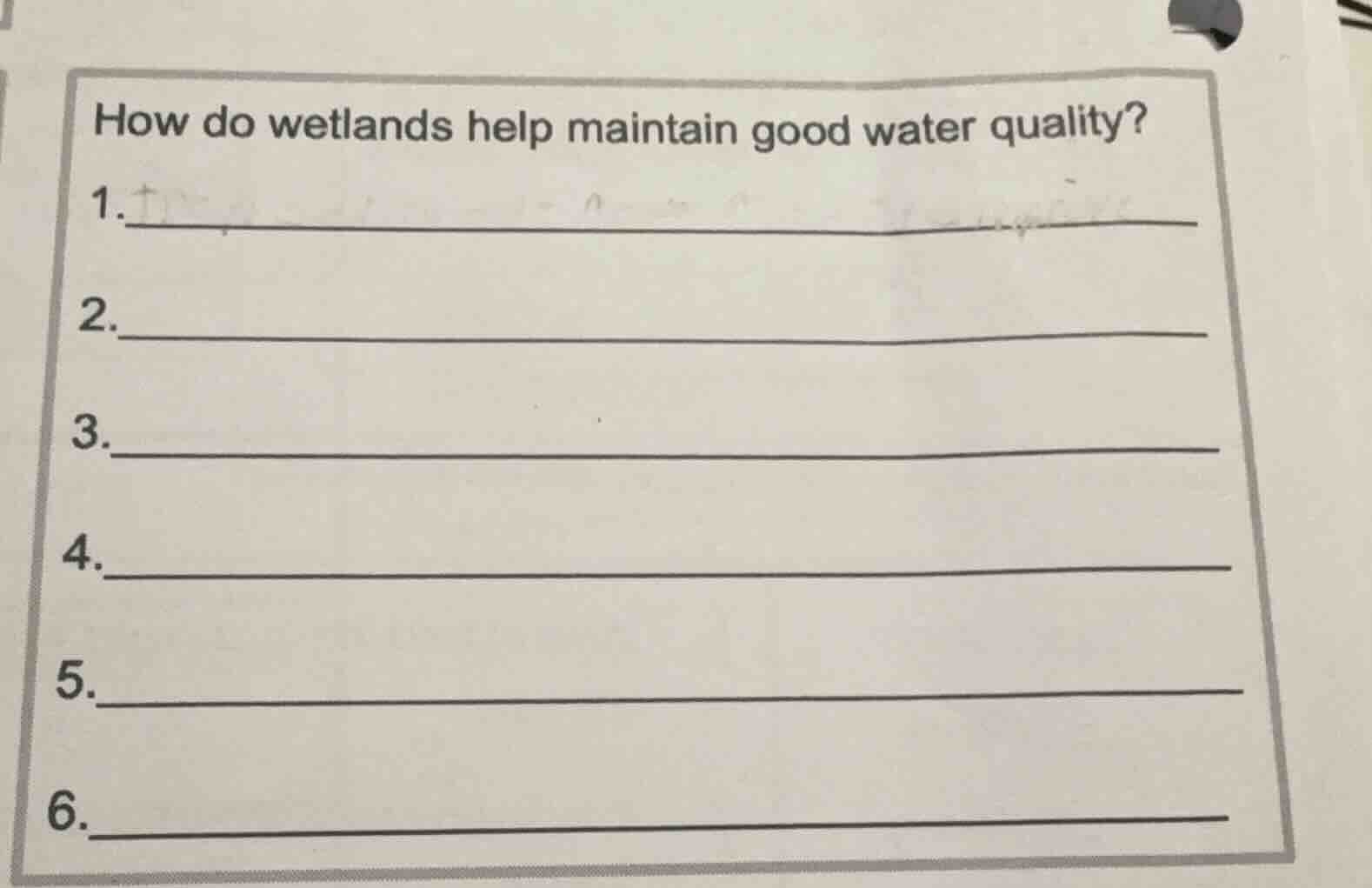
how do wetlands help maintain good water quality?
1.
2.
3.
4.
5.
6.
Brief Explanations
- Wetlands filter sediments: Sediments like sand, silt from runoff are trapped by wetland vegetation and soil, preventing them from clouding water and harming aquatic life.
- Remove nutrients: Excess nutrients (e.g., nitrogen, phosphorus from fertilizers) are taken up by wetland plants or transformed by microbes, reducing eutrophication.
- Absorb pollutants: Pollutants such as heavy metals, pesticides in water are adsorbed by wetland soils or broken down by organisms, purifying water.
- Promote sedimentation: Slow - moving water in wetlands allows suspended particles to settle out, improving water clarity.
- Support microbial breakdown: Microbes in wetlands decompose organic matter, reducing organic pollutants and recycling nutrients.
- Buffer against runoff: Wetlands act as a buffer, slowing down and filtering stormwater runoff before it enters larger water bodies, reducing the load of contaminants.

Snap & solve any problem in the app
Get step-by-step solutions on Sovi AI
Photo-based solutions with guided steps
Explore more problems and detailed explanations
- Wetlands filter sediments from water.
- Wetlands remove excess nutrients (e.g., N, P) from water.
- Wetlands absorb pollutants (e.g., heavy metals, pesticides).
- Wetlands promote sedimentation of suspended particles.
- Wetlands support microbial breakdown of organic matter.
- Wetlands buffer and filter stormwater runoff.