QUESTION IMAGE
Question
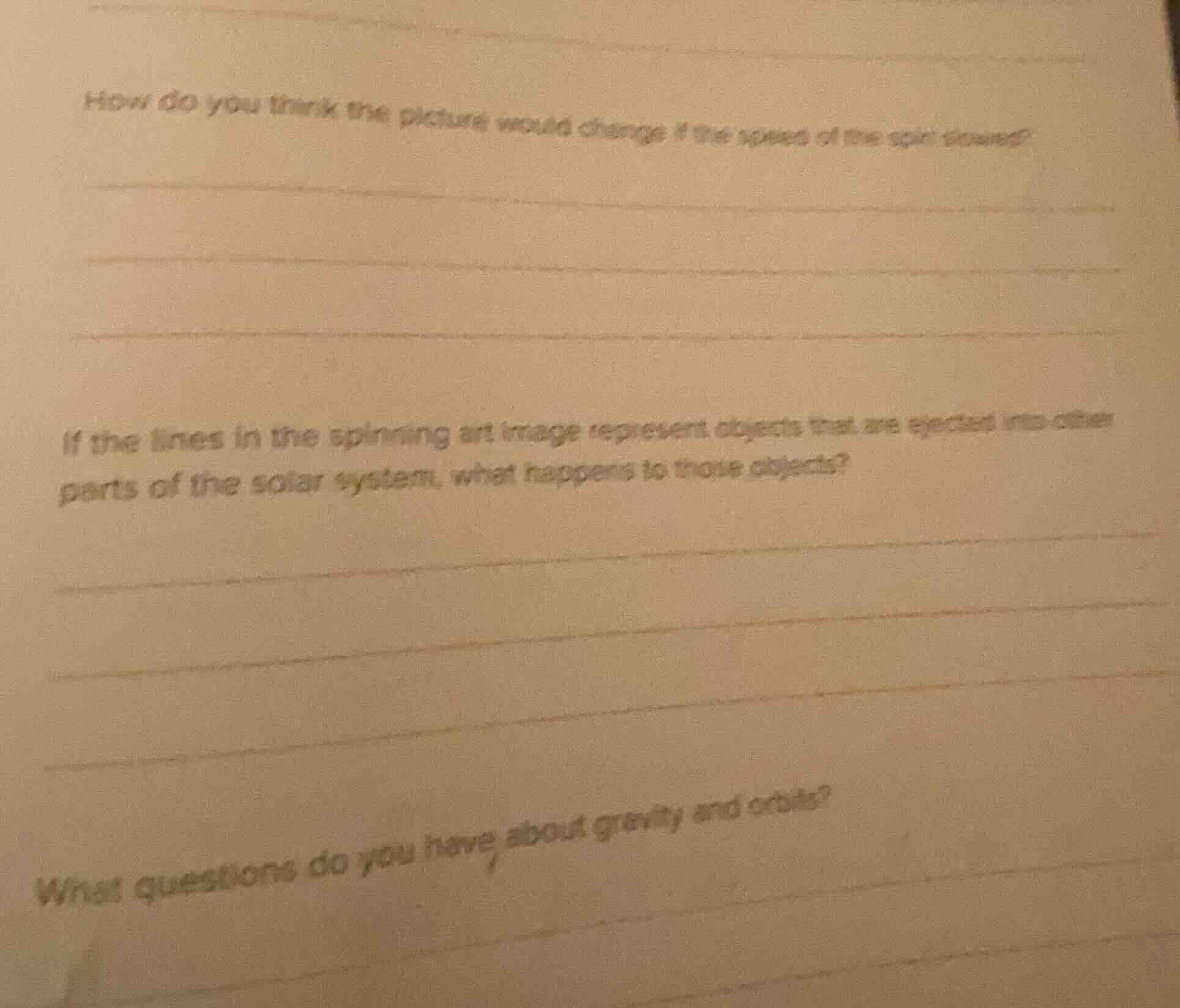
how do you think the picture would change if the speed of the spin slowing?
if the lines in the spinning art image represent objects that are ejected into other parts of the solar system, what happens to those objects?
what questions do you have about gravity and orbits?
First Question: How do you think the picture would change if the speed of the spin slows?
If the spin speed slows, the centrifugal - like effect (in the context of the spinning system, maybe a rotating celestial - like system) would decrease. If the lines represent objects in circular motion due to the spin, with slower spin, the "stretching" or the spread of the lines (representing the paths or positions of objects) would likely reduce. For example, in a rotating disk - like structure (like a protoplanetary disk), slower rotation would mean less outward - pushing force from rotation, so the objects (represented by lines) would be more concentrated towards the center or have less radial spread. The pattern of the lines might become more compact, and the "shape" of the picture (the distribution of the lines) would show less extension in the radial direction.
Once ejected into other parts of the solar system, these objects will be subject to the gravitational forces of other celestial bodies (like planets, moons, asteroids, or the Sun). They may enter into new orbits around other celestial bodies. For example, an ejected object could be captured by a planet's gravity and start orbiting that planet, or it could continue on a hyperbolic or elliptical path through the solar system, potentially interacting with multiple celestial bodies. It might also collide with other objects in the solar system, or be slingshot - ed by a planet's gravity to gain or lose speed and change its trajectory further.
There are many possible questions. For example, we can ask about the factors that determine the shape of an orbit (like why some orbits are elliptical and some are more circular). Or, how does the mass of a celestial body affect the orbits of objects around it? Another question could be: Can an object have an orbit that is not in a plane (a non - planar orbit) and what causes such orbits? Or, how does the gravitational pull of multiple celestial bodies simultaneously affect the orbit of a single object?

Snap & solve any problem in the app
Get step-by-step solutions on Sovi AI
Photo-based solutions with guided steps
Explore more problems and detailed explanations
If the spin speed slows, the lines (representing objects) would likely become more concentrated (less spread out radially). The overall pattern of the picture would appear more compact as the centrifugal - like effect from the spin decreases, reducing the outward - directed motion of the objects represented by the lines.