QUESTION IMAGE
Question
hs language arts 11 a
the mississippi river runaways
excerpt from the adventures of huckleberry finn
by mark twain
chapter 22
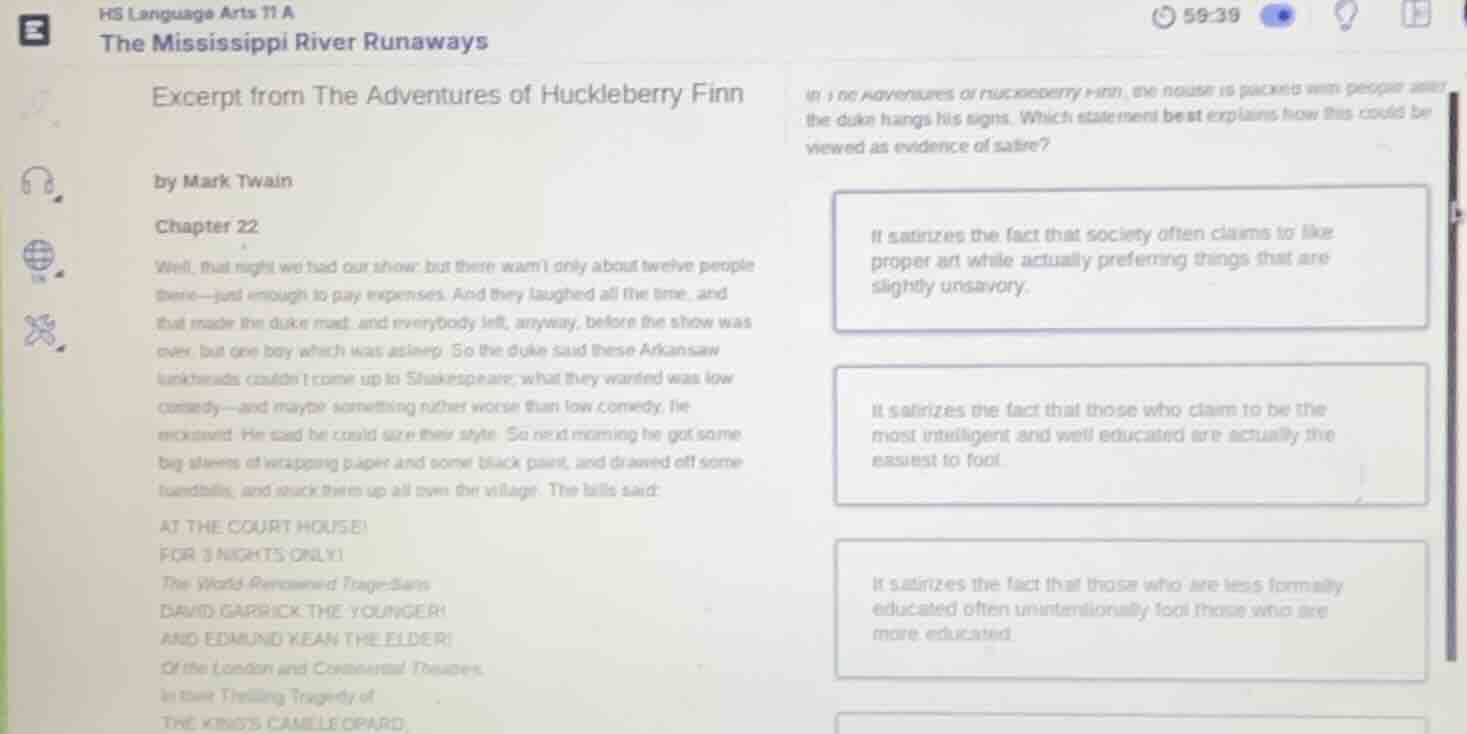
well, that night we had our show but there warnt only about twelve people there—just enough to pay expenses. and they laughed all the time, and that made the duke mad; and everybody left, anyway, before the show was over, but one boy which was asleep. so the duke said these arkansaw lunkheads couldnt come up to shakespeare; what they wanted was low comedy—and maybe something rather worse than low comedy. he reckoned. he said he could suit their style. so next morning he got some big sheets of wrapping paper and some black paint, and drawed off some handbills, and stuck them up all over the village. the bills said:
at the court house!
for 3 nights only!
the world-renowned tragedians
david garrick the younger!
and edmund kean the elder!
of the london and continental theatres,
in their thrilling tragedy of
the kings camelle ohara,
in the adventures of huckleberry finn, the house is packed with people after the duke hangs his signs. which statement best explains how this could be viewed as evidence of satire?
it satirizes the fact that society often claims to like proper art while actually preferring things that are slightly unsavory.
it satirizes the fact that those who claim to be the most intelligent and well educated are actually the easiest to fool.
it satirizes the fact that those who are less formally educated often unintentionally fool those who are more educated.
Satire in Huckleberry Finn here targets the hypocrisy of audiences who rejected "high art" (Shakespeare) but were drawn to a deceptive, lowbrow spectacle advertised with fake, prestigious claims. The duke's false high-culture signs lure the same people who dismissed proper art, highlighting society's preference for unsavory, overhyped entertainment over legitimate art.

Snap & solve any problem in the app
Get step-by-step solutions on Sovi AI
Photo-based solutions with guided steps
Explore more problems and detailed explanations
It satirizes the fact that society often claims to like proper art while actually preferring things that are slightly unsavory.