QUESTION IMAGE
Question
hs language arts 11a
ralph waldo emerson
excerpt from nature
by ralph waldo emerson
chapter 1 - nature
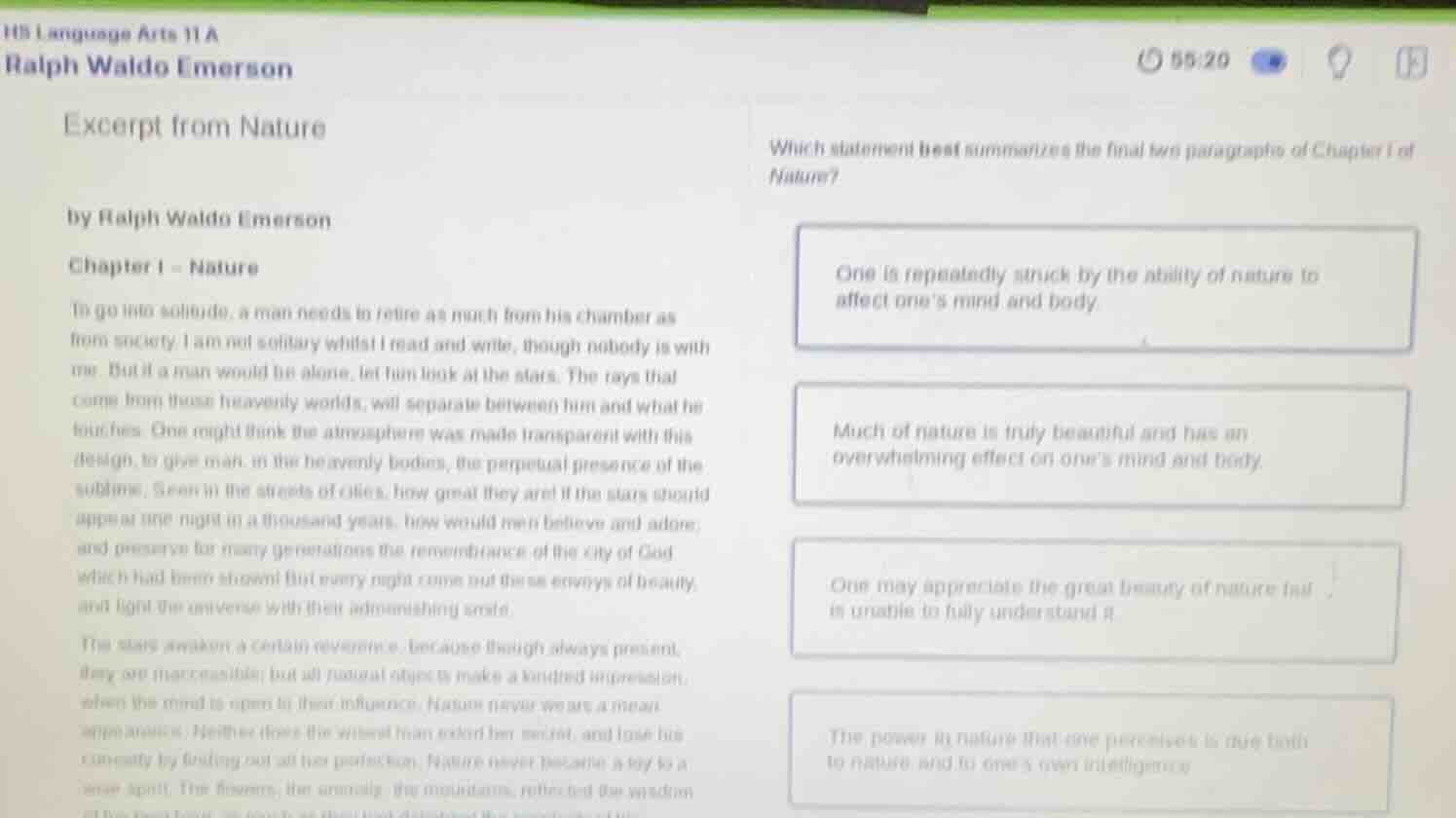
to go into solitude, a man needs to retire as much from his chamber as from society. i am not solitary whilst i read and write, though nobody is with me. but if a man would be alone, let him look at the stars. the rays that come from those heavenly worlds, will separate between him and what he touches. one might think the atmosphere was made transparent with this design, to give man, in the heavenly bodies, the perpetual presence of the sublime. seen in the streets of cities, how great they are! if the stars should appear one night in a thousand years, how would men believe and adore; and preserve for many generations the remembrance of the city of god which had been shown! but every night come out these envoys of beauty, and light the universe with their admonishing smile.
the stars awaken a certain reverence, because though always present, they are inaccessible; but all natural objects make a kindred impression, when the mind is open to their influence. nature never wears a mean appearance. neither does the wisest man extort her secret, and lose his curiosity by finding out all her perfection. nature never became a toy to a wise spirit. the flowers, the animals, the mountains, reflected the wisdom
which statement best summarizes the final two paragraphs of chapter 1 of nature?
one is repeatedly struck by the ability of nature to affect ones mind and body.
much of nature is truly beautiful and has an overwhelming effect on ones mind and body.
one may appreciate the great beauty of nature but is unable to fully understand it.
the power in nature that one perceives is the faith to nature and to ones own intelligence.
The final two paragraphs of Chapter 1 of Nature focus on how nature (exemplified by the stars) evokes a sense of the sublime, connects to the human mind, and frames nature's power as a reflection of both the natural world and inner human wisdom. The correct option aligns with Emerson's transcendentalist idea that nature's perceived power links external nature and one's own inner intelligence, while other options either understate the connection, focus only on beauty, or emphasize inability to understand, which does not match the text's core point.

Snap & solve any problem in the app
Get step-by-step solutions on Sovi AI
Photo-based solutions with guided steps
Explore more problems and detailed explanations
The power in nature that one perceives is due both to nature and to one's own intelligence.