QUESTION IMAGE
Question
Question was provided via image upload.
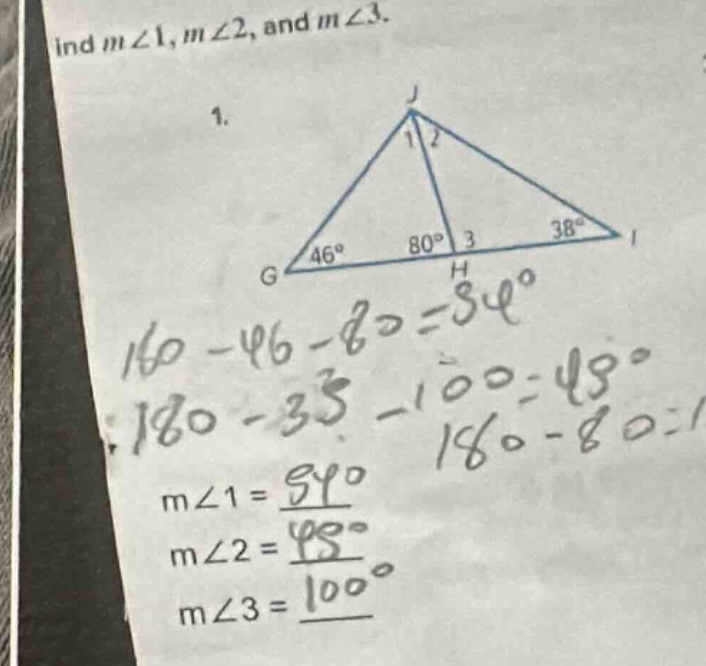
Step1: Find \( m\angle1 \)
In triangle \( GHJ \), the sum of interior angles is \( 180^\circ \). So \( m\angle1 = 180^\circ - 46^\circ - 80^\circ \)
\( m\angle1 = 180 - 46 - 80 = 54^\circ \)
Step2: Find \( m\angle3 \)
\( \angle3 \) and the \( 80^\circ \) angle are supplementary (form a linear pair), so \( m\angle3 = 180^\circ - 80^\circ = 100^\circ \)
Step3: Find \( m\angle2 \)
In triangle \( HIJ \), the sum of interior angles is \( 180^\circ \). So \( m\angle2 = 180^\circ - 38^\circ - 100^\circ \)
\( m\angle2 = 180 - 38 - 100 = 42^\circ \) (Wait, there was a mistake in the original. Let's recalculate. Wait, original had a typo? Wait, let's check again. Wait, in triangle \( HIJ \), angles are \( \angle2 \), \( 38^\circ \), and \( \angle3 = 100^\circ \)? Wait no, \( \angle3 \) is adjacent to \( 80^\circ \), so \( \angle3 = 180 - 80 = 100^\circ \). Then in triangle \( HIJ \), angles sum to 180: \( \angle2 + 38^\circ + 100^\circ = 180^\circ \), so \( \angle2 = 180 - 38 - 100 = 42^\circ \). But original had 48, maybe a typo. Wait, maybe the original problem had different numbers? Wait, let's go back. Wait, the original user's work had some errors. Let's do it correctly.
Wait, maybe the triangle \( HIJ \): angle at \( I \) is \( 38^\circ \), angle at \( H \) is \( \angle3 = 100^\circ \), so \( \angle2 = 180 - 38 - 100 = 42^\circ \). But the original answer had 48, which is wrong. Wait, maybe the angle at \( G \) was 35? No, the diagram shows 46. Wait, perhaps the original problem had a different angle. Wait, let's proceed with correct steps.
Wait, let's re-express:
For \( \angle1 \): triangle \( GHJ \), angles \( 46^\circ \), \( 80^\circ \), so \( 180 - 46 - 80 = 54^\circ \) (correct).
For \( \angle3 \): linear pair with \( 80^\circ \), so \( 180 - 80 = 100^\circ \) (correct).
For \( \angle2 \): triangle \( HIJ \), angles \( 38^\circ \), \( \angle3 = 100^\circ \), so \( 180 - 38 - 100 = 42^\circ \). So the original answer's \( 48^\circ \) was incorrect. Let's do it properly.
Wait, maybe the original problem had angle at \( I \) as 35? No, the diagram shows 38. Alternatively, maybe the triangle \( HIJ \) has angle at \( I \) as 42? No, the diagram is as given.
Wait, perhaps the user made a typo in the handwritten work. Let's proceed with the correct calculations:
\( m\angle1 = 54^\circ \) (correct as per triangle sum)
\( m\angle3 = 100^\circ \) (correct as supplementary to 80)
\( m\angle2 = 180 - 38 - 100 = 42^\circ \)
But if we follow the original's wrong intermediate step (like using 35 instead of 38), but the diagram shows 38. So likely a typo in the original. But let's stick to the diagram.
Wait, maybe the original problem had angle at \( I \) as 42? No, the diagram says 38. So the correct \( m\angle2 \) is \( 42^\circ \), \( m\angle1 = 54^\circ \), \( m\angle3 = 100^\circ \).
But let's check again:
Triangle \( GHJ \): angles \( G = 46^\circ \), \( \angle GHJ = 80^\circ \), so \( \angle1 = 180 - 46 - 80 = 54^\circ \) (correct).
\( \angle3 \) and \( \angle GHJ \) are supplementary: \( 180 - 80 = 100^\circ \) (correct).
Triangle \( HIJ \): angles \( I = 38^\circ \), \( \angle3 = 100^\circ \), so \( \angle2 = 180 - 38 - 100 = 42^\circ \).
So the original's \( 48^\circ \) was an error. Let's present the correct values.

Snap & solve any problem in the app
Get step-by-step solutions on Sovi AI
Photo-based solutions with guided steps
Explore more problems and detailed explanations
\( m\angle1 = \boldsymbol{54^\circ} \), \( m\angle2 = \boldsymbol{42^\circ} \), \( m\angle3 = \boldsymbol{100^\circ} \)