QUESTION IMAGE
Question
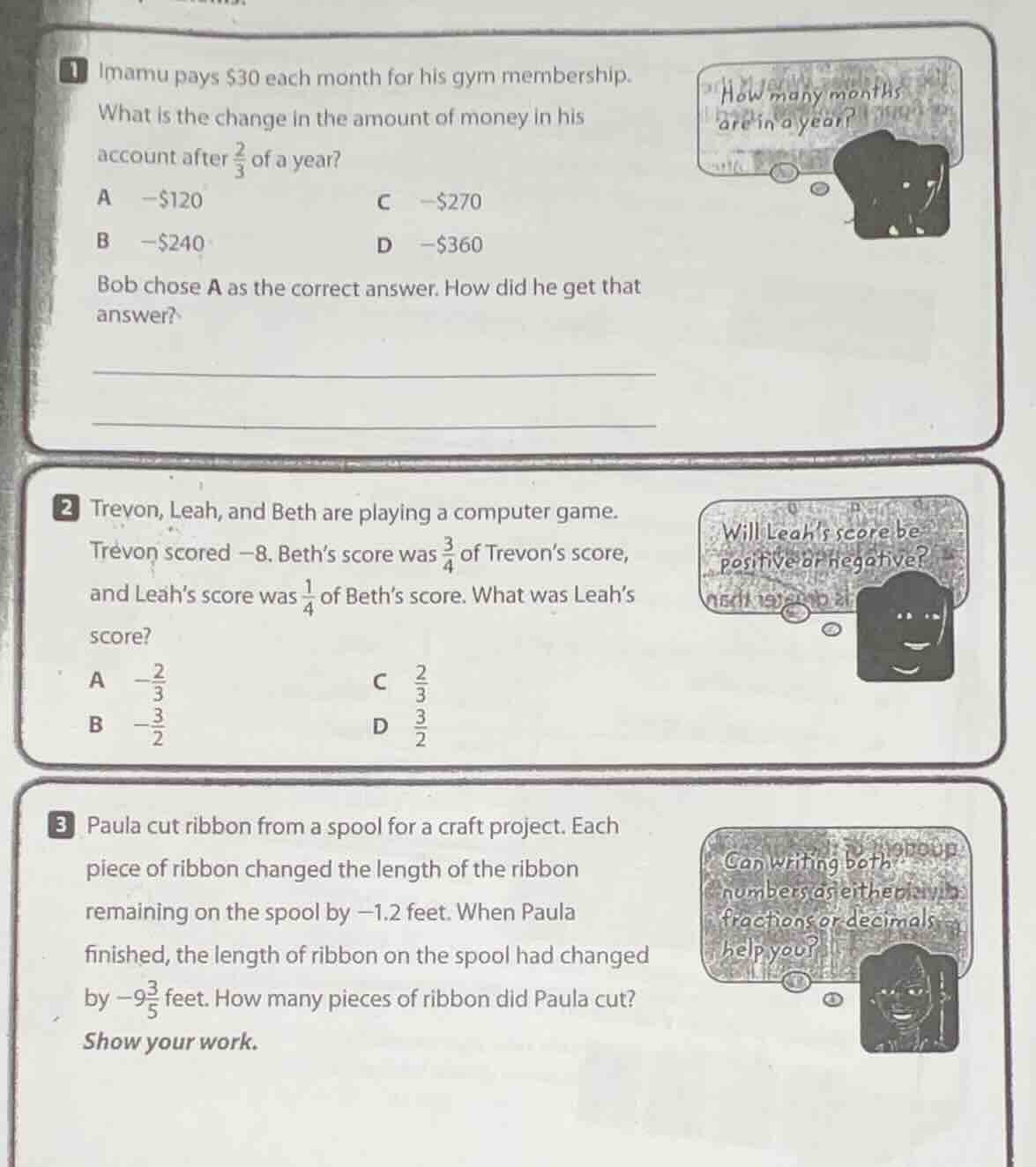
Question was provided via image upload.
Sub - Question 1
Step - by - Step Explanation:
Step 1: Analyze Bob's Mistake
Bob probably made a mistake in calculating the number of months. A year has 12 months. To find \(\frac{2}{3}\) of a year, the correct calculation is \(12\times\frac{2}{3}=8\) months. But Bob might have used \(12\times\frac{1}{3} = 4\) months (incorrectly taking \(\frac{1}{3}\) instead of \(\frac{2}{3}\) of the year).
Step 2: Calculate the Amount Using Bob's Mistake
If we use 4 months (Bob's incorrect number of months) and the monthly cost is \(\$30\), then the total change in money is \(30\times4=\$120\). Since it's a cost (money leaving his account), the change is \(-\$120\), which is why Bob chose option A.
Sub - Question 2
Step - by - Step Explanation:
Step 1: Find Beth's Score
Trevon's score is \(- 8\). Beth's score is \(\frac{3}{4}\) of Trevon's score. So Beth's score \(=\frac{3}{4}\times(-8)=-6\).
Step 2: Find Leah's Score
Leah's score is \(\frac{1}{4}\) of Beth's score. So Leah's score \(=\frac{1}{4}\times(-6)=-\frac{6}{4}=-\frac{3}{2}\). Wait, no, let's recalculate. Wait, \(\frac{3}{4}\times(-8)=-6\), then \(\frac{1}{4}\times(-6)=-\frac{6}{4}=-\frac{3}{2}\)? Wait, no, maybe I made a mistake. Wait, \(\frac{3}{4}\) of \(-8\): \(-8\times\frac{3}{4}=-6\). Then \(\frac{1}{4}\) of \(-6\) is \(-6\times\frac{1}{4}=-\frac{6}{4}=-\frac{3}{2}\)? But the options are A \(-\frac{2}{3}\), B \(-\frac{3}{2}\), C \(\frac{2}{3}\), D \(\frac{3}{2}\). Wait, maybe I messed up the order. Wait, the problem says "Beth’s score was \(\frac{3}{4}\) of Trevon’s score, and Leah’s score was \(\frac{1}{4}\) of Beth’s score". So Trevon: \(-8\), Beth: \(\frac{3}{4}\times(-8)=-6\), Leah: \(\frac{1}{4}\times(-6)=-\frac{6}{4}=-\frac{3}{2}\). So the correct answer is B.
Sub - Question 3
Step - by - Step Explanation:
Step 1: Convert the Mixed Number to a Decimal
The total change in the length of the ribbon is \(-9\frac{3}{5}\) feet. Convert \(9\frac{3}{5}\) to a decimal. \(\frac{3}{5}=0.6\), so \(9\frac{3}{5}=9.6\) feet. So the total change is \(-9.6\) feet.
Step 2: Find the Number of Pieces
Each piece changes the length by \(-1.2\) feet. Let the number of pieces be \(n\). We know that the total change is the number of pieces times the change per piece. So \(-9.6=n\times(-1.2)\). To find \(n\), we can solve for \(n\) by dividing both sides by \(-1.2\). \(n=\frac{-9.6}{-1.2}=8\).

Snap & solve any problem in the app
Get step-by-step solutions on Sovi AI
Photo-based solutions with guided steps
Explore more problems and detailed explanations
s:
- Bob got his answer by incorrectly calculating the number of months as \(12\times\frac{1}{3} = 4\) (instead of \(12\times\frac{2}{3}=8\)) and then multiplying \(30\times4 = 120\), resulting in a change of \(-\$120\).
- The correct answer is B. \(-\frac{3}{2}\) (Leah's score calculation: Trevon's score \(-8\), Beth's score \(\frac{3}{4}\times(-8)=-6\), Leah's score \(\frac{1}{4}\times(-6)=-\frac{3}{2}\))
- Paula cut 8 pieces of ribbon. (Explanation: Convert \(-9\frac{3}{5}\) to \(-9.6\). Then divide the total change \(-9.6\) by the change per piece \(-1.2\): \(\frac{-9.6}{-1.2}=8\))