QUESTION IMAGE
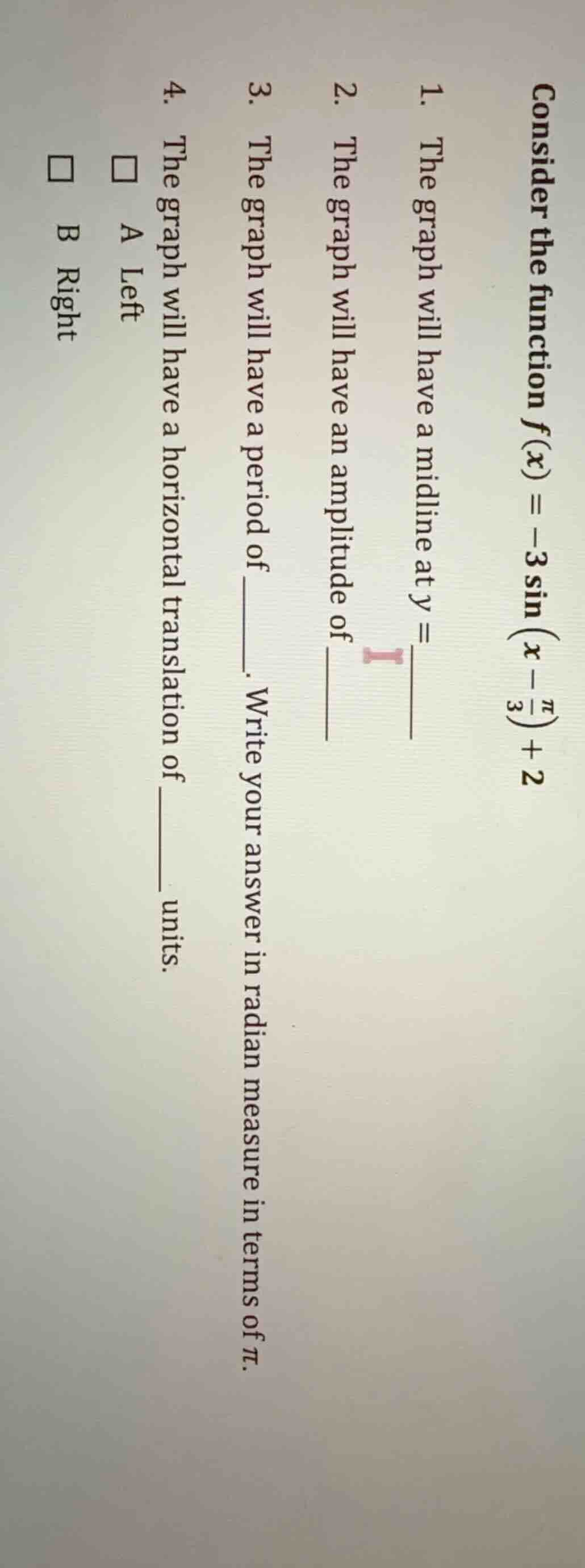
Question
Question was provided via image upload.
Sub - question 1
The general form of a sinusoidal function is \(y = A\sin(B(x - C))+D\), where the midline is \(y = D\). For the function \(f(x)=- 3\sin(x-\frac{\pi}{3}) + 2\), we compare it with the general form. Here, \(D = 2\). So the midline is at \(y = 2\).
In the general form of a sinusoidal function \(y = A\sin(B(x - C))+D\), the amplitude is given by \(|A|\). For the function \(f(x)=-3\sin(x - \frac{\pi}{3})+2\), we have \(A=-3\). Then the amplitude is \(|-3| = 3\).
For a sinusoidal function of the form \(y = A\sin(B(x - C))+D\), the period \(T\) is given by the formula \(T=\frac{2\pi}{|B|}\). In the function \(f(x)=-3\sin(x-\frac{\pi}{3})+2\), we can see that \(B = 1\) (since the coefficient of \(x\) inside the sine function is \(1\) when we write it as \(x-\frac{\pi}{3}=1\times(x - \frac{\pi}{3})\)). Then using the period formula \(T=\frac{2\pi}{|B|}\), with \(|B| = 1\), we get \(T = 2\pi\).

Snap & solve any problem in the app
Get step-by-step solutions on Sovi AI
Photo-based solutions with guided steps
Explore more problems and detailed explanations
\(y = 2\)