QUESTION IMAGE
Question
Question was provided via image upload.
Response
To solve these fill - in - the - blank questions about the Russian Revolution of 1917, we can use our knowledge of this historical event:
Question 1 (Green - pre - revolution situation)
- Peasants in Russia before the revolution lived in poverty as they had very little in terms of material wealth and resources, and the situation was a form of exploitation where the elite (nobles, etc.) took advantage of their labor and resources while living in luxury.
- The Duma (the Russian legislative body) had limited power, and it was also ineffective in bringing about real change or representing the interests of the majority of the people.
- Russia faced devastating losses in World War I, both in terms of human lives and military setbacks. At home, there was a food and fuel (like coal, wood for heating and industrial use) crisis as resources were diverted to the war effort.
Question 2 (Pink - revolution and post - revolution)
- The Bolsheviks gained a majority in the Petrograd soviet. At that time, the soviet was sharing power with the Provisional Government, which was pro - democracy but was unable to address the key issues of the country.
- After Lenin took control of the provisional government's headquarters, the Bolsheviks fought a civil war against the Whites (the counter - revolutionaries who were loyal to the old tsarist order and wanted to restore the tsar to power).
- The Bolsheviks won the civil war, executed the tsar (Nicholas II) and his family to eliminate the possibility of a tsarist restoration, and created the Soviet Union in 1922.
Final Answers (filling the blanks)
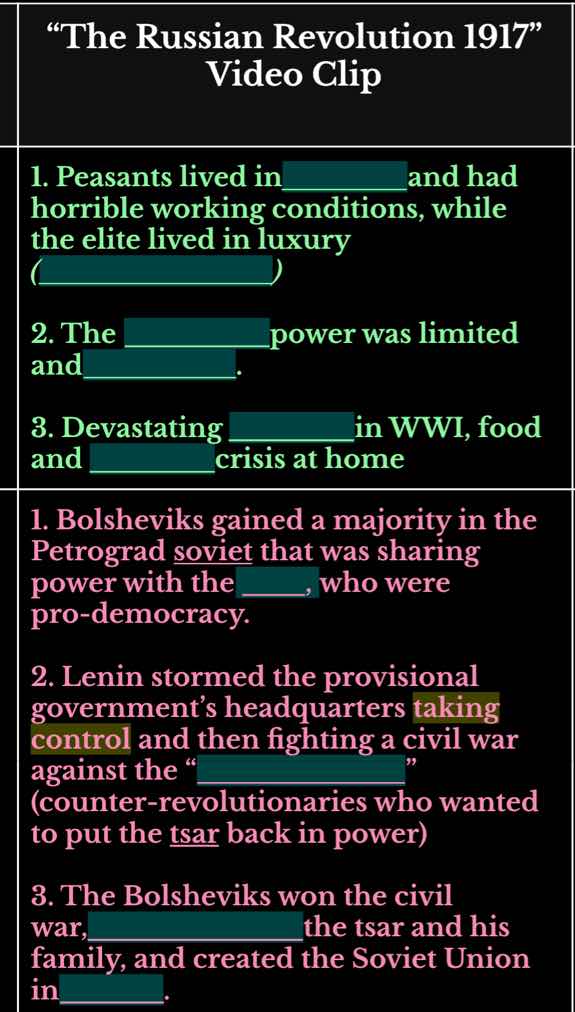
- Peasants lived in \(\boldsymbol{\text{poverty}}\) and had horrible working conditions, while the elite lived in luxury (\(\boldsymbol{\text{exploitation}}\))
- The \(\boldsymbol{\text{Duma}}\) power was limited and \(\boldsymbol{\text{ineffective}}\).
- Devastating \(\boldsymbol{\text{losses}}\) in WWI, food and \(\boldsymbol{\text{fuel}}\) crisis at home
- Bolsheviks gained a majority in the Petrograd soviet that was sharing power with the \(\boldsymbol{\text{Provisional Government}}\), who were pro - democracy.
- Lenin stormed the provisional government’s headquarters taking control and then fighting a civil war against the “\(\boldsymbol{\text{Whites}}\)” (counter - revolutionaries who wanted to put the tsar back in power)
- The Bolsheviks won the civil war, \(\boldsymbol{\text{executed}}\) the tsar and his family, and created the Soviet Union in \(\boldsymbol{\text{1922}}\).

Snap & solve any problem in the app
Get step-by-step solutions on Sovi AI
Photo-based solutions with guided steps
Explore more problems and detailed explanations
To solve these fill - in - the - blank questions about the Russian Revolution of 1917, we can use our knowledge of this historical event:
Question 1 (Green - pre - revolution situation)
- Peasants in Russia before the revolution lived in poverty as they had very little in terms of material wealth and resources, and the situation was a form of exploitation where the elite (nobles, etc.) took advantage of their labor and resources while living in luxury.
- The Duma (the Russian legislative body) had limited power, and it was also ineffective in bringing about real change or representing the interests of the majority of the people.
- Russia faced devastating losses in World War I, both in terms of human lives and military setbacks. At home, there was a food and fuel (like coal, wood for heating and industrial use) crisis as resources were diverted to the war effort.
Question 2 (Pink - revolution and post - revolution)
- The Bolsheviks gained a majority in the Petrograd soviet. At that time, the soviet was sharing power with the Provisional Government, which was pro - democracy but was unable to address the key issues of the country.
- After Lenin took control of the provisional government's headquarters, the Bolsheviks fought a civil war against the Whites (the counter - revolutionaries who were loyal to the old tsarist order and wanted to restore the tsar to power).
- The Bolsheviks won the civil war, executed the tsar (Nicholas II) and his family to eliminate the possibility of a tsarist restoration, and created the Soviet Union in 1922.
Final Answers (filling the blanks)
- Peasants lived in \(\boldsymbol{\text{poverty}}\) and had horrible working conditions, while the elite lived in luxury (\(\boldsymbol{\text{exploitation}}\))
- The \(\boldsymbol{\text{Duma}}\) power was limited and \(\boldsymbol{\text{ineffective}}\).
- Devastating \(\boldsymbol{\text{losses}}\) in WWI, food and \(\boldsymbol{\text{fuel}}\) crisis at home
- Bolsheviks gained a majority in the Petrograd soviet that was sharing power with the \(\boldsymbol{\text{Provisional Government}}\), who were pro - democracy.
- Lenin stormed the provisional government’s headquarters taking control and then fighting a civil war against the “\(\boldsymbol{\text{Whites}}\)” (counter - revolutionaries who wanted to put the tsar back in power)
- The Bolsheviks won the civil war, \(\boldsymbol{\text{executed}}\) the tsar and his family, and created the Soviet Union in \(\boldsymbol{\text{1922}}\).