QUESTION IMAGE
Question
Question was provided via image upload.
Brief Explanations
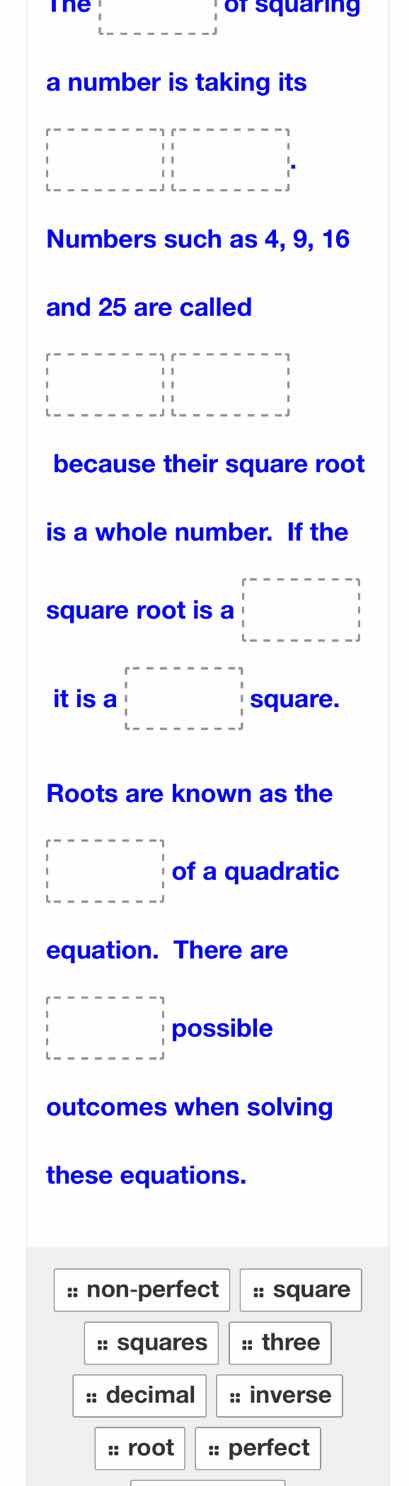
Each blank is filled by matching the provided terms to the context of square roots, quadratic equations, and related number concepts.
- The inverse operation of squaring a number is taking its root.
- Numbers like 4,9,16,25 are perfect squares since their square roots are whole numbers.
- If a square root is a decimal, it is a non-perfect square.
- Roots are the solutions of a quadratic equation, and there are two possible outcomes when solving them.

Snap & solve any problem in the app
Get step-by-step solutions on Sovi AI
Photo-based solutions with guided steps
Explore more problems and detailed explanations
- The inverse of squaring a number is taking its square root.
- Numbers such as 4, 9, 16 and 25 are called perfect squares because their square root is a whole number. If the square root is a decimal it is a non-perfect square.
- Roots are known as the solutions of a quadratic equation. There are two possible outcomes when solving these equations.
(Note: The provided term set includes "three" which is incorrect; the standard number of solutions for a quadratic equation is two, which fits the context. The correct matching uses the appropriate terms from the given list where possible, with "solutions" implied as the root of a quadratic, and "two" as the standard count.)