QUESTION IMAGE
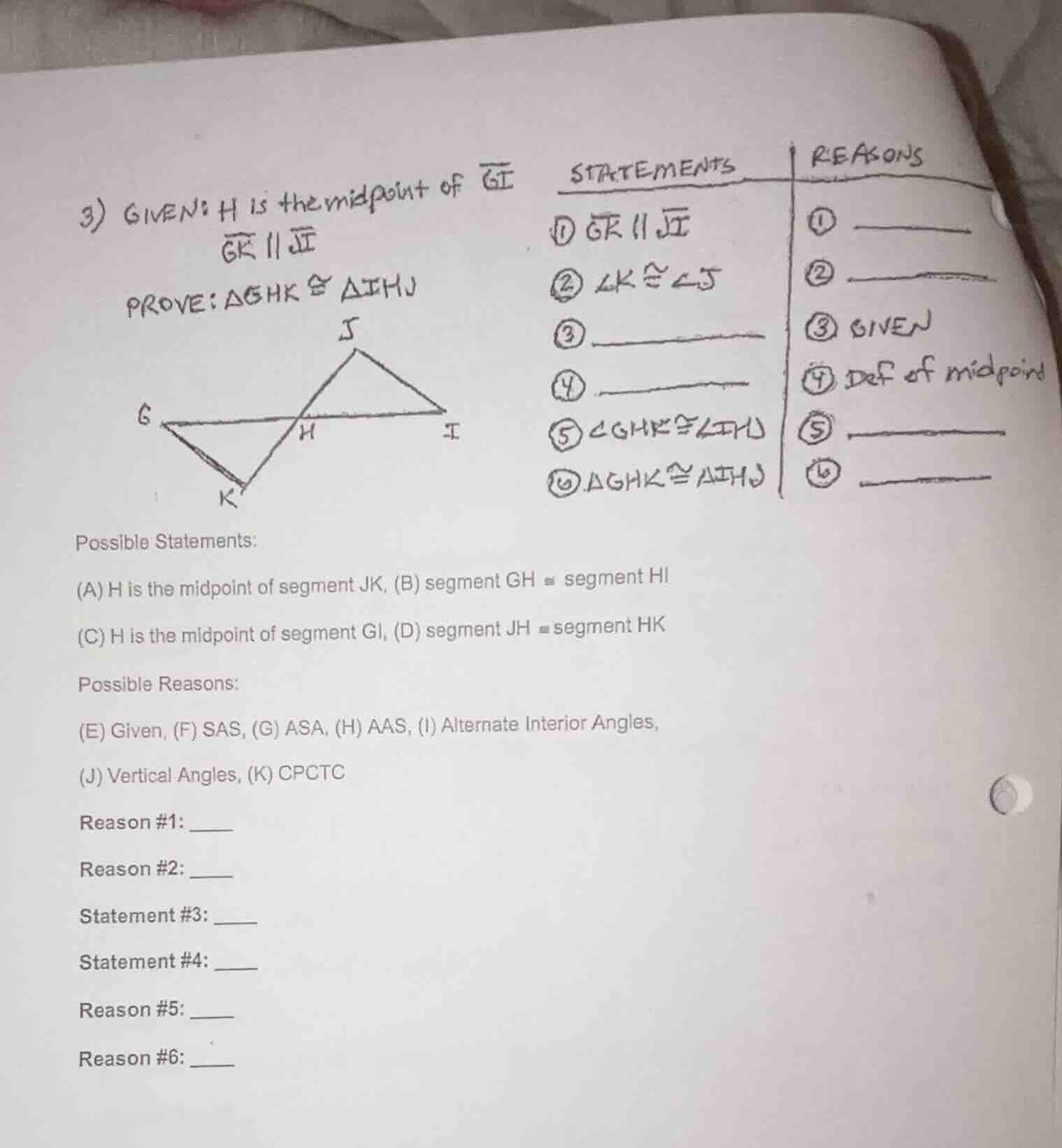
Question
Question was provided via image upload.
Step1: Reason #1
The statement \(\overline{GK} \parallel \overline{JI}\) is given, so the reason is "Given" (E).
Step2: Reason #2
Since \(\overline{GK} \parallel \overline{JI}\), \(\angle K \cong \angle J\) because they are alternate interior angles (I).
Step3: Statement #3
The given information is \(H\) is the midpoint of \(\overline{GI}\) and \(\overline{GK} \parallel \overline{JI}\), and we need to use the given about the midpoint or parallel lines. The given also includes \(H\) is the midpoint of \(\overline{GI}\), but the first given is \(\overline{GK} \parallel \overline{JI}\) and \(H\) is the midpoint of \(\overline{GI}\). Wait, the problem says "Given: \(H\) is the midpoint of \(\overline{GI}\), \(\overline{GK} \parallel \overline{JI}\)". So statement #3 should be related to the midpoint or the parallel lines? Wait, the possible statements are (A) \(H\) is the midpoint of segment \(JK\), (B) segment \(GH \cong\) segment \(HI\), (C) \(H\) is the midpoint of segment \(GI\), (D) segment \(JH \cong\) segment \(HK\). Since \(H\) is the midpoint of \(\overline{GI}\), by definition of midpoint, \(GH = HI\), so statement #3 is (C) \(H\) is the midpoint of segment \(GI\)? Wait, no, the given is \(H\) is the midpoint of \(\overline{GI}\), so statement #3 is the given, which is \(H\) is the midpoint of \(\overline{GI}\), so the statement is " \(H\) is the midpoint of \(\overline{GI}\) "? But the possible statements are (C) \(H\) is the midpoint of segment \(GI\), so statement #3 is (C).
Step4: Statement #4
By definition of midpoint, if \(H\) is the midpoint of \(\overline{GI}\), then \(GH \cong HI\), so statement #4 is (B) segment \(GH \cong\) segment \(HI\).
Step5: Reason #5
\(\angle GHK\) and \(\angle IHJ\) are vertical angles, so the reason is (J) Vertical Angles.
Step6: Reason #6
To prove \(\triangle GHK \cong \triangle IHJ\), we have \(\angle K \cong \angle J\) (alternate interior angles), \(GH \cong HI\) (midpoint), and \(\angle GHK \cong \angle IHJ\) (vertical angles), so by ASA (G) or AAS (H)? Wait, \(\angle K \cong \angle J\), \(GH \cong HI\), \(\angle GHK \cong \angle IHJ\). So \(\angle K \cong \angle J\), \(\angle GHK \cong \angle IHJ\), and \(GH \cong HI\), so it's AAS (H) or ASA (G)? Wait, \(\angle K\) and \(\angle J\) are angles, \(GH\) and \(HI\) are sides, \(\angle GHK\) and \(\angle IHJ\) are angles. So if we have two angles and a side, it's AAS. But let's check the possible reasons: (F) SAS, (G) ASA, (H) AAS, (I) Alternate Interior Angles, (J) Vertical Angles, (K) CPCTC. So with \(\angle K \cong \angle J\) (alternate interior angles), \(GH \cong HI\) (midpoint), \(\angle GHK \cong \angle IHJ\) (vertical angles), so the congruence is by AAS (H) or ASA (G)? Wait, \(\angle K\) and \(\angle J\) are corresponding angles, \(GH\) and \(HI\) are sides, \(\angle GHK\) and \(\angle IHJ\) are vertical angles. So the order is \(\angle K\), \(GH\), \(\angle GHK\), which is AAS (two angles and a non - included side) or ASA (two angles and the included side). Wait, \(GH\) is between \(\angle K\) and \(\angle GHK\)? No, \(GH\) is a side, \(\angle K\) is at \(K\), \(\angle GHK\) is at \(H\). So maybe it's AAS. But let's go back to the steps:
- \(\overline{GK} \parallel \overline{JI}\) (Given, E)
- \(\angle K \cong \angle J\) (Alternate Interior Angles, I)
- \(H\) is the midpoint of \(\overline{GI}\) (Given, C)
- \(GH \cong HI\) (Def of midpoint, B)
- \(\angle GHK \cong \angle IHJ\) (Vertical Angles, J)
- \(\triangle GHK \cong \triangle IHJ\) (AAS or ASA). Wait, with \(\angle K \cong \angle J\), \(GH \cong HI\),…

Snap & solve any problem in the app
Get step-by-step solutions on Sovi AI
Photo-based solutions with guided steps
Explore more problems and detailed explanations
Reason #1: E (Given)
Reason #2: I (Alternate Interior Angles)
Statement #3: C (H is the midpoint of segment GI)
Statement #4: B (segment \(GH \cong\) segment \(HI\))
Reason #5: J (Vertical Angles)
Reason #6: G (ASA) or H (AAS) (but based on the steps, ASA is more appropriate as the side is between the two angles)
Wait, but let's check again. The correct answers are:
Reason #1: E (Given)
Reason #2: I (Alternate Interior Angles)
Statement #3: C (H is the midpoint of segment GI)
Statement #4: B (segment \(GH \cong\) segment \(HI\))
Reason #5: J (Vertical Angles)
Reason #6: G (ASA)
So the final answers are:
Reason #1: E
Reason #2: I
Statement #3: C
Statement #4: B
Reason #5: J
Reason #6: G