QUESTION IMAGE
Question
Question was provided via image upload.
Brief Explanations
All answers are based on standard ancient Near Eastern historical and textual scholarship, drawing from primary sources (Epic of Gilgamesh, Genesis, The Great Hymn to the Aten) and secondary academic resources on ancient Mesopotamia, Egypt, and Hebrew history. Key distinctions between regions, core textual themes, and comparative analysis of mythic elements follow established academic consensus.

Snap & solve any problem in the app
Get step-by-step solutions on Sovi AI
Photo-based solutions with guided steps
Explore more problems and detailed explanations
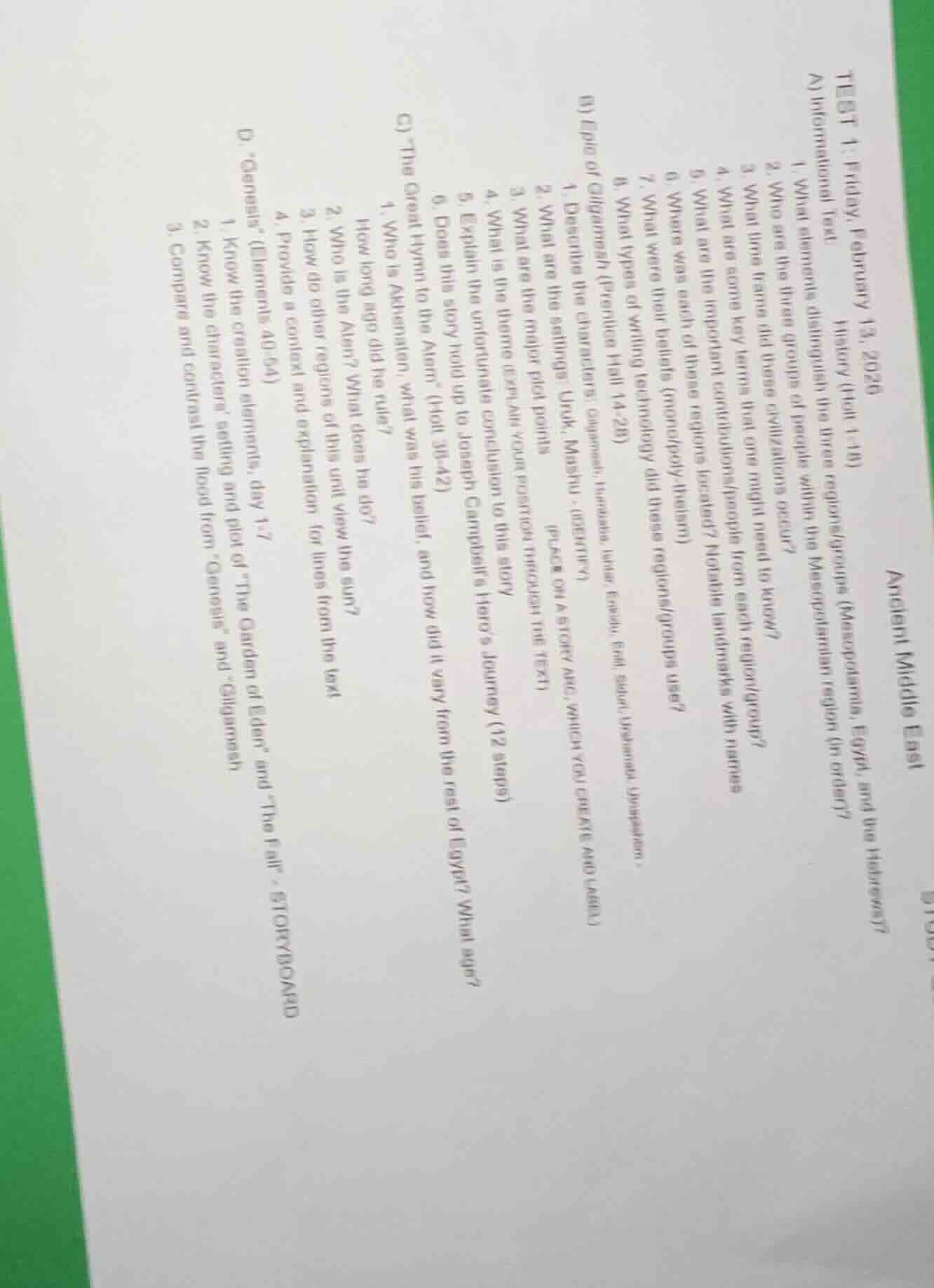
A) Informational Text (History)
- The three regions/groups are distinguished by:
- Mesopotamia: Fertile Crescent between Tigris/Euphrates rivers, city-state based, polytheistic, cuneiform writing.
- Egypt: Nile River valley, unified kingdom, polytheistic (later Atenism), hieroglyphs, centralized rule.
- Hebrews: Levant region, monotheistic (Yahweh), nomadic then settled, Torah as sacred text.
- The three groups within Mesopotamia (in order of emergence):
- Sumerians
- Akkadians
- Babylonians
- Time frames:
- Mesopotamia: ~3500 BCE to 539 BCE
- Egypt: ~3100 BCE to 30 BCE
- Hebrew kingdoms: ~1000 BCE to 586 BCE
- Key terms:
- Mesopotamia: Cuneiform, Ziggurat, Code of Hammurabi
- Egypt: Pharaoh, Hieroglyphs, Pyramid
- Hebrews: Monotheism, Torah, Covenant
- Key contributions:
- Mesopotamia: First writing system (cuneiform), Code of Hammurabi (early legal code), wheel invention
- Egypt: Pyramid engineering, 365-day calendar, advanced medicine
- Hebrews: Monotheistic tradition (Judaism), foundational Abrahamic religious texts
- Locations:
- Mesopotamia: Modern-day Iraq, parts of Syria/Turkey/Iran
- Egypt: Modern-day Egypt, Nile River valley/delta
- Hebrews: Modern-day Israel/Palestine, Levant region
- Beliefs:
- Mesopotamia: Polytheistic, anthropomorphic gods, afterlife as a gloomy underworld
- Egypt: Polytheistic (except Akhenaten's Atenism), afterlife focused on preservation (mummification), pharaoh as divine
- Hebrews: Monotheistic (worship of Yahweh), ethical covenant, focus on moral law
- Writing technology:
- Mesopotamia: Cuneiform on clay tablets
- Egypt: Hieroglyphs on papyrus/stone
- Hebrews: Hebrew script on scrolls (papyrus/parchment)
B) Epic of Gilgamesh
- Characters:
- Gilgamesh: Arrogant king of Uruk, demigod, seeks immortality
- Humbaba: Guardian of the Cedar Forest, defeated by Gilgamesh/Enkidu
- Ishtar: Mesopotamian goddess of love/war, rejected by Gilgamesh
- Enkidu: Wild man created to balance Gilgamesh, his closest friend
- Shamash: Sun god, aids Gilgamesh/Enkidu
- Siduri: Tavern keeper, advises Gilgamesh
- Utnapishtim: Survivor of the flood, holds secret of immortality
- Utnapishtim's Wife: Helps Gilgamesh in his quest
- Settings:
- Uruk: Ancient Mesopotamian city, Gilgamesh's kingdom
- Mashu: Mountain pass between the mortal world and the edge of the sun
- Major plot points:
- Enkidu is created to challenge Gilgamesh; they fight and become friends
- Gilgamesh and Enkidu defeat Humbaba and the Bull of Heaven
- Enkidu is cursed and dies, devastating Gilgamesh
- Gilgamesh travels to find Utnapishtim to learn immortality
- Gilgamesh fails Utnapishtim's immortality test, returns to Uruk
- Theme: The inevitability of human mortality, and the value of leaving a lasting legacy through one's deeds.
- Hero's Journey conclusion: Gilgamesh follows the 12-step structure:
- Ordinary World: King of Uruk, tyrannical and unfulfilled
- Call to Adventure: Enkidu's arrival forces him to confront his flaws
- Refusal of the Call: Initially hostile to Enkidu
- Meeting the Mentor: Shamash (sun god) aids him in battles
- Crossing the Threshold: Travels to the Cedar Forest to fight Humbaba
- Tests, Allies, Enemies: Fights Humbaba/Bull of Heaven; allies with Enkidu, enemies are divine beings
- Approach: Travels to the edge of the world to find Utnapishtim
- Ordeal: Grieves Enkidu's death, faces the fear of his own mortality
- Reward: Learns the secret of the immortality plant (loses it to a snake)
- The Road Back: Returns to Uruk, humbled
- Resurrection: Accepts his mortality, becomes a wise, just king
- Return with the Elixir: Wisdom about legacy and mortality, which he brings to his people
- The story aligns with Joseph Campbell's Hero's Journey perfectly, as it follows the full arc of a hero leaving their ordinary world, facing trials, undergoing transformation, and returning with wisdom.
C) The Great Hymn to the Aten
- Akhenaten was an 18th Dynasty Egyptian pharaoh (r. ~1353–1336 BCE). His core belief was Atenism: the worship of Aten, the sun disk, as the sole, universal god, rejecting Egypt's traditional polytheistic pantheon. This varied from mainstream Egyptian religion, which was polytheistic with a large pantheon of gods (e.g., Ra, Osiris, Isis) and local cults.
- He ruled for approximately 17 years.
- The Aten is the sun disk, the sole divine entity in Akhenaten's monotheistic belief system. Akhenaten declared Aten the only god, closed temples to other deities, moved the capital to Amarna, and promoted a new artistic style focused on the royal family and Aten.
- Other regions (Mesopotamia, Hebrews) viewed the sun as one of many gods (Mesopotamia's Shamash) or a creation of their single god (Hebrews' Yahweh), not the sole universal deity as Akhenaten framed Aten.
D) Genesis (Elements 40-54)
- Creation elements (Day 1-7):
- Day 1: Light/darkness separated
- Day 2: Sky separated from waters
- Day 3: Dry land/vegetation created
- Day 4: Sun, moon, stars created
- Day 5: Aquatic and flying animals created
- Day 6: Land animals and humans (Adam/Eve) created
- Day 7: God rested, sanctified the day
- The Garden of Eden:
- Setting: A perfect, enclosed garden with the Tree of Life and Tree of the Knowledge of Good and Evil
- Plot: God places Adam/Eve in Eden; they are tempted by a serpent to eat from the forbidden tree; they are expelled from Eden after gaining knowledge of good and evil
- Characters: Adam (first man), Eve (first woman), God, Serpent (tempter)
- The Fall: Refers to Adam and Eve's disobedience, which introduces sin and mortality into the human world.
- Flood comparison:
- Similarities: Both stories feature a divine flood sent to wipe out corrupt humanity; a single righteous individual (Utnapishtim in Gilgamesh, Noah in Genesis) is instructed to build a vessel to save their family and animals; the flood is followed by a divine sign of a covenant (rainbow in Genesis, promise in Gilgamesh).
- Differences: In Gilgamesh, the flood is sent by multiple gods due to human noise; in Genesis, it is sent by the single Hebrew God to punish human wickedness. Utnapishtim is granted immortality as a reward, while Noah is given a covenant of protection and becomes the ancestor of post-flood humanity.