QUESTION IMAGE
Question
Question was provided via image upload.
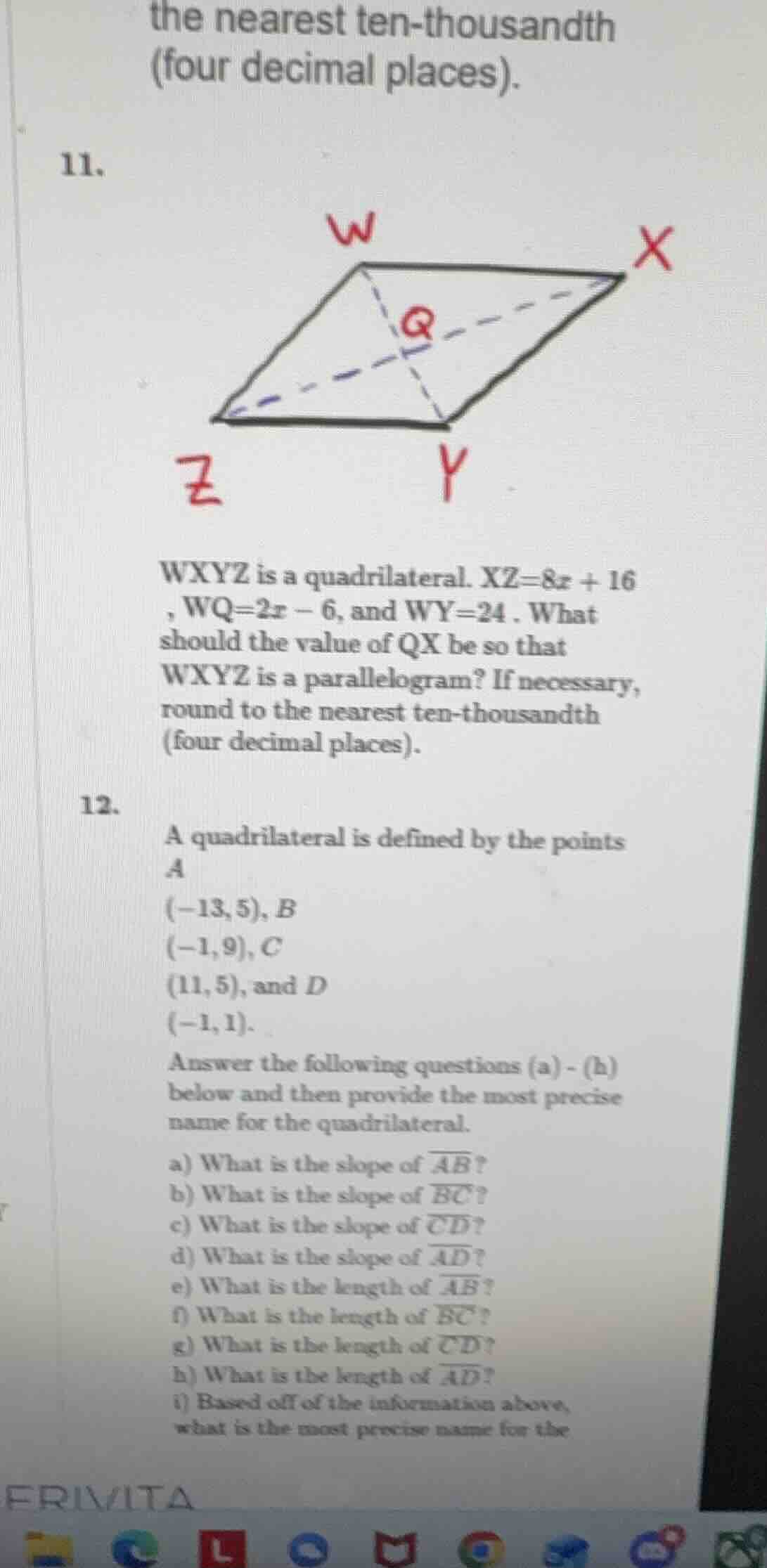
Problem 11
Step1: Recall parallelogram diagonals property
In a parallelogram, diagonals bisect each other. So, \( WQ=\frac{1}{2}WY \) and \( QX = \frac{1}{2}XZ \), also \( WQ=\frac{1}{2}WY \) can be used to find \( x \), then find \( XZ \) and then \( QX \).
First, find \( x \) using \( WQ=\frac{1}{2}WY \). Given \( WQ = 2x - 6 \) and \( WY=24 \), so:
\( 2x - 6=\frac{1}{2}\times24 \)
Step2: Solve for \( x \)
Simplify the right - hand side: \( \frac{1}{2}\times24 = 12 \)
So the equation is \( 2x-6 = 12 \)
Add 6 to both sides: \( 2x=12 + 6=18 \)
Divide both sides by 2: \( x=\frac{18}{2}=9 \)
Step3: Find \( XZ \)
Given \( XZ = 8x+16 \), substitute \( x = 9 \):
\( XZ=8\times9 + 16=72+16 = 88 \)
Step4: Find \( QX \)
Since in a parallelogram diagonals bisect each other, \( QX=\frac{1}{2}XZ \)
\( QX=\frac{1}{2}\times88 = 44 \)
Step1: Recall slope formula
The slope of a line passing through two points \( (x_1,y_1) \) and \( (x_2,y_2) \) is given by \( m=\frac{y_2 - y_1}{x_2 - x_1} \)
For \( \overline{AB} \), \( A(-13,5) \) and \( B(-1,9) \), so \( x_1=-13,y_1 = 5,x_2=-1,y_2 = 9 \)
Step2: Calculate the slope
\( m_{AB}=\frac{9 - 5}{-1-(-13)}=\frac{4}{-1 + 13}=\frac{4}{12}=\frac{1}{3}\approx0.3333 \)
Step1: Use slope formula
For \( \overline{BC} \), \( B(-1,9) \) and \( C(11,5) \), \( x_1=-1,y_1 = 9,x_2 = 11,y_2=5 \)
Step2: Calculate the slope
\( m_{BC}=\frac{5 - 9}{11-(-1)}=\frac{-4}{12}=-\frac{1}{3}\approx - 0.3333 \)

Snap & solve any problem in the app
Get step-by-step solutions on Sovi AI
Photo-based solutions with guided steps
Explore more problems and detailed explanations
\( 44 \)