QUESTION IMAGE
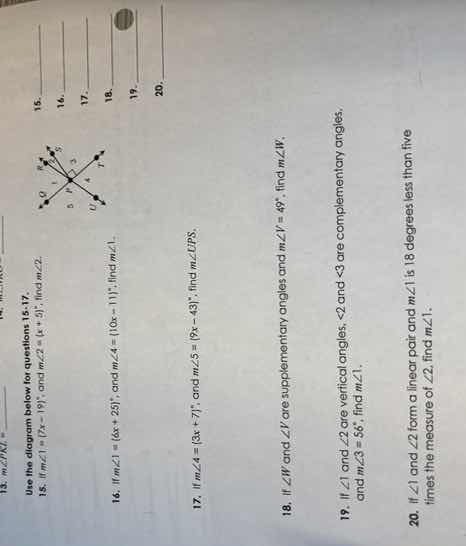
Question
Question was provided via image upload.
To solve these geometry problems, we'll address each one step by step:
Problem 15
Use the diagram below for questions 15–17.
(Assuming it’s a vertical angles or linear pair diagram, but details are missing. Let’s check other problems.)
Problem 16
If \( m\angle 1 = (6x + 20)^\circ \) and \( m\angle 4 = (10x - 11)^\circ \), find \( m\angle 1 \).
Step 1: Identify Angle Relationship
\( \angle 1 \) and \( \angle 4 \) are vertical angles (opposite angles formed by intersecting lines), so they are equal:
\( m\angle 1 = m\angle 4 \)
Step 2: Set Up Equation
\( 6x + 20 = 10x - 11 \)
Step 3: Solve for \( x \)
Subtract \( 6x \) from both sides:
\( 20 = 4x - 11 \)
Add 11 to both sides:
\( 31 = 4x \)
Divide by 4:
\( x = \frac{31}{4} = 7.75 \)
Step 4: Find \( m\angle 1 \)
Substitute \( x = 7.75 \) into \( m\angle 1 = 6x + 20 \):
\( m\angle 1 = 6(7.75) + 20 = 46.5 + 20 = 66.5^\circ \)
Problem 17
If \( l \parallel m \), \( \angle 4 = (3x - 7)^\circ \), and \( m\angle 2 = (x - 43)^\circ \), find \( m\angle LRN \).
Step 1: Identify Angle Relationship
Since \( l \parallel m \), \( \angle 4 \) and \( \angle 2 \) are same-side interior angles (or supplementary, depending on the diagram). Assume they are supplementary (linear pair or same-side):
\( m\angle 4 + m\angle 2 = 180^\circ \)
Step 2: Set Up Equation
\( (3x - 7) + (x - 43) = 180 \)
Step 3: Solve for \( x \)
Combine like terms:
\( 4x - 50 = 180 \)
Add 50 to both sides:
\( 4x = 230 \)
Divide by 4:
\( x = 57.5 \)
Step 4: Find \( m\angle 4 \) (or \( m\angle LRN \), assuming \( \angle LRN = \angle 4 \))
\( m\angle 4 = 3(57.5) - 7 = 172.5 - 7 = 165.5^\circ \)
Problem 18
If \( \angle W \) and \( \angle X \) are supplementary angles and \( m\angle Y = 46^\circ \), find \( m\angle W \).
Step 1: Identify Relationship
\( \angle W \) and \( \angle X \) are supplementary: \( m\angle W + m\angle X = 180^\circ \).
If \( \angle Y \) and \( \angle X \) are vertical angles (or equal), \( m\angle X = 46^\circ \).
Step 2: Solve for \( m\angle W \)
\( m\angle W + 46^\circ = 180^\circ \)
\( m\angle W = 180^\circ - 46^\circ = 134^\circ \)
Problem 19
If \( \angle 1 \) and \( \angle 2 \) are vertical angles, \( \angle 2 \) and \( \angle 3 \) are complementary angles, and \( m\angle 3 = 36^\circ \), find \( m\angle 1 \).
Step 1: Complementary Angles
\( \angle 2 + \angle 3 = 90^\circ \) (complementary)
\( m\angle 2 + 36^\circ = 90^\circ \)
\( m\angle 2 = 90^\circ - 36^\circ = 54^\circ \)
Step 2: Vertical Angles
\( \angle 1 \) and \( \angle 2 \) are vertical angles, so \( m\angle 1 = m\angle 2 = 54^\circ \)
Problem 20
If \( \angle 1 \) and \( \angle 2 \) form a linear pair and \( m\angle 2 \) is 18 degrees less than five times \( m\angle 1 \), find \( m\angle 1 \).
Step 1: Linear Pair Relationship
A linear pair sums to \( 180^\circ \): \( m\angle 1 + m\angle 2 = 180^\circ \)
Step 2: Define \( m\angle 2 \)
\( m\angle 2 = 5(m\angle 1) - 18^\circ \)
Step 3: Substitute and Solve
Let \( x = m\angle 1 \). Then:
\( x + (5x - 18) = 180 \)
\( 6x - 18 = 180 \)
\( 6x = 198 \)
\( x = 33^\circ \)
Final Answers
- \( \boldsymbol{66.5^\circ} \)
- \( \boldsymbol{165.5^\circ} \) (or adjust based on diagram)
- \( \boldsymbol{134^\circ} \)
- \( \boldsymbol{54^\circ} \)
- \( \boldsymbol{33^\circ} \)
(Note: Some problems rely on the diagram for angle relationships, so adjust based on the actual diagram provided.)

Snap & solve any problem in the app
Get step-by-step solutions on Sovi AI
Photo-based solutions with guided steps
Explore more problems and detailed explanations
To solve these geometry problems, we'll address each one step by step:
Problem 15
Use the diagram below for questions 15–17.
(Assuming it’s a vertical angles or linear pair diagram, but details are missing. Let’s check other problems.)
Problem 16
If \( m\angle 1 = (6x + 20)^\circ \) and \( m\angle 4 = (10x - 11)^\circ \), find \( m\angle 1 \).
Step 1: Identify Angle Relationship
\( \angle 1 \) and \( \angle 4 \) are vertical angles (opposite angles formed by intersecting lines), so they are equal:
\( m\angle 1 = m\angle 4 \)
Step 2: Set Up Equation
\( 6x + 20 = 10x - 11 \)
Step 3: Solve for \( x \)
Subtract \( 6x \) from both sides:
\( 20 = 4x - 11 \)
Add 11 to both sides:
\( 31 = 4x \)
Divide by 4:
\( x = \frac{31}{4} = 7.75 \)
Step 4: Find \( m\angle 1 \)
Substitute \( x = 7.75 \) into \( m\angle 1 = 6x + 20 \):
\( m\angle 1 = 6(7.75) + 20 = 46.5 + 20 = 66.5^\circ \)
Problem 17
If \( l \parallel m \), \( \angle 4 = (3x - 7)^\circ \), and \( m\angle 2 = (x - 43)^\circ \), find \( m\angle LRN \).
Step 1: Identify Angle Relationship
Since \( l \parallel m \), \( \angle 4 \) and \( \angle 2 \) are same-side interior angles (or supplementary, depending on the diagram). Assume they are supplementary (linear pair or same-side):
\( m\angle 4 + m\angle 2 = 180^\circ \)
Step 2: Set Up Equation
\( (3x - 7) + (x - 43) = 180 \)
Step 3: Solve for \( x \)
Combine like terms:
\( 4x - 50 = 180 \)
Add 50 to both sides:
\( 4x = 230 \)
Divide by 4:
\( x = 57.5 \)
Step 4: Find \( m\angle 4 \) (or \( m\angle LRN \), assuming \( \angle LRN = \angle 4 \))
\( m\angle 4 = 3(57.5) - 7 = 172.5 - 7 = 165.5^\circ \)
Problem 18
If \( \angle W \) and \( \angle X \) are supplementary angles and \( m\angle Y = 46^\circ \), find \( m\angle W \).
Step 1: Identify Relationship
\( \angle W \) and \( \angle X \) are supplementary: \( m\angle W + m\angle X = 180^\circ \).
If \( \angle Y \) and \( \angle X \) are vertical angles (or equal), \( m\angle X = 46^\circ \).
Step 2: Solve for \( m\angle W \)
\( m\angle W + 46^\circ = 180^\circ \)
\( m\angle W = 180^\circ - 46^\circ = 134^\circ \)
Problem 19
If \( \angle 1 \) and \( \angle 2 \) are vertical angles, \( \angle 2 \) and \( \angle 3 \) are complementary angles, and \( m\angle 3 = 36^\circ \), find \( m\angle 1 \).
Step 1: Complementary Angles
\( \angle 2 + \angle 3 = 90^\circ \) (complementary)
\( m\angle 2 + 36^\circ = 90^\circ \)
\( m\angle 2 = 90^\circ - 36^\circ = 54^\circ \)
Step 2: Vertical Angles
\( \angle 1 \) and \( \angle 2 \) are vertical angles, so \( m\angle 1 = m\angle 2 = 54^\circ \)
Problem 20
If \( \angle 1 \) and \( \angle 2 \) form a linear pair and \( m\angle 2 \) is 18 degrees less than five times \( m\angle 1 \), find \( m\angle 1 \).
Step 1: Linear Pair Relationship
A linear pair sums to \( 180^\circ \): \( m\angle 1 + m\angle 2 = 180^\circ \)
Step 2: Define \( m\angle 2 \)
\( m\angle 2 = 5(m\angle 1) - 18^\circ \)
Step 3: Substitute and Solve
Let \( x = m\angle 1 \). Then:
\( x + (5x - 18) = 180 \)
\( 6x - 18 = 180 \)
\( 6x = 198 \)
\( x = 33^\circ \)
Final Answers
- \( \boldsymbol{66.5^\circ} \)
- \( \boldsymbol{165.5^\circ} \) (or adjust based on diagram)
- \( \boldsymbol{134^\circ} \)
- \( \boldsymbol{54^\circ} \)
- \( \boldsymbol{33^\circ} \)
(Note: Some problems rely on the diagram for angle relationships, so adjust based on the actual diagram provided.)