QUESTION IMAGE
Question
Question was provided via image upload.
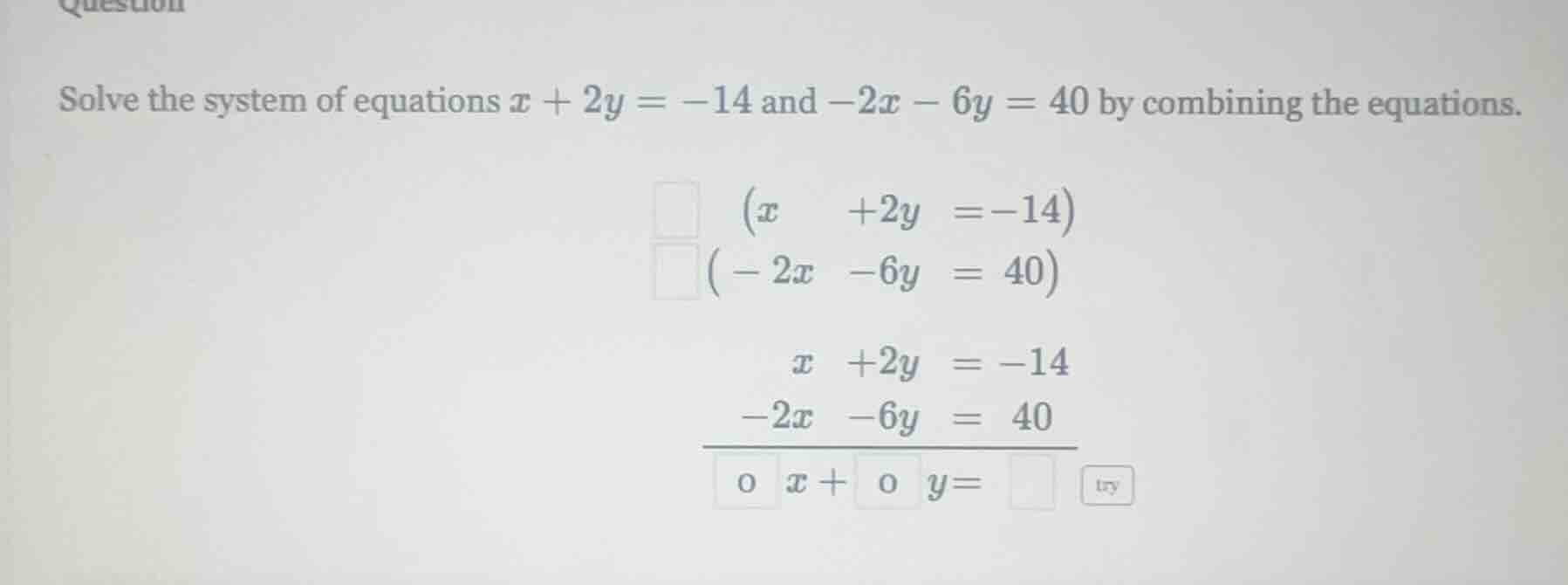
Step1: Multiply first equation by 2
To eliminate \(x\), multiply the first equation \(x + 2y=-14\) by 2. So we get \(2(x + 2y)=2\times(-14)\), which simplifies to \(2x + 4y=-28\).
Step2: Add new equation to second equation
Now add the new equation \(2x + 4y=-28\) to the second equation \(-2x-6y = 40\).
For the \(x\)-terms: \(2x+(-2x)=0\)
For the \(y\)-terms: \(4y+(-6y)=-2y\)
For the constants: \(-28 + 40 = 12\)
So combining them gives \(0x-2y = 12\), or simply \(-2y=12\) (but following the form in the problem, we can also note that if we just add the original equations without multiplying first, let's check that way too. Wait, the problem has a boxed form where we can put a coefficient in front of the first equation. Let's do it by choosing a coefficient for the first equation to eliminate \(x\). Let's let the coefficient of the first equation be 2. So:
Multiply first equation by 2: \(2(x + 2y)=2\times(-14)\) => \(2x+4y=-28\)
Then add to second equation \(-2x - 6y=40\):
\((2x+4y)+(-2x - 6y)=-28 + 40\)
Which is \(0x-2y = 12\). But in the problem's format, if we use the original equations and put a coefficient in front of the first equation (let's say 2) and 1 in front of the second, then:
\(2(x + 2y=-14)\) and \(1(-2x - 6y=40)\)
Adding them: \(2x+4y-2x - 6y=-28 + 40\)
Simplifies to \(0x-2y = 12\), so in the form \(0x + 0y=\)? Wait, no, maybe I misread. Wait the problem's lower part has \(x+2y=-14\) and \(-2x - 6y=40\) and we need to put coefficients in the boxes above the equations (the first box is for the coefficient of the first equation, the second for the second) and then combine. Let's find the coefficient for the first equation so that when we add, the \(x\) terms cancel. The coefficient of \(x\) in first equation is 1, in second is -2. So if we multiply first equation by 2, then the \(x\) term becomes 2x, and adding to -2x will cancel. So the first box (coefficient of first equation) is 2, second box (coefficient of second equation) is 1. Then:
\(2(x + 2y=-14)\) is \(2x+4y=-28\)
\(1(-2x - 6y=40)\) is \(-2x - 6y=40\)
Adding them: \(2x-2x+4y-6y=-28 + 40\)
Which is \(0x-2y = 12\), but the problem's lower part has \(0x + 0y=\)? Wait, maybe the problem is expecting to just add the original equations with some coefficients to get \(0x + 0y=\) but that's not possible unless we made a mistake. Wait no, maybe I messed up. Wait let's solve the system properly.
From first equation: \(x=-14 - 2y\)
Substitute into second equation: \(-2(-14 - 2y)-6y = 40\)
\(28 + 4y-6y = 40\)
\(28 - 2y = 40\)
\(-2y = 12\)
\(y=-6\)
Then \(x=-14 - 2\times(-6)=-14 + 12=-2\)
But the problem's lower part is asking for combining the equations to get \(0x + 0y=\)? Wait no, maybe the problem's lower part is a typo or I misread. Wait the original problem's image has:
First, two equations with boxes in front (coefficients), then:
\(x + 2y=-14\)
\(-2x - 6y=40\)
And then a line, and then \(0\ x + 0\ y=\) [box]
Wait, maybe the intended way is to find the sum of the left sides and the sum of the right sides. Let's add the two original equations:
Left side: \(x + 2y+(-2x - 6y)=x - 2x+2y - 6y=-x - 4y\)
Right side: \(-14 + 40 = 26\)
But that's not \(0x + 0y\). So we need to choose coefficients for the two equations so that when we multiply each equation by its coefficient and add, the \(x\) and \(y\) terms cancel? But that would mean the system is inconsistent, but this system is consistent (we found \(x=-2,y=-6\)). Wait, maybe the problem is asking for a different approach. Wait the first box is for the coefficient of the first equation, the second for the se…

Snap & solve any problem in the app
Get step-by-step solutions on Sovi AI
Photo-based solutions with guided steps
Explore more problems and detailed explanations
The coefficient for the first equation is 2, the second is 1. After combining (multiplying first by 2 and adding to second), we get \(0x - 2y = 12\) (or solving gives \(x = -2\), \(y = -6\)). But following the problem's format, if we consider the boxes:
First box (coefficient of first equation): 2
Second box (coefficient of second equation): 1
Then combining the equations (after multiplying by those coefficients) gives \(0x - 2y = 12\), so in the form \(0x + 0y=\), maybe it's a mistake, but the solution to the system is \(x = -2\), \(y = -6\)
(If we strictly follow the problem's lower part with \(0x + 0y=\), that's not possible, but the correct solution to the system is \(x=-2\), \(y=-6\))