QUESTION IMAGE
Question
hw 3.7: rational functions
score: 5.5/28 answered: 6/28
question 7
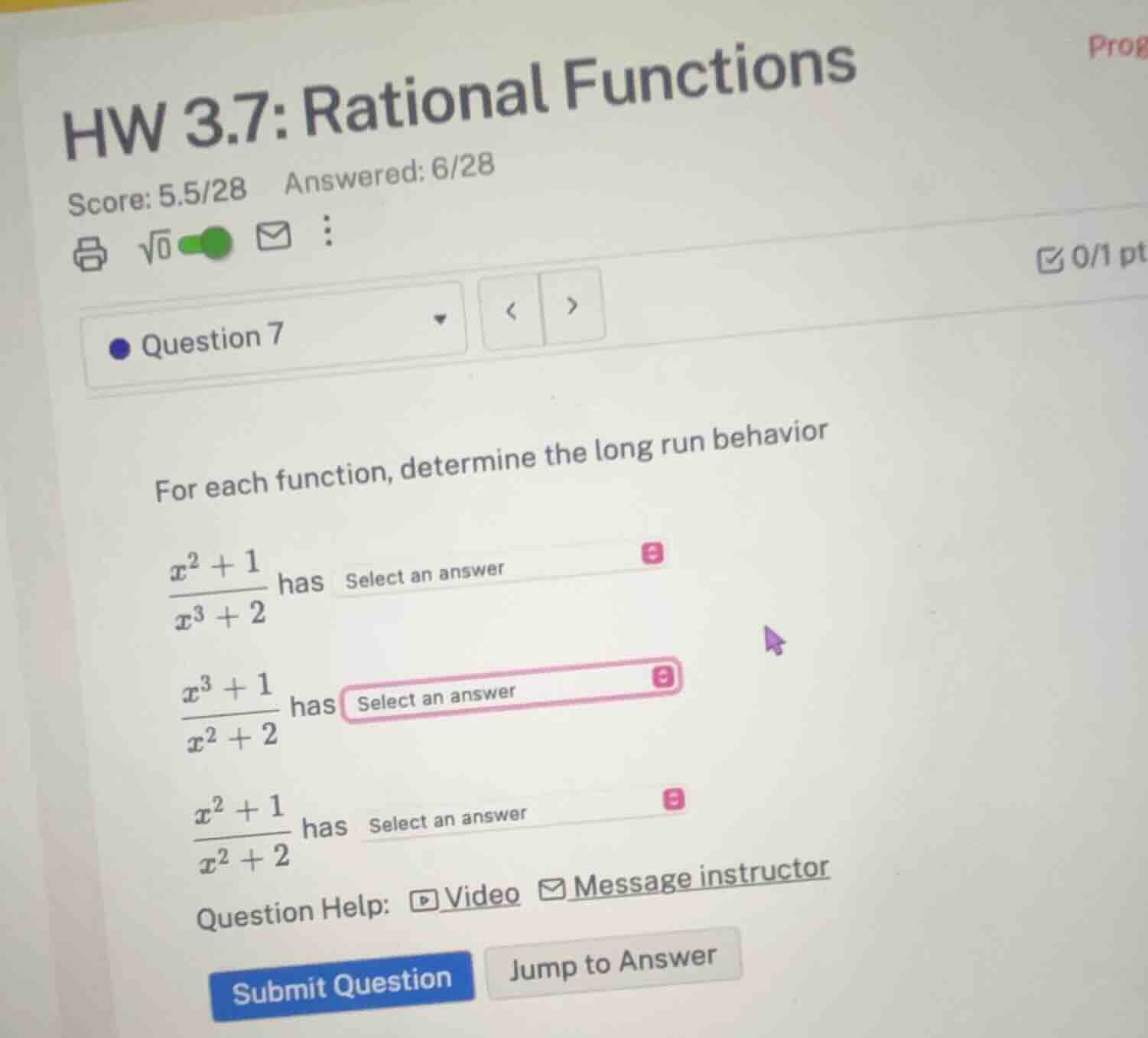
for each function, determine the long run behavior
\\(\frac{x^2 + 1}{x^3 + 2}\\) has select an answer
\\(\frac{x^3 + 1}{x^2 + 2}\\) has select an answer
\\(\frac{x^2 + 1}{x^2 + 2}\\) has select an answer
question help: video message instructor
submit question jump to answer
To determine the long - run behavior of a rational function \(y = \frac{f(x)}{g(x)}\), we compare the degrees of the numerator \(f(x)\) and the denominator \(g(x)\). Let the degree of the numerator be \(n\) and the degree of the denominator be \(m\).
For the function \(\frac{x^{2}+1}{x^{3}+2}\)
- Step 1: Identify degrees
The degree of the numerator \(f(x)=x^{2} + 1\) is \(n = 2\) (the highest power of \(x\) in the numerator). The degree of the denominator \(g(x)=x^{3}+2\) is \(m = 3\) (the highest power of \(x\) in the denominator).
- Step 2: Compare degrees
Since \(n=2\) and \(m = 3\) and \(n The degree of the numerator \(f(x)=x^{3}+1\) is \(n = 3\), and the degree of the denominator \(g(x)=x^{2}+2\) is \(m = 2\). Since \(n = 3\) and \(m=2\) and \(n>m\), we can perform polynomial long - division or analyze the leading terms. The leading term of the numerator is \(x^{3}\) and the leading term of the denominator is \(x^{2}\). So \(\frac{x^{3}+1}{x^{2}+2}\approx\frac{x^{3}}{x^{2}}=x\) as \(x\to\pm\infty\). This means that as \(x\to\infty\), \(y\to\infty\) and as \(x\to-\infty\), \(y\to-\infty\) (there is no horizontal asymptote, and the function has an oblique (slant) asymptote - related behavior where it behaves like the line \(y = x\) for large \(|x|\)). The degree of the numerator \(f(x)=x^{2}+1\) is \(n = 2\), and the degree of the denominator \(g(x)=x^{2}+2\) is \(m = 2\). When \(n = m\), the horizontal asymptote is \(y=\frac{a}{b}\), where \(a\) is the leading coefficient of the numerator and \(b\) is the leading coefficient of the denominator. For \(f(x)=x^{2}+1\), the leading coefficient \(a = 1\), and for \(g(x)=x^{2}+2\), the leading coefficient \(b = 1\). So \(y=\frac{1}{1}=1\) is the horizontal asymptote, and as \(x\to\pm\infty\), \(\frac{x^{2}+1}{x^{2}+2}\approx\frac{x^{2}}{x^{2}} = 1\), so the function approaches \(1\) as \(x\to\pm\infty\).For the function \(\frac{x^{3}+1}{x^{2}+2}\)
For the function \(\frac{x^{2}+1}{x^{2}+2}\)

Snap & solve any problem in the app
Get step-by-step solutions on Sovi AI
Photo-based solutions with guided steps
Explore more problems and detailed explanations
s:
- For \(\frac{x^{2}+1}{x^{3}+2}\): Approaches \(0\) (horizontal asymptote \(y = 0\))
- For \(\frac{x^{3}+1}{x^{2}+2}\): Behaves like \(y=x\) (no horizontal asymptote, goes to \(\pm\infty\) as \(x\to\pm\infty\) respectively)
- For \(\frac{x^{2}+1}{x^{2}+2}\): Approaches \(1\) (horizontal asymptote \(y = 1\))