QUESTION IMAGE
Question
hw 2.4
score: 2/8 answered: 2/8
question 3
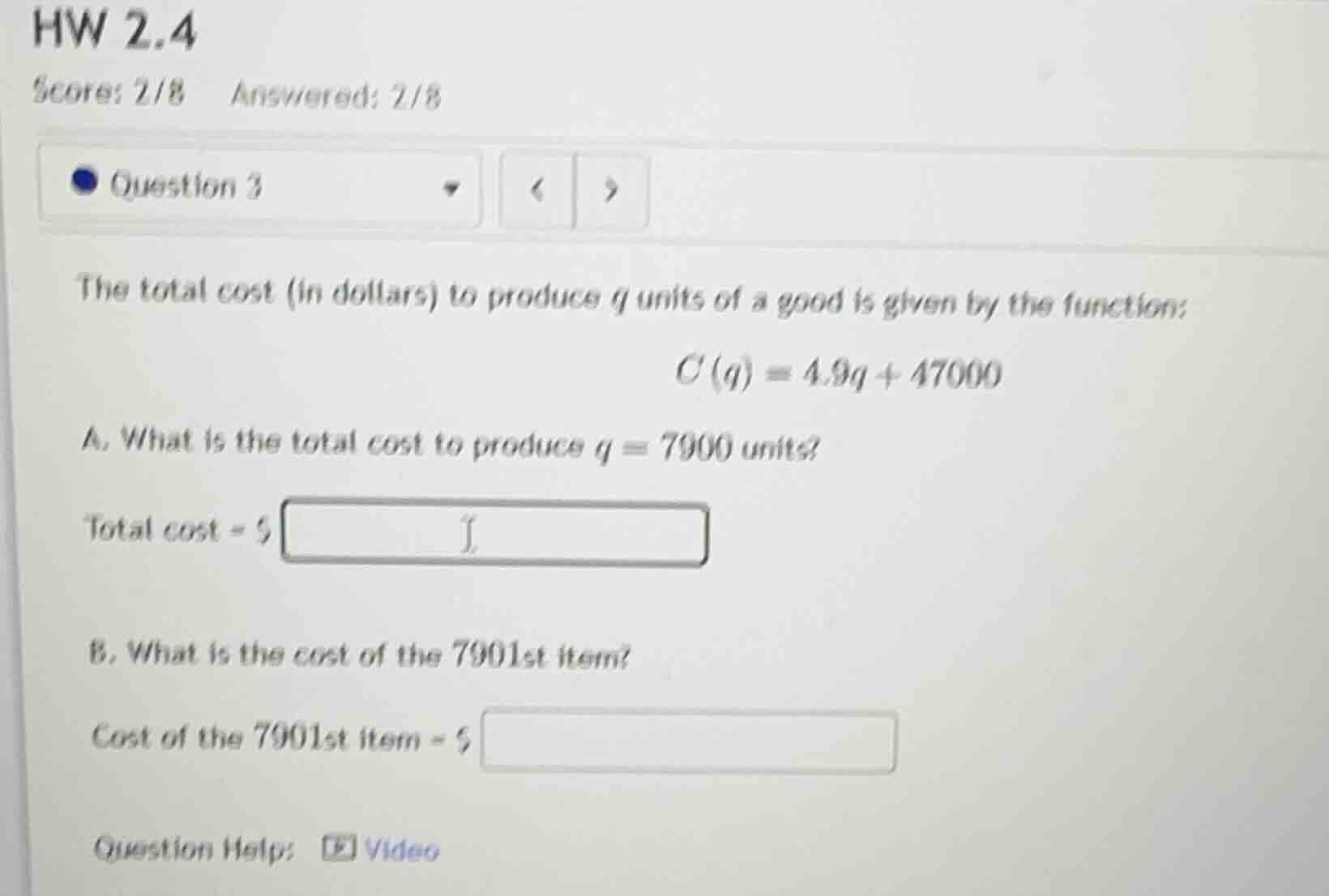
the total cost (in dollars) to produce q units of a good is given by the function:
c(q) = 4.9q + 47000
a. what is the total cost to produce q = 7900 units?
total cost = $
b. what is the cost of the 7901st item?
cost of the 7901st item = $
question help: video
Part A
Step1: Substitute \( q = 7900 \) into \( C(q) \)
We have the cost function \( C(q)=4.9q + 47000 \). Substitute \( q = 7900 \) into the function:
\( C(7900)=4.9\times7900 + 47000 \)
Step2: Calculate the product
First, calculate \( 4.9\times7900 \). \( 4.9\times7900 = 4.9\times(7000 + 900)=4.9\times7000+4.9\times900 = 34300+4410 = 38710 \)
Step3: Add the constant term
Then add 47000 to the result: \( 38710+47000=85710 \)
Step1: Understand marginal cost
For a linear cost function \( C(q)=mq + b \), the marginal cost (cost of producing one additional unit) is the slope \( m \). Also, the cost of the \( (n + 1) \)-th item is \( C(n + 1)-C(n) \). Let's calculate \( C(7901)-C(7900) \)
Step2: Calculate \( C(7901) \) and \( C(7900) \)
\( C(7901)=4.9\times7901+47000 \) and \( C(7900)=4.9\times7900 + 47000 \)
Step3: Find the difference
\( C(7901)-C(7900)=4.9\times7901 + 47000-(4.9\times7900 + 47000)=4.9\times(7901 - 7900)=4.9\times1 = 4.9 \)

Snap & solve any problem in the app
Get step-by-step solutions on Sovi AI
Photo-based solutions with guided steps
Explore more problems and detailed explanations
\( 85710 \)