QUESTION IMAGE
Question
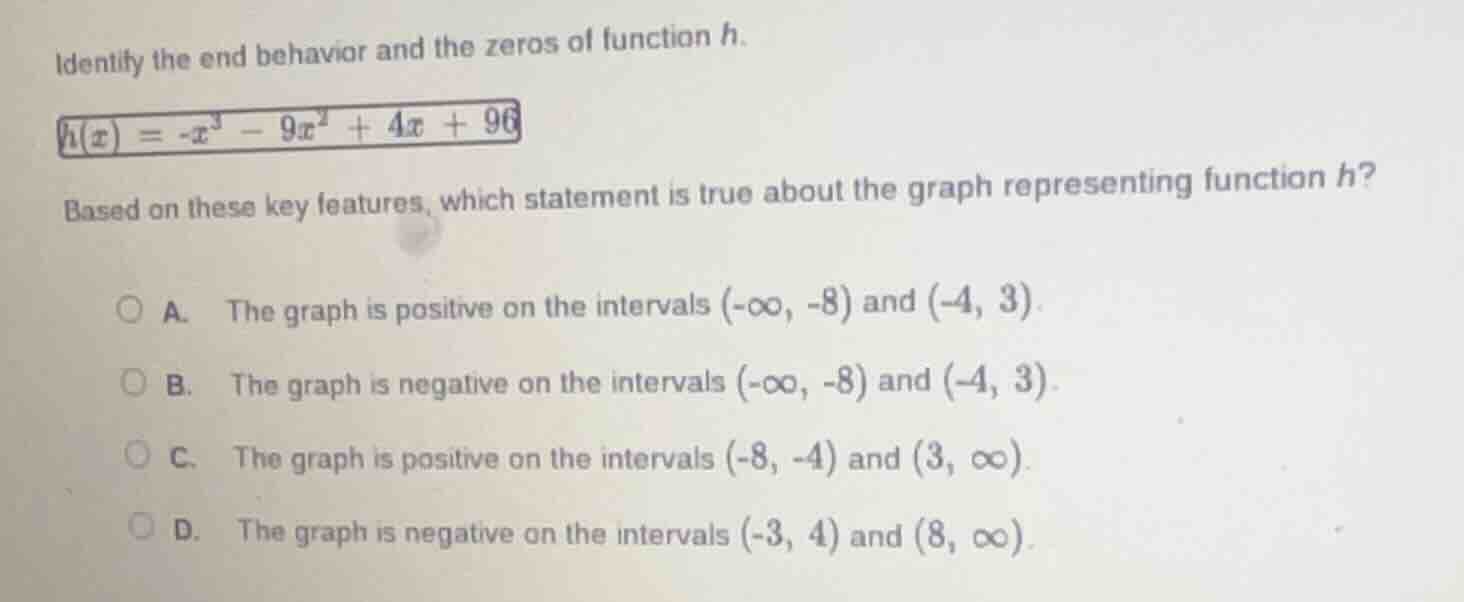
identify the end behavior and the zeros of function h.\\(h(x) = -x^3 - 9x^2 + 4x + 96\\)\
based on these key features, which statement is true about the graph representing function h?\
\\(\bigcirc\\) a. the graph is positive on the intervals \\((-\infty, -8)\\) and \\((-4, 3)\\).\
\\(\bigcirc\\) b. the graph is negative on the intervals \\((-\infty, -8)\\) and \\((-4, 3)\\).\
\\(\bigcirc\\) c. the graph is positive on the intervals \\((-8, -4)\\) and \\((3, \infty)\\).\
\\(\bigcirc\\) d. the graph is negative on the intervals \\((-3, 4)\\) and \\((8, \infty)\\).
Step1: Factor the cubic function
First, group terms:
$$h(x) = -x^3 -9x^2 +4x +96 = -x^2(x+9) +4(x+24)$$
Use rational root theorem: test $x=-8$:
$$h(-8) = -(-8)^3 -9(-8)^2 +4(-8)+96 = 512-576-32+96=0$$
So $(x+8)$ is a factor. Perform polynomial division or use synthetic division:
$$h(x) = (x+8)(-x^2 -x +12) = -(x+8)(x^2 +x -12)$$
Factor quadratic:
$$h(x) = -(x+8)(x+4)(x-3)$$
Step2: Find the zeros
Set $h(x)=0$:
$$-(x+8)(x+4)(x-3)=0$$
Zeros are $x=-8, x=-4, x=3$.
Step3: Analyze end behavior
Leading term is $-x^3$. As $x\to\infty$, $h(x)\to-\infty$; as $x\to-\infty$, $h(x)\to\infty$.
Step4: Test intervals for sign
- Interval $(-\infty,-8)$: test $x=-9$
$$h(-9) = -(-9+8)(-9+4)(-9-3) = -(-1)(-5)(-12)=60>0$$
- Interval $(-8,-4)$: test $x=-6$
$$h(-6) = -(-6+8)(-6+4)(-6-3) = -(2)(-2)(-9)=-36<0$$
- Interval $(-4,3)$: test $x=0$
$$h(0) = -(0+8)(0+4)(0-3) = -(8)(4)(-3)=96>0$$
- Interval $(3,\infty)$: test $x=4$
$$h(4) = -(4+8)(4+4)(4-3) = -(12)(8)(1)=-96<0$$

Snap & solve any problem in the app
Get step-by-step solutions on Sovi AI
Photo-based solutions with guided steps
Explore more problems and detailed explanations
A. The graph is positive on the intervals $(-\infty, -8)$ and $(-4, 3)$.