QUESTION IMAGE
Question
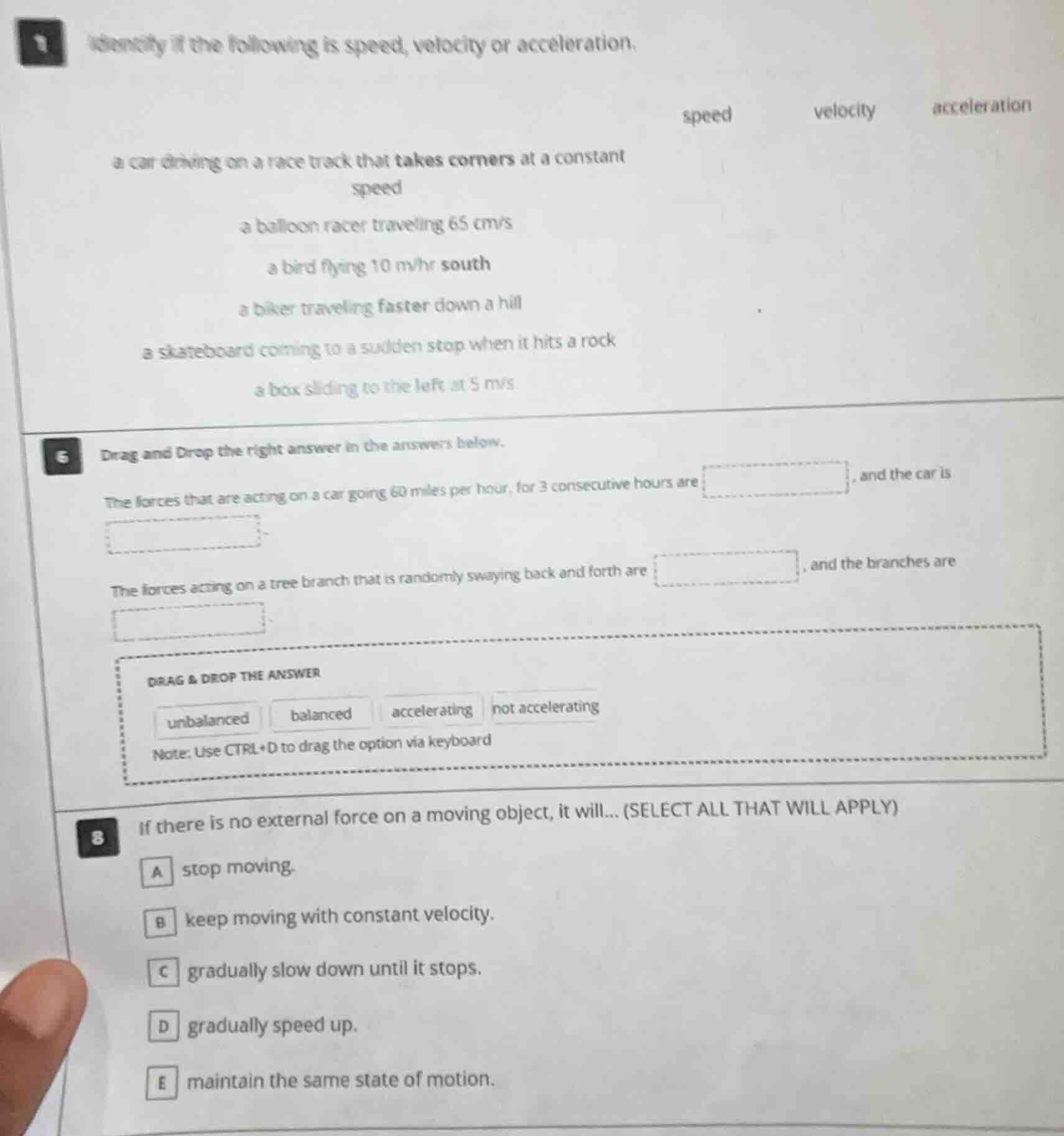
1 identify if the following is speed, velocity or acceleration.
speed velocity acceleration
a car driving on a race track that takes corners at a constant speed
a balloon racer traveling 65 cm/s
a bird flying 10 m/hr south
a biker traveling faster down a hill
a skateboard coming to a sudden stop when it hits a rock
a box sliding to the left at 5 m/s
6 drag and drop the right answer in the answers below.
the forces that are acting on a car going 60 miles per hour, for 3 consecutive hours are, and the car is.
the forces acting on a tree branch that is randomly swaying back and forth are, and the branches are.
drag & drop the answer
unbalanced balanced accelerating not accelerating
note: use ctrl+d to drag the option via keyboard
8 if there is no external force on a moving object, it will... (select all that will apply)
a stop moving.
b keep moving with constant velocity.
c gradually slow down until it stops.
d gradually speed up.
e maintain the same state of motion.
Question 1 (Identify speed, velocity, or acceleration)
a. A car driving on a race track that takes corners at a constant speed
When a car takes corners, its direction changes. Velocity is speed with direction, so a change in direction means a change in velocity, which is acceleration (since acceleration is a change in velocity, either speed or direction or both). But the problem states "constant speed" – however, direction change still means acceleration. Wait, no, the question is to identify if it's speed, velocity, or acceleration. Wait, the car is moving with constant speed but changing direction (taking corners), so the motion involves acceleration (because velocity is a vector, direction change means velocity change, hence acceleration). But maybe the initial analysis: Wait, the first part: "a car driving on a race track that takes corners at a constant speed" – the key is that when taking corners, even with constant speed, the velocity changes (direction), so it's acceleration? Wait, no, maybe I misread. Wait, the options are speed, velocity, acceleration. Let's re-express:
- Speed: scalar, magnitude only.
- Velocity: vector, magnitude and direction.
- Acceleration: change in velocity (magnitude, direction, or both).
So:
- Car taking corners at constant speed: direction changes, so velocity changes → acceleration.
- Balloon racer traveling 65 cm/s: only magnitude, no direction specified → speed.
- Bird flying 10 m/hr south: magnitude and direction → velocity.
- Biker traveling faster down a hill: speed increasing → acceleration (change in speed).
- Skateboard coming to a sudden stop: speed decreasing (change in speed) → acceleration.
- Box sliding to the left at 5 m/s: magnitude (5 m/s) and direction (left) → velocity.
Question 6 (Drag and Drop: Forces and Acceleration)
First part: Car going 60 miles per hour for 3 consecutive hours
- If a car is moving at constant speed (60 mph) for 3 hours, assuming it’s moving in a straight line (constant direction), then its velocity is constant (since speed and direction are constant). For an object with constant velocity, the net force is zero (balanced forces), and it is not accelerating (since acceleration is change in velocity; constant velocity means acceleration = 0).
Second part: Tree branch randomly swaying back and forth
- A tree branch swaying back and forth has changing velocity (direction and/or speed), so it is accelerating. The forces acting on it are unbalanced (since unbalanced forces cause acceleration, balanced forces cause constant velocity or rest).
Question 8 (Multiple Choice: No external force on a moving object)
Newton’s First Law (Law of Inertia): An object in motion will remain in motion with constant velocity (same speed and direction) unless acted upon by a net external force.
- Option A: Wrong. Without external force, it won’t stop (inertia).
- Option B: Correct. Constant velocity (same speed and direction).
- Option C: Wrong. Slowing down implies a force (like friction), but there’s no external force.
- Option D: Wrong. Speeding up implies a force, but no external force.
- Option E: Correct. "Same state of motion" means constant velocity (since motion state is defined by velocity: speed and direction).

Snap & solve any problem in the app
Get step-by-step solutions on Sovi AI
Photo-based solutions with guided steps
Explore more problems and detailed explanations
s
Question 1 (Identifications):
- a car driving on a race track...: acceleration
- a balloon racer traveling 65 cm/s: speed
- a bird flying 10 m/hr south: velocity
- a biker traveling faster down a hill: acceleration
- a skateboard coming to a sudden stop: acceleration
- a box sliding to the left at 5 m/s: velocity
Question 6 (Drag and Drop):
- Forces on car: balanced; Car is: not accelerating
- Forces on tree branch: unbalanced; Branches are: accelerating
Question 8 (Multiple Choice):
Correct options: B, E
Final Answers
Question 1 (each item):
- a car driving on a race track...: acceleration
- a balloon racer traveling 65 cm/s: speed
- a bird flying 10 m/hr south: velocity
- a biker traveling faster down a hill: acceleration
- a skateboard coming to a sudden stop: acceleration
- a box sliding to the left at 5 m/s: velocity
Question 6:
- Forces on car: balanced; Car: not accelerating
- Forces on tree branch: unbalanced; Branches: accelerating
Question 8:
B. keep moving with constant velocity.
E. maintain the same state of motion.