QUESTION IMAGE
Question
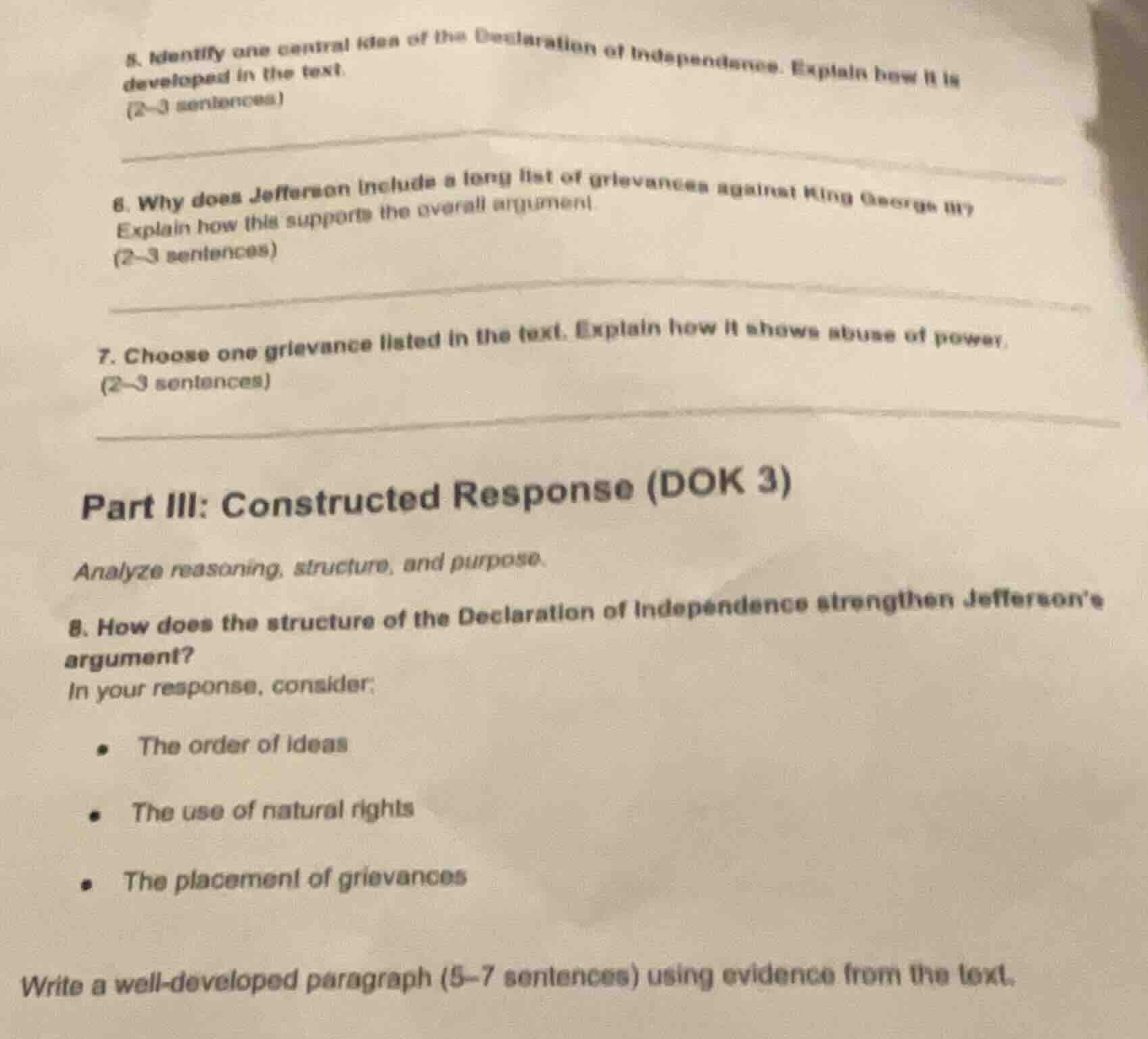
- identify one central idea of the declaration of independence. explain how it is developed in the text. (2–3 sentences)
- why does jefferson include a long list of grievances against king george iii? explain how this supports the overall argument. (2–3 sentences)
- choose one grievance listed in the text. explain how it shows abuse of power. (2–3 sentences)
part iii: constructed response (dok 3)
analyze reasoning, structure, and purpose.
- how does the structure of the declaration of independence strengthen jefferson’s argument?
in your response, consider:
- the order of ideas
- the use of natural rights
- the placement of grievances
write a well - developed paragraph (5–7 sentences) using evidence from the text.
For Question 5:
A central idea is the inalienable right to self-governance. Jefferson first establishes natural rights (life, liberty, pursuit of happiness) as the foundation, then argues that when a government violates these rights, the people have the right to abolish it and form a new one—using King George III's actions as proof of such violations to justify American independence.
For Question 6:
Jefferson includes the list to provide concrete, documented evidence that King George III had systematically violated the colonists' natural rights and self-governing liberties. This supports the overall argument by framing the colonists' push for independence not as a reckless rebellion, but as a necessary, justified response to repeated, unaddressed abuses of power.
For Question 7:
One grievance is King George III dissolving colonial legislatures, which were the colonists' elected bodies for local governance. This is an abuse of power because it stripped colonists of their right to make laws for their own communities, forcing them to submit to unaccountable, distant British rule that ignored their needs and interests.
For Question 8:
The Declaration’s structure builds a logically unassailable argument by moving from foundational principles to concrete proof, then to a definitive conclusion. It opens with the assertion of natural rights ("all men are created equal... endowed by their Creator with certain unalienable Rights"), establishing a moral framework that defines legitimate governance as protecting these rights. Next, it lists dozens of grievances against King George III—such as dissolving colonial assemblies, imposing unfair taxes without consent, and quartering troops in private homes—placed strategically after the natural rights thesis to show that the British government had systematically violated the very principles it was supposed to uphold. This order of ideas first convinces readers of the moral standard for good governance, then proves that Britain failed to meet that standard, making the colonists' decision to declare independence a logical, justified step rather than an act of defiance. By grounding the argument in universal natural rights, Jefferson frames the colonists' cause as a defense of fundamental human freedoms, not just local interests, and the placement of grievances provides irrefutable, specific evidence to back up the core claim that independence is necessary to protect their inalienable rights.

Snap & solve any problem in the app
Get step-by-step solutions on Sovi AI
Photo-based solutions with guided steps
Explore more problems and detailed explanations
- Question 5: A central idea is the right to self-governance when a government violates natural rights. Jefferson first lays out natural rights as a moral foundation, then cites King George III's abuses to argue the colonists are justified in forming their own independent government.
- Question 6: Jefferson includes the list to provide concrete evidence of King George III's repeated violations of colonists' rights. This supports the argument by framing independence as a necessary, justified response to unaccountable tyranny, not an unjust rebellion.
- Question 7: The grievance of dissolving colonial legislatures is an abuse of power. It stripped colonists of their right to elect representatives to make local laws, forcing them to obey distant, unaccountable British rule that ignored their needs.
- Question 8: The Declaration’s structure strengthens Jefferson’s argument by building from moral principles to concrete proof. It opens with the universal natural rights thesis ("all men are created equal... with unalienable Rights") to set a standard for legitimate governance, then places the long list of grievances against King George III—such as dissolving colonial assemblies and imposing taxes without consent—directly after this framework to prove Britain systematically violated that standard. This order first persuades readers of the moral basis for just rule, then uses specific, documented abuses to show the British government failed to uphold its obligations, making independence a logical, justified step. By grounding the argument in natural rights, Jefferson frames the colonists' cause as a defense of fundamental human freedoms, not just local interests, and the strategic placement of grievances provides irrefutable evidence that independence was the only way to protect their inalienable rights.