QUESTION IMAGE
Question
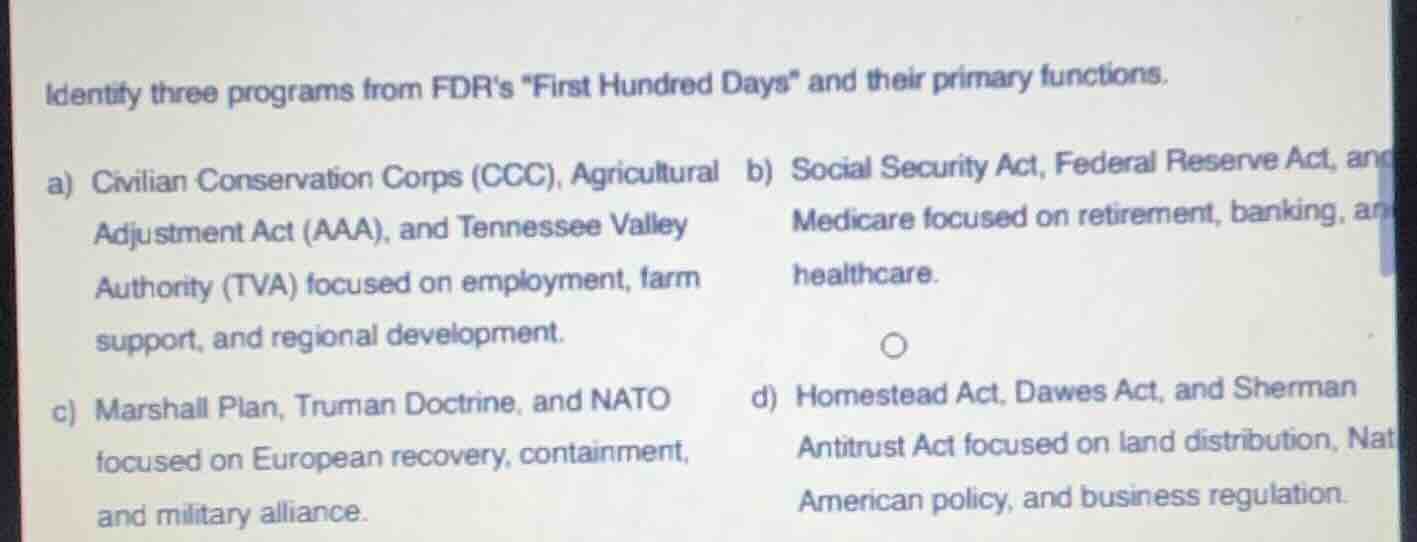
identify three programs from fdrs \first hundred days\ and their primary functions.
a) civilian conservation corps (ccc), agricultural adjustment act (aaa), and tennessee valley authority (tva) focused on employment, farm support, and regional development.
b) social security act, federal reserve act, and medicare focused on retirement, banking, and healthcare.
c) marshall plan, truman doctrine, and nato focused on european recovery, containment, and military alliance.
d) homestead act, dawes act, and sherman antitrust act focused on land distribution, nat american policy, and business regulation.
To solve this, we analyze each option:
- Option a: The Civilian Conservation Corps (CCC) provided employment (especially for young men in conservation work), the Agricultural Adjustment Act (AAA) aimed to support farms by reducing surplus and raising prices, and the Tennessee Valley Authority (TVA) focused on regional development (like electricity, jobs) in the Tennessee Valley. These were all part of FDR's New Deal during the First Hundred Days (or early New Deal).
- Option b: Social Security Act and Medicare (Medicare was part of LBJ's Great Society, not FDR's First Hundred Days; Federal Reserve Act was 1913, not New Deal). So incorrect.
- Option c: Marshall Plan, Truman Doctrine, NATO are post - WWII (Truman, Eisenhower era), not FDR's time. Incorrect.
- Option d: Homestead Act (1862), Dawes Act (1887), Sherman Antitrust Act (1890) are all pre - FDR. Incorrect.

Snap & solve any problem in the app
Get step-by-step solutions on Sovi AI
Photo-based solutions with guided steps
Explore more problems and detailed explanations
a) Civilian Conservation Corps (CCC), Agricultural Adjustment Act (AAA), and Tennessee Valley Authority (TVA) focused on employment, farm support, and regional development.