QUESTION IMAGE
Question
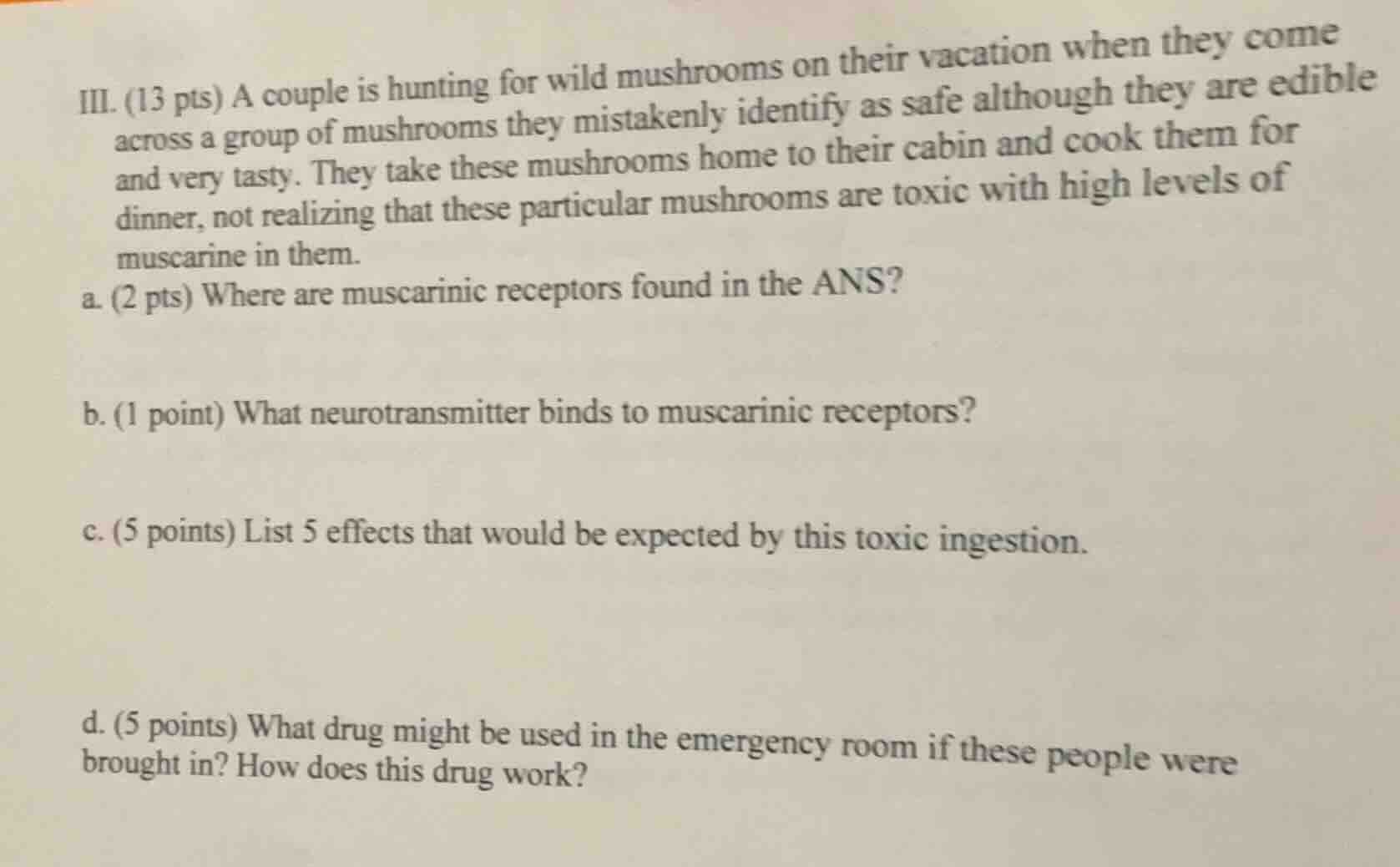
iii. (13 pts) a couple is hunting for wild mushrooms on their vacation when they come across a group of mushrooms they mistakenly identify as safe although they are edible and very tasty. they take these mushrooms home to their cabin and cook them for dinner, not realizing that these particular mushrooms are toxic with high levels of muscarine in them.
a. (2 pts) where are muscarinic receptors found in the ans?
b. (1 point) what neurotransmitter binds to muscarinic receptors?
c. (5 points) list 5 effects that would be expected by this toxic ingestion.
d. (5 points) what drug might be used in the emergency room if these people were brought in? how does this drug work?
Part a
Muscarinic receptors in the Autonomic Nervous System (ANS) are found in the postganglionic parasympathetic target organs (smooth muscles, cardiac muscle, glands) and also on sweat glands (which are innervated by sympathetic cholinergic fibers) and some blood vessels (for vasodilation via parasympathetic or non - adrenergic, non - cholinergic mechanisms).
Muscarinic receptors are cholinergic receptors, and the neurotransmitter that binds to them is acetylcholine (ACh). Acetylcholine is released by pre - ganglionic neurons of both sympathetic and parasympathetic systems, and by post - ganglionic parasympathetic neurons, and it acts on muscarinic receptors at the target organs.
Ingestion of muscarine - containing toxic mushrooms activates muscarinic receptors. Some common effects include: 1. Bradycardia: Muscarinic receptors on the heart (M₂ receptors) cause a decrease in heart rate when activated. 2. Increased salivation: Muscarinic receptors in salivary glands stimulate salivary secretion. 3. Bronchoconstriction: Muscarinic receptors in bronchial smooth muscle cause the smooth muscle to contract, leading to narrowed airways. 4. Increased gastrointestinal motility: Muscarinic receptors in the gut stimulate peristalsis, leading to increased bowel movements. 5. Miosis: Muscarinic receptors in the iris constrictor muscle cause the pupil to constrict.

Snap & solve any problem in the app
Get step-by-step solutions on Sovi AI
Photo-based solutions with guided steps
Explore more problems and detailed explanations
Muscarinic receptors in the ANS are found on the effector cells (smooth muscle, cardiac muscle, glands) of the parasympathetic nervous system's post - ganglionic targets, as well as on sweat glands (innervated by sympathetic cholinergic fibers) and some blood vessel endothelial cells.