QUESTION IMAGE
Question
iii. $int_{1}^{7} f(x) dx = 14$
find $f(x)$. show your work.
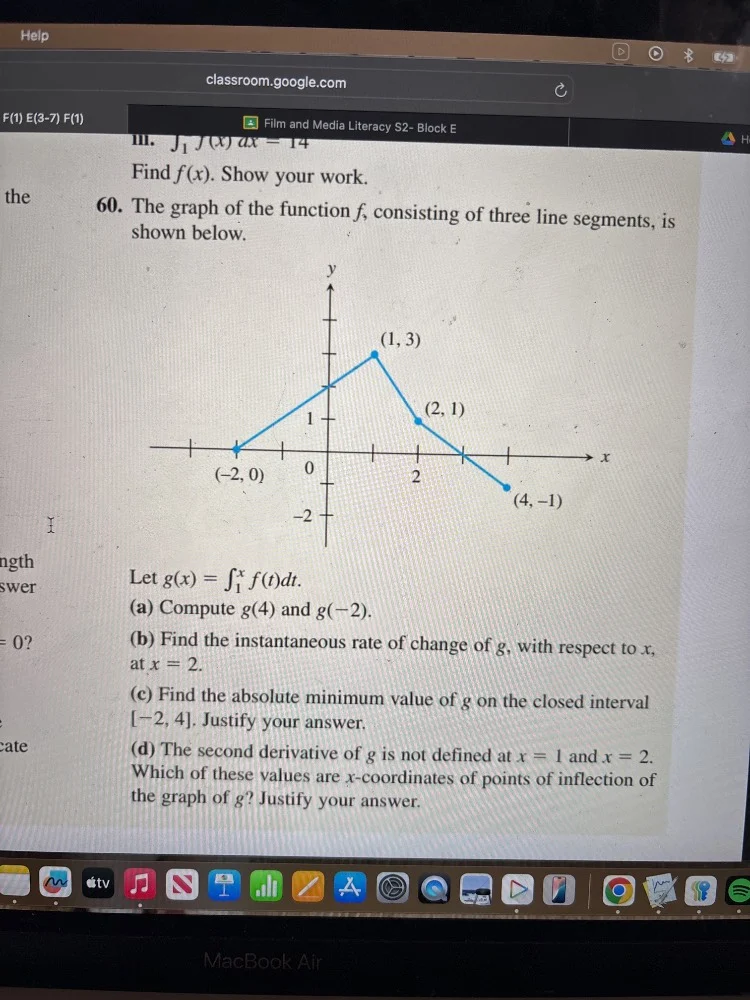
- the graph of the function $f$, consisting of three line segments, is shown below.
let $g(x) = \int_{1}^{x} f(t)dt$.
(a) compute $g(4)$ and $g(-2)$.
(b) find the instantaneous rate of change of $g$, with respect to $x$, at $x = 2$.
(c) find the absolute minimum value of $g$ on the closed interval $-2, 4$. justify your answer.
(d) the second derivative of $g$ is not defined at $x = 1$ and $x = 2$. which of these values are $x$-coordinates of points of inflection of the graph of $g$? justify your answer.
Part (a): Compute $g(4)$ and $g(-2)$
Recall that $g(x) = \int_{1}^{x} f(t)dt$, which represents the net signed area between $f(t)$ and the $t$-axis from $t=1$ to $t=x$.
Step1: Calculate $g(4)$
$g(4) = \int_{1}^{4} f(t)dt$. This is the sum of the area of the triangle from $(1,3)$ to $(2,1)$ and the area of the triangle from $(2,1)$ to $(4,-1)$.
First triangle area: $\frac{1}{2} \times 1 \times 2 = 1$
Second triangle area (negative, since below axis): $\frac{1}{2} \times 2 \times (-2) = -2$
Expression: $g(4) = 1 + (-2) = -1$
Step2: Calculate $g(-2)$
$g(-2) = \int_{1}^{-2} f(t)dt = -\int_{-2}^{1} f(t)dt$. The integral $\int_{-2}^{1} f(t)dt$ is the area of the triangle from $(-2,0)$ to $(1,3)$.
Triangle area: $\frac{1}{2} \times 3 \times 3 = \frac{9}{2}$
Expression: $g(-2) = -\frac{9}{2}$
---
Part (b): Instantaneous rate at $x=2$
The instantaneous rate of change of $g(x)$ is $g'(x) = f(x)$ (by the Fundamental Theorem of Calculus).
Step1: Evaluate $f(2)$
From the graph, $f(2) = 1$.
Expression: $g'(2) = f(2) = 1$
---
Part (c): Absolute minimum of $g$ on $[-2,4]$
Step1: Find critical points
Critical points occur where $g'(x)=f(x)=0$ or $g'(x)$ is undefined. From the graph, $f(x)=0$ at $x=-2$ and $x=3$ (intersection of the line from $(2,1)$ to $(4,-1)$ with the $x$-axis).
Step2: Evaluate $g(x)$ at key points
- $g(-2) = -\frac{9}{2} = -4.5$
- $g(1) = \int_{1}^{1} f(t)dt = 0$
- $g(3)$: $\int_{1}^{3} f(t)dt = \int_{1}^{2}f(t)dt + \int_{2}^{3}f(t)dt = 1 + \frac{1}{2} \times 1 \times (-1) = \frac{1}{2}$
- $g(4) = -1$
Step3: Compare values
The smallest value is $-4.5$.
---
Part (d): Points of inflection of $g$
A point of inflection occurs where $g''(x)$ changes sign. $g''(x)$ is the derivative of $f(x)$ (slope of $f(x)$).
Step1: Analyze slope at $x=1$
Left of $x=1$, slope of $f(x)$ is $\frac{3-0}{1-(-2)} = 1$. Right of $x=1$, slope is $\frac{1-3}{2-1} = -2$. The slope changes from positive to negative, so $g''(x)$ changes sign.
Step2: Analyze slope at $x=2$
Left of $x=2$, slope of $f(x)$ is $-2$. Right of $x=2$, slope is $\frac{-1-1}{4-2} = -1$. The slope stays negative, so $g''(x)$ does not change sign.

Snap & solve any problem in the app
Get step-by-step solutions on Sovi AI
Photo-based solutions with guided steps
Explore more problems and detailed explanations
(a) $g(4) = -1$, $g(-2) = -\frac{9}{2}$
(b) $1$
(c) The absolute minimum value is $-\frac{9}{2}$, since it is the smallest value of $g(x)$ evaluated at critical points and endpoints of $[-2,4]$.
(d) The $x$-coordinate $x=1$ is a point of inflection, because the slope of $f(x)$ (which is $g''(x)$) changes sign at $x=1$, while it does not change sign at $x=2$.