QUESTION IMAGE
Question
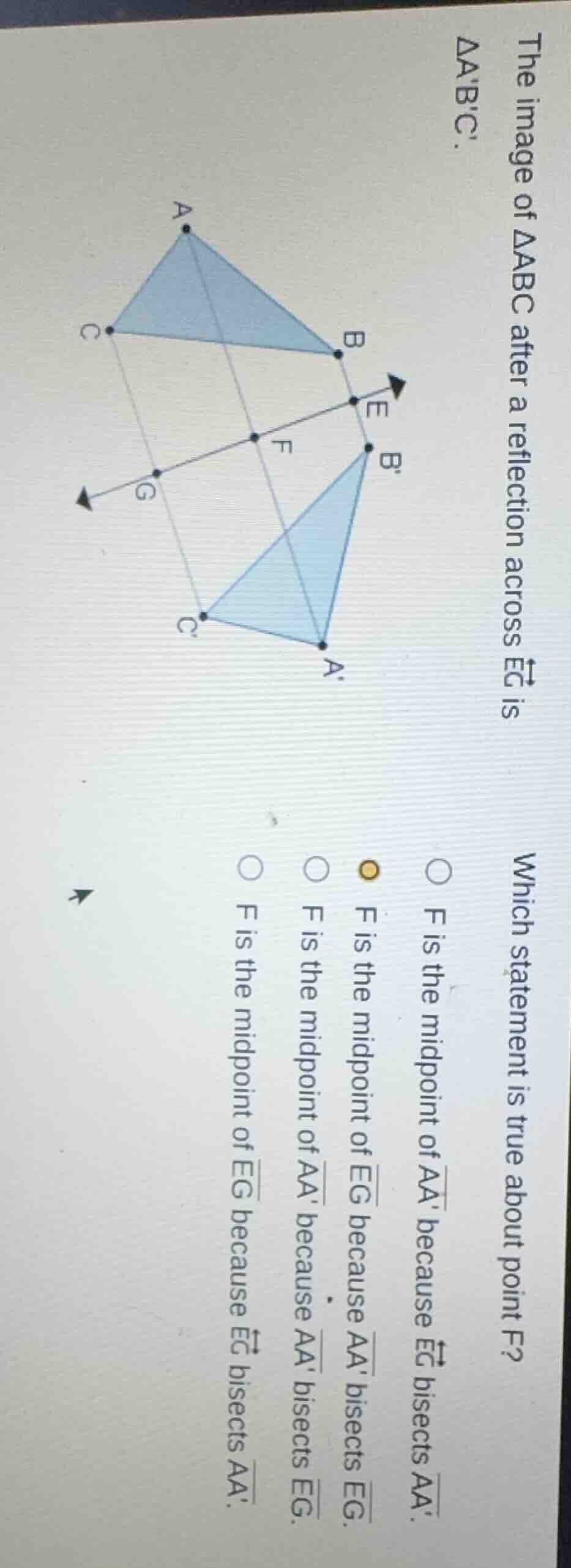
the image of $\triangle abc$ after a reflection across $\overleftrightarrow{ec}$ is $\triangle abc$. which statement is true about point $f$? \bigcirc f is the midpoint of $\overline{aa}$ because $\overleftrightarrow{ec}$ bisects $\overline{aa}$. \bigcirc f is the midpoint of $\overline{eg}$ because $\overline{aa}$ bisects $\overline{eg}$. \bigcirc f is the midpoint of $\overline{aa}$ because $\overline{aa}$ bisects $\overleftrightarrow{eg}$. \bigcirc f is the midpoint of $\overline{eg}$ because $\overleftrightarrow{ec}$ bisects $\overline{aa}$.
When a figure is reflected over a line (here, \(\overleftrightarrow{EG}\) or \(\overleftrightarrow{EC}\) – likely a typo, should be \(\overleftrightarrow{EG}\) or the reflection line), the reflection line is the perpendicular bisector of the segment joining a point and its image (like \(AA'\)). Also, for the line of reflection, it bisects segments connecting corresponding points or is the midline for related segments.
In a reflection, the line of reflection (\(\overleftrightarrow{EG}\) here) bisects the segment joining a pre - image point and its image (e.g., \(AA'\)). So, point \(F\) lies on \(\overleftrightarrow{EG}\) (the reflection line) and on \(AA'\). By the property of reflection, the reflection line bisects the segment joining a point and its image. So, \(F\) is the midpoint of \(AA'\) because \(\overleftrightarrow{EG}\) (the reflection line) bisects \(AA'\). Wait, no – let's re - examine. Wait, the reflection is across \(\overleftrightarrow{EG}\) (assuming the notation \(\overleftrightarrow{EC}\) is a typo, likely \(\overleftrightarrow{EG}\)). When you reflect \(\triangle ABC\) to \(\triangle A'B'C'\), the line of reflection (\(\overleftrightarrow{EG}\)) is the set of points equidistant from a point and its image. So, for point \(A\) and its image \(A'\), the line of reflection (\(\overleftrightarrow{EG}\)) bisects \(AA'\), meaning \(F\) (the intersection of \(AA'\) and \(\overleftrightarrow{EG}\)) is the midpoint of \(AA'\) because \(\overleftrightarrow{EG}\) (the reflection line) bisects \(AA'\). Wait, no, the correct reasoning: In a reflection, the line of reflection is the perpendicular bisector of the segment joining any point and its image. So, if we have point \(A\) and its image \(A'\), then the line of reflection (\(\overleftrightarrow{EG}\)) intersects \(AA'\) at its midpoint. So \(F\) is the midpoint of \(AA'\) because \(\overleftrightarrow{EG}\) (the reflection line) bisects \(AA'\). Wait, but let's check the options. The correct option should be: "F is the midpoint of \(AA'\) because \(\overleftrightarrow{EG}\) bisects \(AA'\)"? Wait, no, looking at the options:
Option 1: F is the midpoint of \(AA'\) because \(\overleftrightarrow{EC}\) bisects \(AA'\) – but \(\overleftrightarrow{EC}\) doesn't seem to be the reflection line.
Option 2: F is the midpoint of \(AA'\) because \(AA'\) bisects \(\overline{EG}\) – no, \(AA'\) is a segment from pre - image to image, it doesn't bisect \(\overline{EG}\) (the reflection line is a line, not a segment, but if \(\overline{EG}\) is a segment on the reflection line, \(AA'\) intersects it at \(F\), and by reflection, \(F\) is midpoint of \(AA'\) and midpoint of \(\overline{EG}\)? Wait, no. Wait, the reflection line is a line, so \(\overleftrightarrow{EG}\) is the reflection line. Then, for the reflection line, any segment on the reflection line (like \(\overline{EG}\)) – but actually, the key is that the reflection line bisects the segment joining a point and its image (\(AA'\)). So \(F\) is on \(\overleftrightarrow{EG}\) and on \(AA'\), so \(F\) is the midpoint of \(AA'\) because \(\overleftrightarrow{EG}\) (the reflection line) bisects \(AA'\). Wait, but the options: Let's list the options again (from the image description):
- F is the midpoint of \(AA'\) because \(\overleftrightarrow{EC}\) bisects \(AA'\)
- F is the midpoint of \(AA'\) because \(AA'\) bisects \(\overline{EG}\)
- F is the midpoint of \(\overline{EG}\) because \(AA'\) bisects \(\overline{EG}\)
- F is the midpoint of \(\overline{EG}\) because \(\overleftrightarrow{EC}\) bisects \(AA'\)
Wait, maybe the…

Snap & solve any problem in the app
Get step-by-step solutions on Sovi AI
Photo-based solutions with guided steps
Explore more problems and detailed explanations
The correct option (assuming the notation and options are as per the problem's intended meaning, after correcting for possible typos) is the one stating: "F is the midpoint of \(\overline{AA'}\) because \(\overleftrightarrow{EG}\) (or the reflection line, possibly mis - notated as \(\overleftrightarrow{EC}\)) bisects \(\overline{AA'}\)". If we take the options as given (with possible typo in the line notation), the correct option is the one where \(F\) is the midpoint of \(AA'\) because the reflection line bisects \(AA'\). For example, if the option is "F is the midpoint of \(\overline{AA'}\) because \(\overleftrightarrow{EG}\) bisects \(\overline{AA'}\)" (or the corresponding option with the correct line and segment), that is the correct answer.
(Note: If we strictly follow the options as presented in the problem (with possible typographical errors in the line notation), and based on reflection properties, the correct answer is the option where \(F\) is the midpoint of \(AA'\) because the reflection line (the line of reflection, which should bisect \(AA'\)) passes through \(F\) and thus \(F\) is the midpoint of \(AA'\) due to the reflection line bisecting \(AA'\).)