QUESTION IMAGE
Question
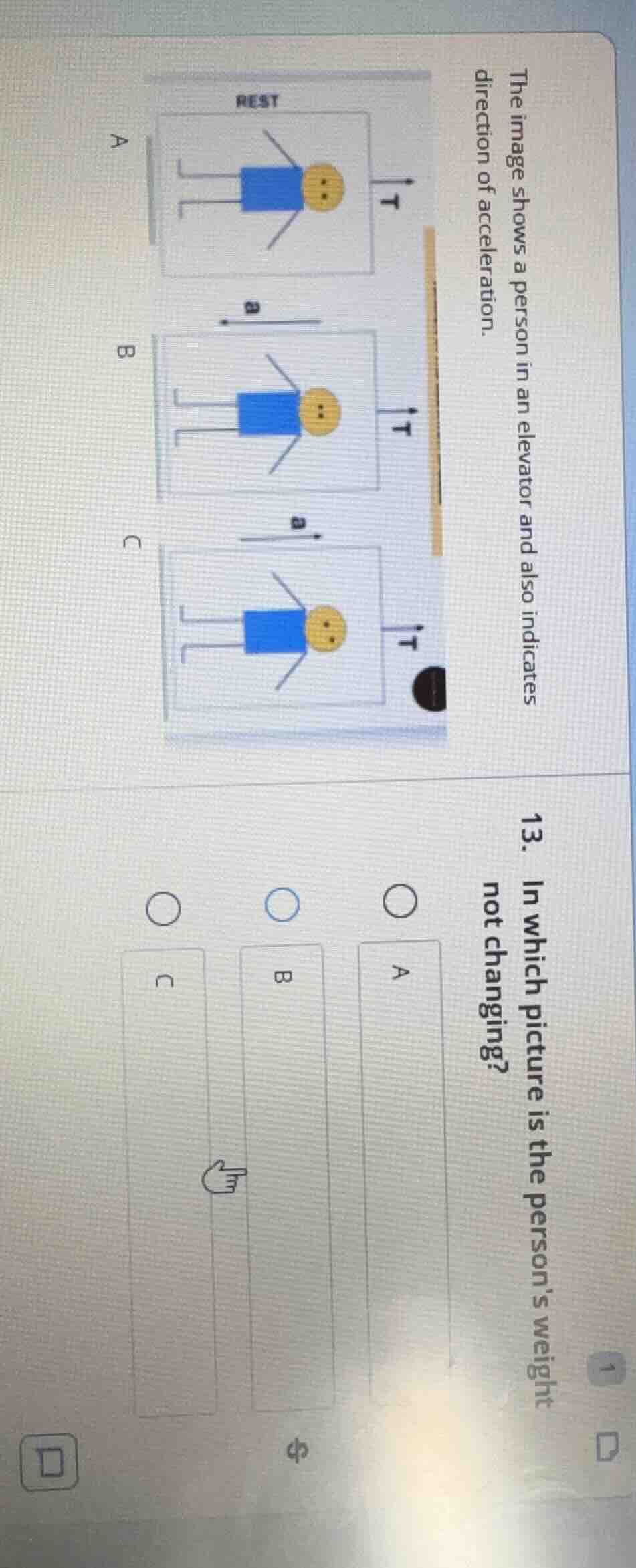
the image shows a person in an elevator and also indicates direction of acceleration.
- in which picture is the persons weight not changing?
a
b
c
Step1: Recall Weight in Elevator Concepts
Weight (apparent weight) in an elevator is related to the normal force \( T \) (or tension here, representing the force from the elevator floor). When acceleration \( a = 0 \) (no acceleration, rest or constant velocity), the normal force \( T = mg \) (true weight, so weight doesn't change). When there's acceleration (either upward or downward), \( T \) changes (apparent weight changes).
Step2: Analyze Each Option
- Option A: The elevator is at rest (labeled "REST"), so acceleration \( a = 0 \). By Newton's second law, \( T - mg = ma = 0 \), so \( T = mg \). Apparent weight (what the person feels, related to \( T \)) equals true weight, so weight doesn't change.
- Option B: There's a leftward acceleration (but vertical acceleration? Wait, no—wait, the elevator's vertical motion? Wait, maybe the diagram's \( a \) is vertical? Wait, no, the labels: in elevator problems, acceleration is usually vertical (up/down). Wait, maybe the diagram's \( a \) direction: if \( a \) is horizontal, but weight is vertical. Wait, no—probably a typo, and \( a \) is vertical. Wait, no, the key is: when acceleration is zero (rest or constant speed), weight (apparent) is same as true weight. In A, it's at rest (so \( a = 0 \)). In B and C, there's acceleration (so \( T \) changes, apparent weight changes).

Snap & solve any problem in the app
Get step-by-step solutions on Sovi AI
Photo-based solutions with guided steps
Explore more problems and detailed explanations
A. REST (where the elevator is at rest, so acceleration \( a = 0 \), and the person's weight (apparent weight) does not change as the normal force equals the true weight \( mg \))