QUESTION IMAGE
Question
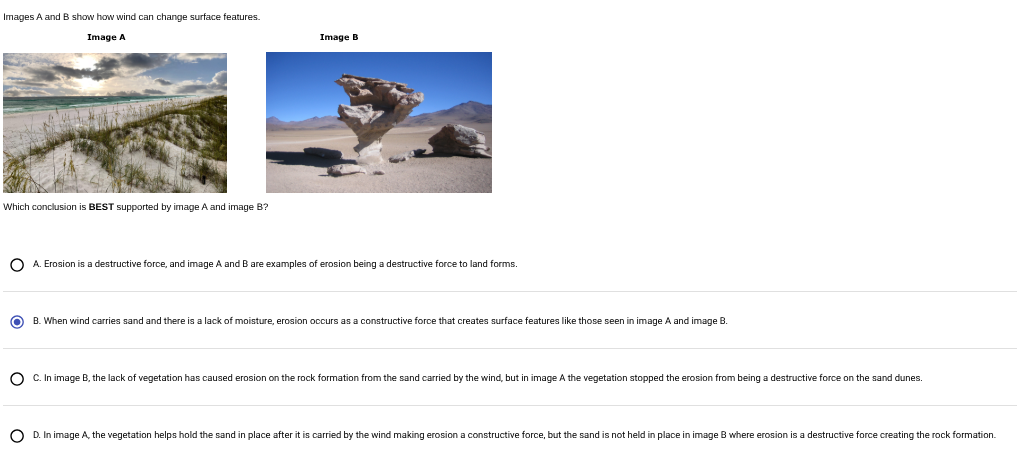
images a and b show how wind can change surface features.
which conclusion is best supported by image a and image b?
a. erosion is a destructive force, and image a and b are examples of erosion being a destructive force to land forms.
b. when wind carries sand and there is a lack of moisture, erosion occurs as a constructive force that creates surface features like those seen in image a and image b.
c. in image b, the lack of vegetation has caused erosion on the rock formation from the sand carried by the wind, but in image a the vegetation stopped the erosion from being a destructive force on the sand dunes.
d. in image a, the vegetation helps hold the sand in place after it is carried by the wind making erosion a constructive force, but the sand is not held in place in image b where erosion is a destructive force creating the rock formation.
- Analyze Option A: Image A shows sand dunes (constructive, as vegetation holds sand; not destructive). So A is wrong.
- Analyze Option B: Image A has vegetation - wind carrying sand with moisture? No, and constructive/destructive mix. B's logic is flawed.
- Analyze Option C: Image B: lack of veg → wind - carried sand erodes rock (destructive). Image A: veg stops erosion from destroying sand dunes (so erosion would be destructive without veg, but veg makes it constructive? No, C says "erosion being a destructive force" in A is stopped by veg. Wait, re - read: In B, lack of veg causes erosion (destructive on rock). In A, veg stops erosion from being destructive on sand dunes (so erosion would be destructive to sand dunes without veg, but veg makes it constructive). This matches: B's erosion is destructive (rock), A's veg prevents destructive erosion on sand dunes. But wait, let's check D.
- Analyze Option D: Image A: vegetation holds sand (erosion as constructive? No, erosion is usually considered destructive when it removes, constructive when it builds. Wait, when wind deposits sand (with veg holding it), that's deposition (constructive), but erosion is the transport. Wait, the option says "erosion a constructive force" in A. Erosion is transport, deposition is constructive. But the option's wording: "erosion a constructive force" (maybe using erosion - related processes). In B, sand not held, erosion (abrasion) is destructive (shapes rock). Let's re - evaluate the options with correct erosion concepts:
- Erosion: transport of sediment. Deposition: laying down (constructive). Abrasion: erosion - related destructive process (wearing down rocks).
- Image A: Sand dunes – wind transports sand, vegetation holds it (deposition/constructive, erosion (transport) leads to constructive feature here). Image B: Rock formation – wind - carried sand abrades rock (erosion as destructive, shaping rock).
- Option D: In A, vegetation holds sand after wind carries it (erosion (transport) leads to constructive feature). In B, sand not held, erosion (abrasion) is destructive (shapes rock). This matches the processes. Wait, earlier misanalysis. Let's re - check the options:
- Option D: "In image A, the vegetation helps hold the sand in place after it is carried by the wind making erosion a constructive force, but the sand is not held in place in image B where erosion is a destructive force creating the rock formation."
- Image A: Wind carries sand (erosion), vegetation holds it (so the erosion (transport) leads to a constructive feature (sand dunes)). Image B: No vegetation to hold sand, so wind - carried sand erodes (abrasion) the rock (destructive, shaping the rock formation). This is correct.
- Wait, earlier confusion with C. Let's re - read C: "In image B, the lack of vegetation has caused erosion on the rock formation from the sand carried by the wind, but in image A the vegetation stopped the erosion from being a destructive force on the sand dunes." So in B, erosion is destructive (rock), in A, veg stops erosion from being destructive (so erosion would be destructive to sand dunes without veg, but veg makes it not destructive). But D says in A, erosion is constructive, in B, destructive. Which is correct?
- Erosion is the process of moving sediment. When sediment is moved and then deposited (as in A, with veg holding it), the end result is a constructive feature (sand dunes). The erosion (movement) leads to a constructive outcome. In B, the movement of sand (erosion) is used to abrade the rock (destructive outcome). So D's des…

Snap & solve any problem in the app
Get step-by-step solutions on Sovi AI
Photo-based solutions with guided steps
Explore more problems and detailed explanations
D. In image A, the vegetation helps hold the sand in place after it is carried by the wind making erosion a constructive force, but the sand is not held in place in image B where erosion is a destructive force creating the rock formation.