QUESTION IMAGE
Question
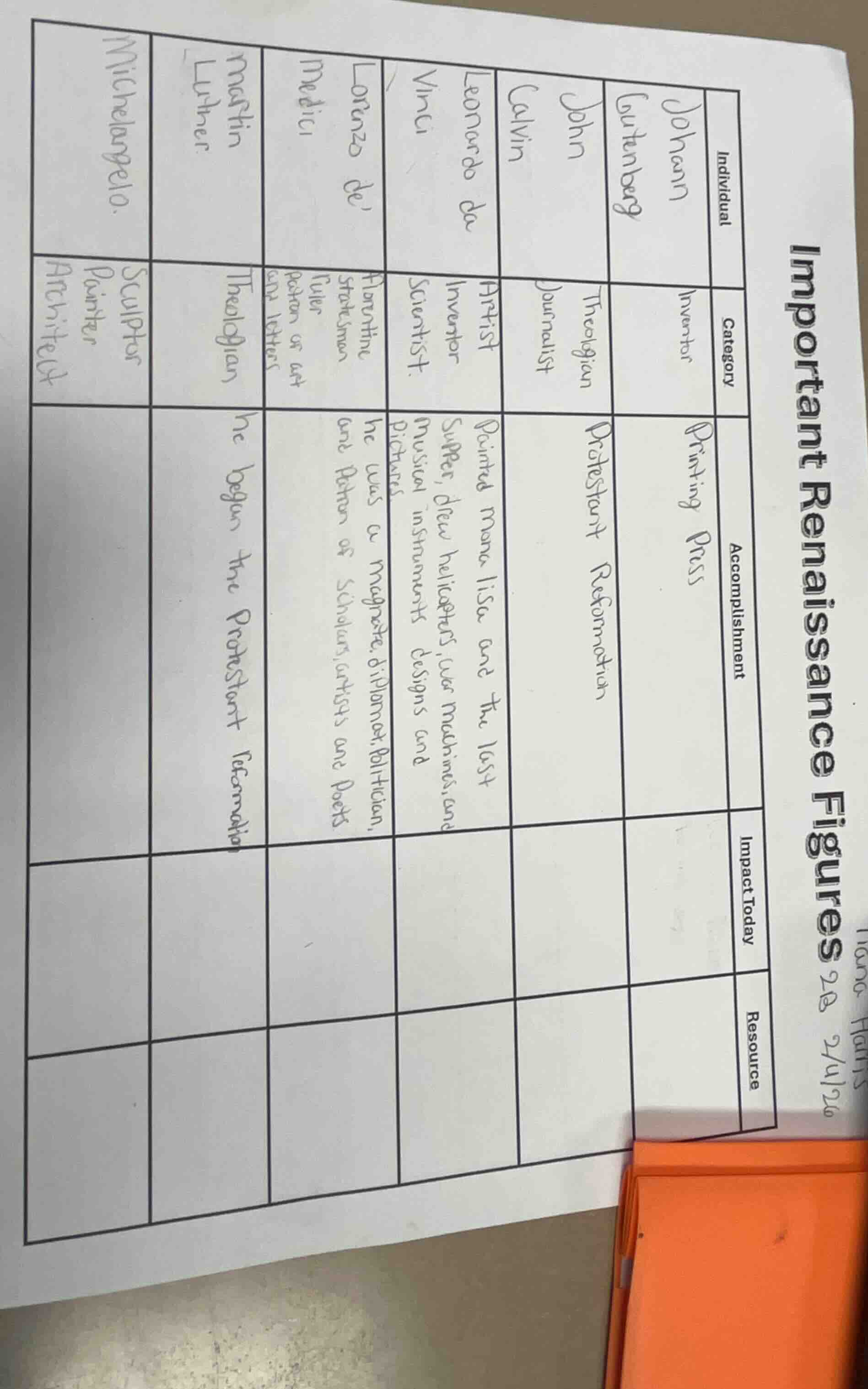
important renaissance figures 2a 24/26
individual\tcategory\taccomplishment\timpact today\tresource
johann gutenberg\tinventor\tprinting press\t\t
john calvin\ttheologian, journalist\tprotestant reformation\t\t
leonardo da vinci\tartist, inventor, scientist\tpainted mona lisa and the last supper, drew helicopters, war machines, and musical instruments, designs and pictures\t\t
lorenzo de’ medici\tflorentine statesman, ruler as art and letters\the was a magnate, diplomat, politician, and patron of scholars, artists and poets\t\t
martin luther\ttheologian\the began the protestant reformation\t\t
michelangelo\tsculptor, painter, architect\t\t
To complete the "Important Renaissance Figures" table, we analyze each figure's accomplishments and impacts:
1. Johann Gutenberg
- Accomplishment: Invented the printing press (movable-type printing), which revolutionized the spread of knowledge, literature, and ideas during the Renaissance and beyond.
- Impact Today: The printing press laid the foundation for modern publishing, education, and information dissemination. It enabled mass production of books, accelerating literacy, scientific progress, and cultural exchange.
- Resource: Historical records, textbooks on Renaissance technology, or articles on the history of printing.
2. John Calvin
- Accomplishment: A key leader of the Protestant Reformation, he developed Calvinism (a theological system emphasizing predestination, divine sovereignty, and the authority of Scripture). His work shaped Protestant theology and influenced religious, social, and political structures in Europe.
- Impact Today: Calvinism’s ideas continue to influence Protestant denominations, political philosophy (e.g., ideas about individualism and self-governance), and cultural norms in regions with Reformed traditions (e.g., parts of Europe, North America).
- Resource: Religious history texts, Calvin’s Institutes of the Christian Religion, or academic studies on the Reformation.
3. Leonardo da Vinci
- Accomplishment: A polymath (artist, inventor, scientist), he painted Mona Lisa and The Last Supper, designed flying machines (helicopters, gliders), studied anatomy, and created detailed scientific sketches. His work bridged art and science, embodying Renaissance humanism.
- Impact Today: His innovations in art (perspective, realism) and science (anatomy, engineering) inspire modern fields like art history, engineering, and design. His notebooks remain a source of inspiration for creativity and interdisciplinary thinking.
- Resource: Leonardo’s notebooks, art history books, or documentaries on Renaissance science.
4. Lorenzo de’ Medici
- Accomplishment: A wealthy Florentine patron of the arts and statesman, he supported artists (e.g., Michelangelo, Botticelli), scholars, and poets. His patronage fueled the Florentine Renaissance, making Florence a cultural hub.
- Impact Today: His support for the arts established the model of artistic patronage, influencing modern philanthropy and cultural institutions. The Medici legacy shaped Renaissance art, architecture, and literature.
- Resource: Biographies of the Medici family, books on Renaissance patronage, or studies of Florentine history.
5. Martin Luther
- Accomplishment: Initiated the Protestant Reformation with his 95 Theses (1517), challenging the Catholic Church’s practices (e.g., indulgences). His ideas led to the creation of Lutheranism and split Western Christianity.
- Impact Today: Luther’s Reformation reshaped Christianity, politics (e.g., the rise of nation-states), and education (emphasis on literacy for Bible study). Lutheran traditions persist globally, and his ideas influenced modern concepts of religious freedom.
- Resource: Luther’s 95 Theses, religious history texts, or studies on the Reformation’s political impact.
6. Michelangelo
- Accomplishment: A sculptor, painter, and architect, he created the David (sculpture), painted the Sistine Chapel ceiling, and designed St. Peter’s Basilica (Rome). His work exemplified Renaissance ideals of beauty, humanism, and technical mastery.
- Impact Today: His art rema…

Snap & solve any problem in the app
Get step-by-step solutions on Sovi AI
Photo-based solutions with guided steps
Explore more problems and detailed explanations
To complete the "Important Renaissance Figures" table, we analyze each figure's accomplishments and impacts:
1. Johann Gutenberg
- Accomplishment: Invented the printing press (movable-type printing), which revolutionized the spread of knowledge, literature, and ideas during the Renaissance and beyond.
- Impact Today: The printing press laid the foundation for modern publishing, education, and information dissemination. It enabled mass production of books, accelerating literacy, scientific progress, and cultural exchange.
- Resource: Historical records, textbooks on Renaissance technology, or articles on the history of printing.
2. John Calvin
- Accomplishment: A key leader of the Protestant Reformation, he developed Calvinism (a theological system emphasizing predestination, divine sovereignty, and the authority of Scripture). His work shaped Protestant theology and influenced religious, social, and political structures in Europe.
- Impact Today: Calvinism’s ideas continue to influence Protestant denominations, political philosophy (e.g., ideas about individualism and self-governance), and cultural norms in regions with Reformed traditions (e.g., parts of Europe, North America).
- Resource: Religious history texts, Calvin’s Institutes of the Christian Religion, or academic studies on the Reformation.
3. Leonardo da Vinci
- Accomplishment: A polymath (artist, inventor, scientist), he painted Mona Lisa and The Last Supper, designed flying machines (helicopters, gliders), studied anatomy, and created detailed scientific sketches. His work bridged art and science, embodying Renaissance humanism.
- Impact Today: His innovations in art (perspective, realism) and science (anatomy, engineering) inspire modern fields like art history, engineering, and design. His notebooks remain a source of inspiration for creativity and interdisciplinary thinking.
- Resource: Leonardo’s notebooks, art history books, or documentaries on Renaissance science.
4. Lorenzo de’ Medici
- Accomplishment: A wealthy Florentine patron of the arts and statesman, he supported artists (e.g., Michelangelo, Botticelli), scholars, and poets. His patronage fueled the Florentine Renaissance, making Florence a cultural hub.
- Impact Today: His support for the arts established the model of artistic patronage, influencing modern philanthropy and cultural institutions. The Medici legacy shaped Renaissance art, architecture, and literature.
- Resource: Biographies of the Medici family, books on Renaissance patronage, or studies of Florentine history.
5. Martin Luther
- Accomplishment: Initiated the Protestant Reformation with his 95 Theses (1517), challenging the Catholic Church’s practices (e.g., indulgences). His ideas led to the creation of Lutheranism and split Western Christianity.
- Impact Today: Luther’s Reformation reshaped Christianity, politics (e.g., the rise of nation-states), and education (emphasis on literacy for Bible study). Lutheran traditions persist globally, and his ideas influenced modern concepts of religious freedom.
- Resource: Luther’s 95 Theses, religious history texts, or studies on the Reformation’s political impact.
6. Michelangelo
- Accomplishment: A sculptor, painter, and architect, he created the David (sculpture), painted the Sistine Chapel ceiling, and designed St. Peter’s Basilica (Rome). His work exemplified Renaissance ideals of beauty, humanism, and technical mastery.
- Impact Today: His art remains a cornerstone of Western art history, influencing sculpture, painting, and architecture. His techniques (e.g., fresco, anatomical precision) are studied by artists and art historians worldwide.
- Resource: Art history textbooks, Michelangelo’s biographies, or visits to his works (e.g., Sistine Chapel, David).
Filling the Table (Example for One Row):
| Individual | Category | Accomplishment | Impact Today | Resource |
|---|---|---|---|---|
| John Calvin | Theologian | Led the Protestant Reformation; developed Calvinism | Influences Protestant theology, political philosophy, and cultural norms. | Institutes of the Christian Religion |
| Leonardo da Vinci | Artist/Inventor | Painted Mona Lisa, designed flying machines, studied anatomy | Inspires art, engineering, and interdisciplinary thinking. | Leonardo’s notebooks |
| Lorenzo de’ Medici | Statesman/Patron | Patron of arts; supported Michelangelo, Botticelli, scholars, and poets | Established artistic patronage; shaped Renaissance art/culture. | Medici family biographies |
| Martin Luther | Theologian | Initiated the Protestant Reformation with 95 Theses | Reshaped Christianity, politics, and education; influenced religious freedom. | 95 Theses (primary source) |
| Michelangelo | Sculptor/Artist | Created David, painted Sistine Chapel, designed St. Peter’s Basilica | Influences art history, sculpture, and architecture globally. | Art history textbooks |
Use this structure to complete the remaining rows, focusing on each figure’s unique contributions and their enduring influence.