QUESTION IMAGE
Question
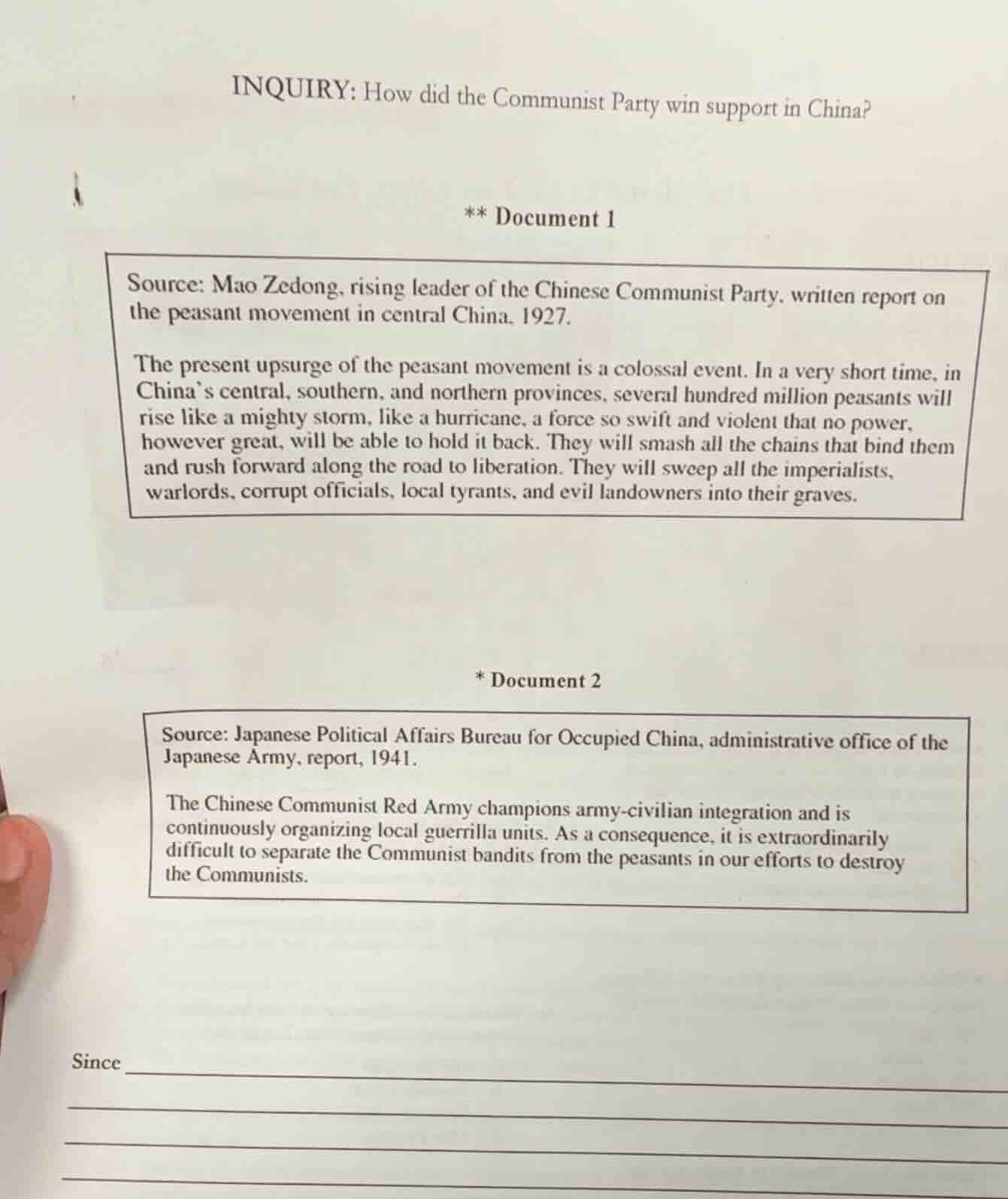
inquiry: how did the communist party win support in china?
** document 1
source: mao zedong, rising leader of the chinese communist party, written report on the peasant movement in central china, 1927.
the present upsurge of the peasant movement is a colossal event. in a very short time, in china’s central, southern, and northern provinces, several hundred million peasants will rise like a mighty storm, like a hurricane, a force so swift and violent that no power, however great, will be able to hold it back. they will smash all the chains that bind them and rush forward along the road to liberation. they will sweep all the imperialists, warlords, corrupt officials, local tyrants, and evil landowners into their graves.
- document 2
source: japanese political affairs bureau for occupied china, administrative office of the japanese army, report, 1941.
the chinese communist red army champions army - civilian integration and is continuously organizing local guerrilla units. as a consequence, it is extraordinarily difficult to separate the communist bandits from the peasants in our efforts to destroy the communists.
since
To answer how the Communist Party won support, we analyze the documents:
- Document 1 (1927, Mao's report) shows the Party aligned with peasants' desire to overthrow oppressors (imperialists, warlords, landlords), tapping into the massive peasant movement for liberation.
- Document 2 (1941, Japanese report) highlights the Party's army - civilian integration and guerrilla organization, which bonded the Red Army with peasants, making it hard for enemies to separate them. This integration (like land reforms, fighting Japanese invaders, and local governance) won peasant support as the Party fought for their interests and protected them.

Snap & solve any problem in the app
Get step-by-step solutions on Sovi AI
Photo-based solutions with guided steps
Explore more problems and detailed explanations
The Communist Party won support in China by: 1) Aligning with the peasant movement (per Document 1), championing peasants' fight against oppressors (imperialists, warlords, landlords) to gain liberation. 2) Promoting army - civilian integration (per Document 2), organizing guerrilla units and working with peasants, which bonded the Party/Red Army with peasants as the Party fought for their interests (e.g., against Japanese occupation, for land reform) and protected them, making peasants support the Party.