QUESTION IMAGE
Question
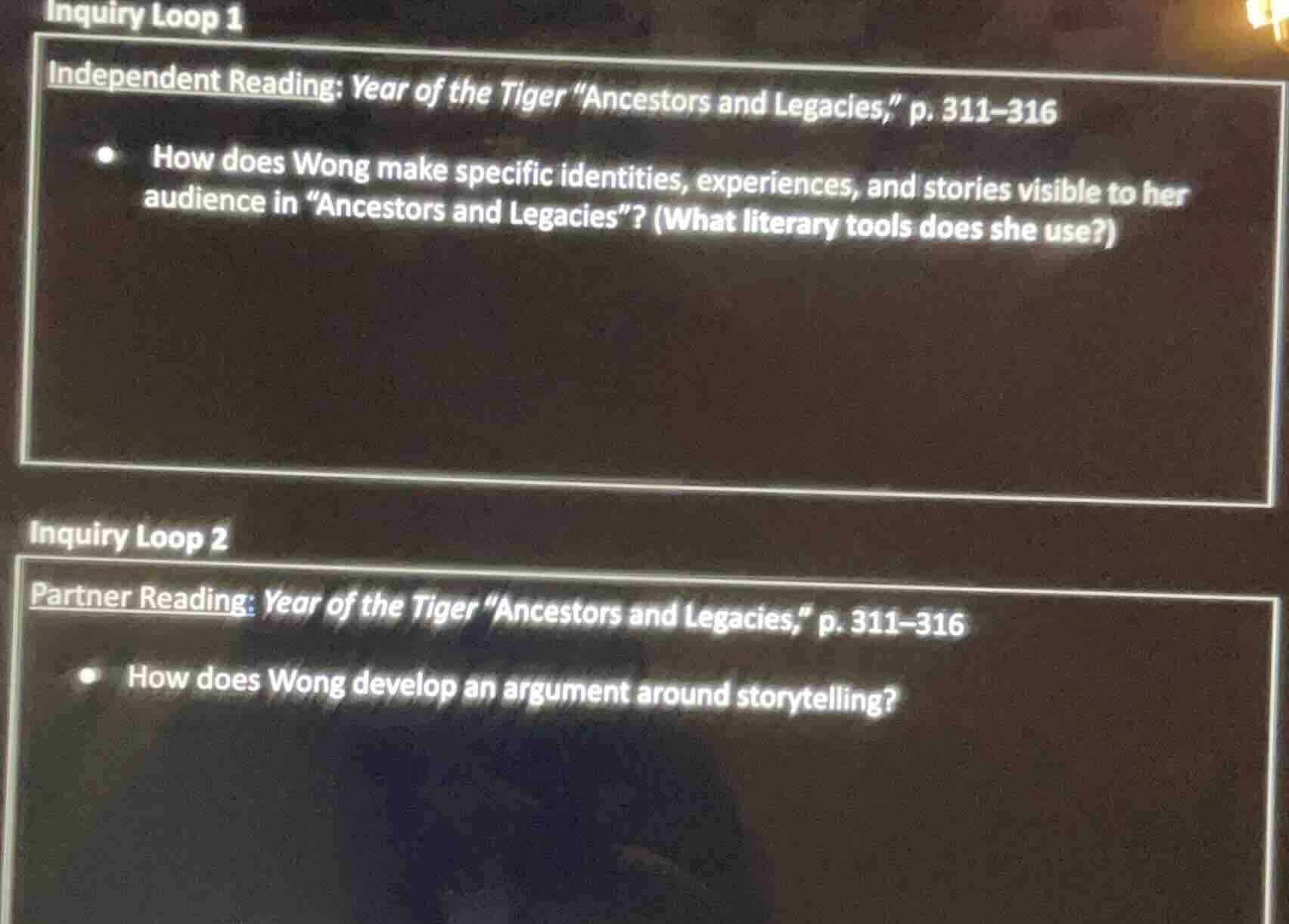
inquiry loop 1
independent reading: year of the tiger \ancestors and legacies,\ p. 311–316
- how does wong make specific identities, experiences, and stories visible to her audience in \ancestors and legacies\? (what literary tools does she use?)
inquiry loop 2
partner reading: year of the tiger \ancestors and legacies,\ p. 311–316
- how does wong develop an argument around storytelling?
Inquiry Loop 1
To answer how Wong makes identities, experiences, and stories visible, we analyze literary tools. She likely uses narrative techniques (e.g., personal anecdotes, vivid descriptions), characterization (developing specific ancestral figures), and symbolism (e.g., tiger imagery for heritage). Also, dialogue or cultural references (like Chinese traditions) to ground stories. Close reading of p. 311–316 reveals these tools: anecdotes humanize ancestors, descriptive language (sensory details) brings experiences to life, and symbolic elements (e.g., family heirlooms) link identities to legacies.
To determine how Wong develops an argument about storytelling, we examine her structure: she likely defines storytelling’s role (e.g., preserving heritage), provides examples (ancestral narratives), and analyzes impact (how stories shape identity/legacy). She may contrast personal storytelling with collective memory, or argue storytelling as a tool for cultural continuity. From p. 311–316, she might use her own family stories to show storytelling’s power to transmit history, connect generations, and affirm identity—structuring the argument with evidence (stories) and analysis (why storytelling matters for legacies).

Snap & solve any problem in the app
Get step-by-step solutions on Sovi AI
Photo-based solutions with guided steps
Explore more problems and detailed explanations
Wong uses literary tools like personal anecdotes (sharing ancestral stories), vivid descriptive language (sensory details to immerse readers in experiences), characterization (developing specific ancestral figures), and symbolism (e.g., cultural symbols/heritages) to make identities, experiences, and stories visible. For example, anecdotes humanize ancestors, descriptive language (e.g., of family rituals) immerses readers in cultural experiences, and symbolic elements (like heirlooms) tie identities to legacies.