QUESTION IMAGE
Question
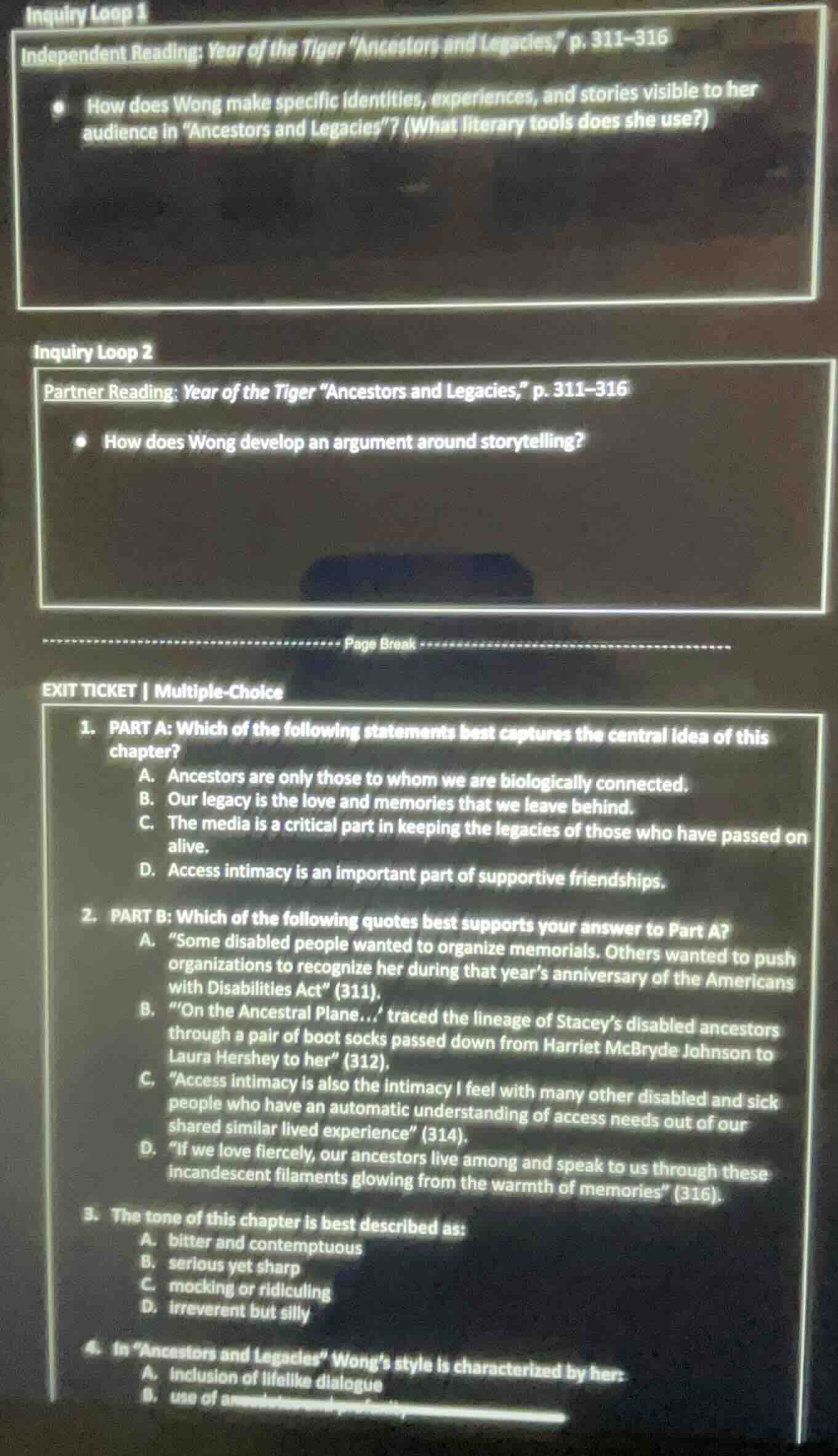
inquiry loop 1
independent reading: year of the tiger \ancestors and legacies,\ p. 311–316
- how does wong make specific identities, experiences, and stories visible to her audience in \ancestors and legacies\? (what literary tools does she use?)
inquiry loop 2
partner reading: year of the tiger \ancestors and legacies,\ p. 311–316
- how does wong develop an argument around storytelling?
page break
exit ticket | multiple - choice
- part a: which of the following statements best captures the central idea of this chapter?
a. ancestors are only those to whom we are biologically connected.
b. our legacy is the love and memories that we leave behind.
c. the media is a critical part in keeping the legacies of those who have passed on alive.
d. access intimacy is an important part of supportive friendships.
- part b: which of the following quotes best supports your answer to part a?
a. \some disabled people wanted to organize memorials. others wanted to push organizations to recognize her during that year’s anniversary of the americans with disabilities act\ (311).
b. \‘on the ancestral plane...’ traced the lineage of stacey’s disabled ancestors through a pair of boot socks passed down from harriet mcbryde johnson to laura hershey to her\ (312).
c. \access intimacy is also the intimacy i feel with many other disabled and sick people who have an automatic understanding of access needs out of our shared similar lived experience\ (314).
d. \if we love fiercely, our ancestors live among and speak to us through these incandescent filaments glowing from the warmth of memories\ (316).
- the tone of this chapter is best described as:
a. bitter and contemptuous
b. serious yet sharp
c. mocking or ridiculing
d. irreverent but silly
- in \ancestors and legacies\ wong’s style is characterized by her:
a. inclusion of lifelike dialogue
b. use of...
Question 1 (PART A)
- Option A is incorrect as the chapter likely expands the concept of ancestors beyond biological connections (e.g., through shared experiences or legacy).
- Option B aligns with the theme of legacy being about love and memories left behind, which fits with the "Ancestors and Legacies" focus on how legacies are carried through memories and connections.
- Option C is incorrect because the chapter’s central idea is not about media’s role in legacy.
- Option D is incorrect as access intimacy is a sub - topic, not the central idea of the chapter.
- Option A talks about memorials and the Americans with Disabilities Act, not directly about legacy as love and memories.
- Option B focuses on ancestral lineage through an object, not on the legacy of love and memories.
- Option C is about access intimacy, a different sub - topic.
- Option D ("If we love fiercely, our ancestors live among and speak to us through these incandescent filaments glowing from the warmth of memories") directly supports the idea that legacy is about love and memories, matching the central idea of Option B in PART A.
- Option A: The chapter does not have a bitter or contemptuous tone; it’s more reflective and serious.
- Option B: The chapter deals with serious themes of ancestry and legacy, and the writing can be sharp in its insights about these topics.
- Option C: There is no mocking or ridiculing tone in the chapter.
- Option D: The chapter is not irreverent or silly; it’s a serious exploration of ancestry and legacy.

Snap & solve any problem in the app
Get step-by-step solutions on Sovi AI
Photo-based solutions with guided steps
Explore more problems and detailed explanations
B. Our legacy is the love and memories that we leave behind.