QUESTION IMAGE
Question
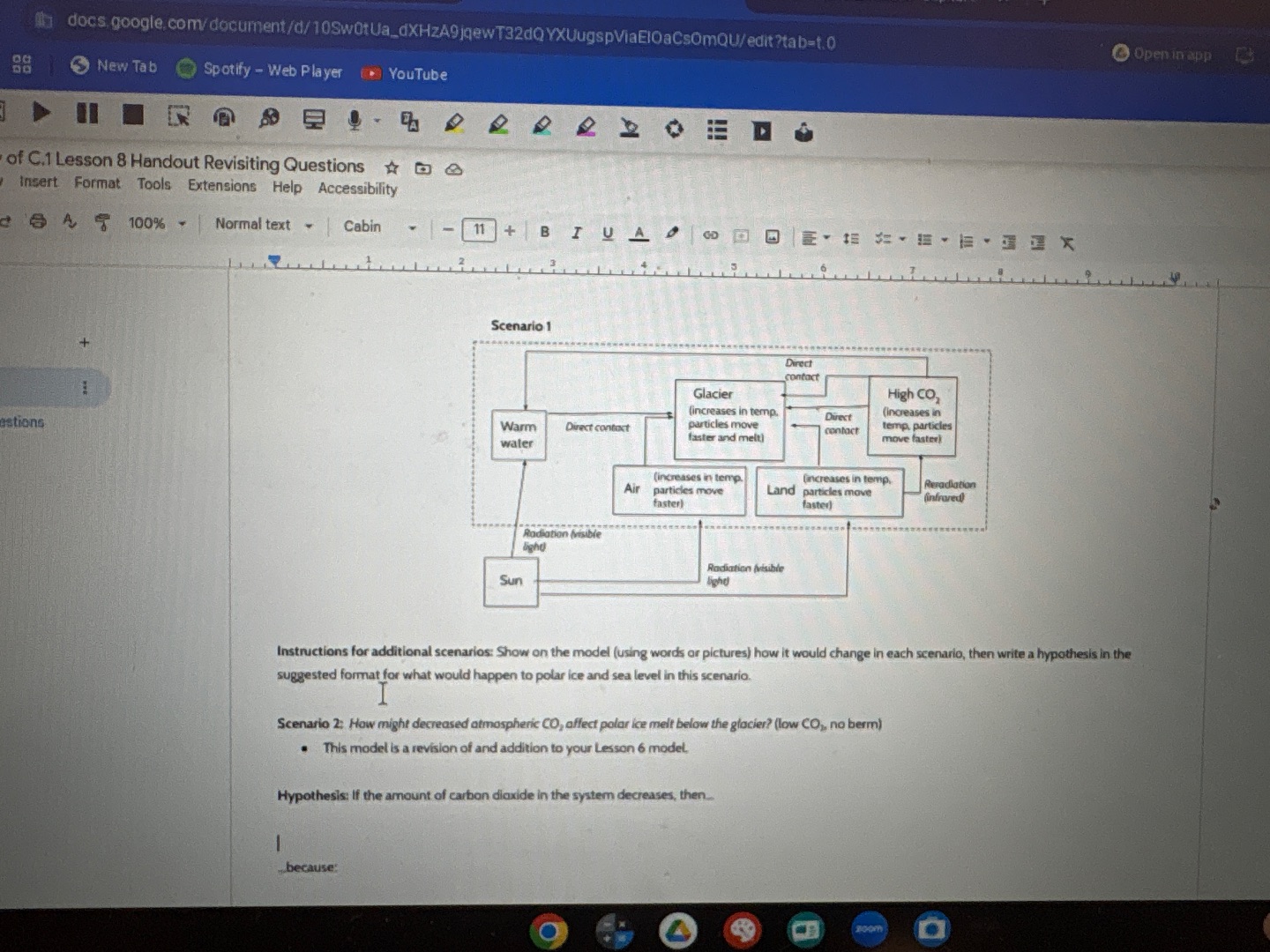
instructions for additional scenarios: show on the model (using words or pictures) how it would change in each scenario, then write a hypothesis in the suggested format for what would happen to polar ice and sea level in this scenario. scenario 2: how might decreased atmospheric co₂ affect polar ice melt below the glacier? (low co₂, no berm) - this model is a revision of and addition to your lesson 6 model. hypothesis: if the amount of carbon dioxide in the system decreases, then... because:
To answer this, we analyze the model. Decreased atmospheric \( \text{CO}_2 \) would lead to lower temperatures (since \( \text{CO}_2 \) is a greenhouse gas, less \( \text{CO}_2 \) means less heat retention). Lower temperatures mean particles (in air, land, etc.) move slower. For the glacier, slower - moving particles and lower temp would reduce melting. Less glacier melt means less water added to the ocean, so sea level change and polar ice melt are affected.
For the hypothesis: If the amount of carbon dioxide in the system decreases, then the rate of polar ice melt below the glacier will decrease and sea level rise will slow (or sea level may even stabilize/decrease slightly) because decreased \( \text{CO}_2 \) leads to lower temperatures (as \( \text{CO}_2 \) is a greenhouse gas that traps heat), which reduces the kinetic energy of particles in the glacier, air, and surrounding areas, thus slowing the melting process of the glacier. Less melted ice means less water is contributed to the ocean, so the rate of sea level increase (or sea level itself) is affected accordingly.

Snap & solve any problem in the app
Get step-by-step solutions on Sovi AI
Photo-based solutions with guided steps
Explore more problems and detailed explanations
If the amount of carbon dioxide in the system decreases, then the rate of polar ice melt below the glacier will decrease and the rate of sea - level rise will slow (or sea level may stabilize) because decreased \( \text{CO}_2 \) reduces the greenhouse effect, leading to lower temperatures, which slows the melting of the glacier as the kinetic energy of particles (in the glacier, air, land, etc.) decreases, and less melted ice contributes to the ocean, affecting sea - level change.