QUESTION IMAGE
Question
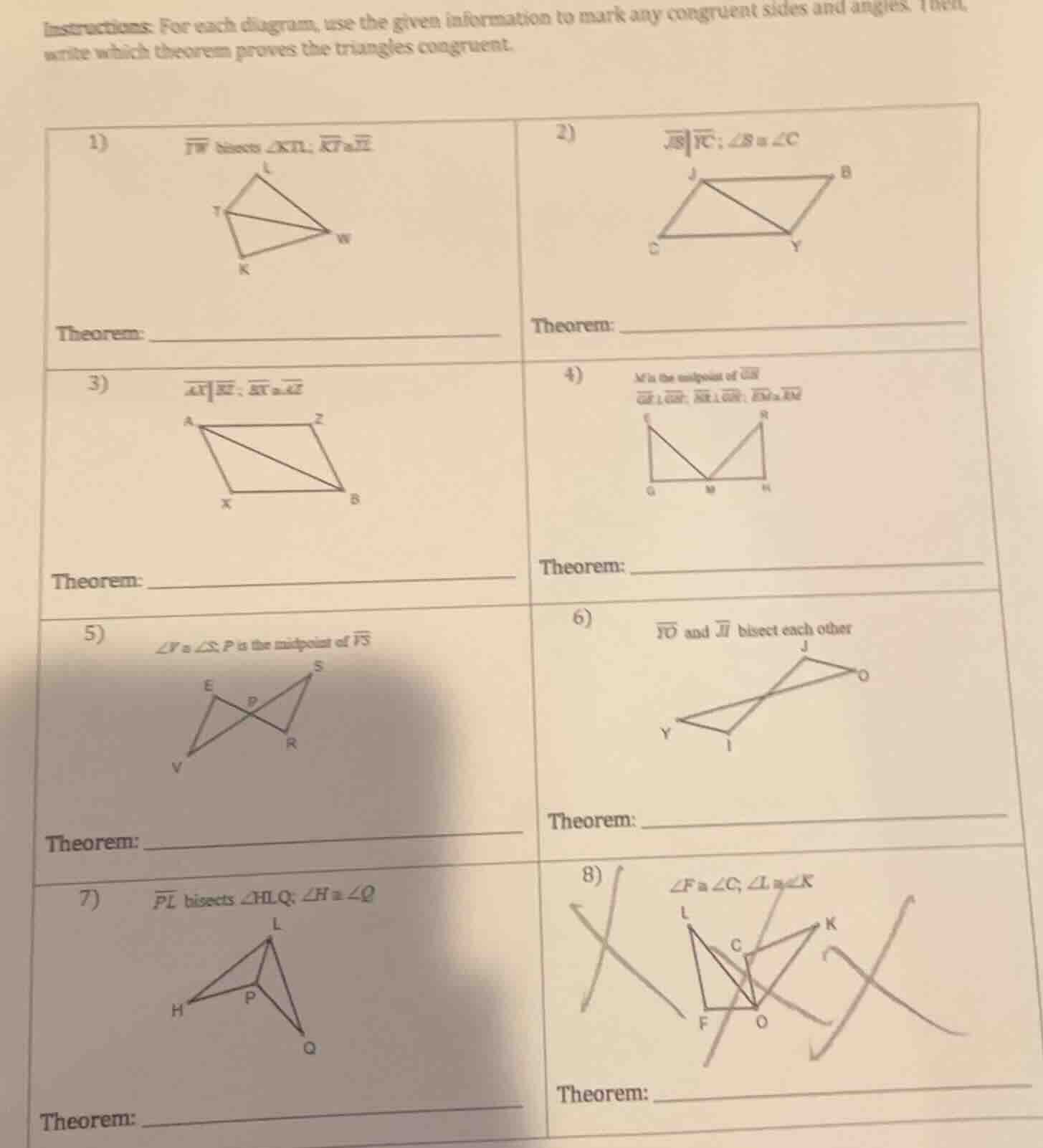
instructions: for each diagram, use the given information to mark any congruent sides and angles. then, write which theorem proves the triangles congruent.
- $overline{tw}$ bisects $\angle ktl$, $overline{kt} \cong overline{lt}$
theorem:
- $overline{jb} \parallel overline{yc}$; $\angle b \cong \angle c$
theorem:
- $overline{ax} \parallel overline{bz}$; $overline{ax} \cong overline{bz}$
theorem:
- $m$ is the midpoint of $overline{gh}$
$overline{cg} \perp overline{gh}$; $overline{nh} \perp overline{gh}$; $overline{gm} \cong overline{hm}$
theorem:
- $\angle v \cong \angle s$; $p$ is the midpoint of $overline{vs}$
theorem:
- $overline{yo}$ and $overline{ji}$ bisect each other
theorem:
- $overline{pl}$ bisects $\angle hlq$; $\angle h \cong \angle q$
theorem:
- $\angle f \cong \angle c$; $\angle l \cong \angle k$
theorem:
Step1: Analyze Problem 1
Given $\overline{TW}$ bisects $\angle KTL$, so $\angle KTW \cong \angle LTW$. We know $\overline{KT} \cong \overline{LT}$, and $\overline{TW} \cong \overline{TW}$ (reflexive property). This is two sides and included angle congruent.
Step2: Analyze Problem 2
$\overline{JB} \parallel \overline{YC}$, so alternate interior angles $\angle JBY \cong \angle CYB$. We have $\angle B \cong \angle C$, and $\overline{BY} \cong \overline{YB}$ (reflexive property). This is two angles and included side congruent.
Step3: Analyze Problem 3
$\overline{AX} \parallel \overline{BZ}$, so alternate interior angles $\angle XAB \cong \angle ZBA$. We know $\overline{AX} \cong \overline{BZ}$, and $\overline{AB} \cong \overline{BA}$ (reflexive property). This is two sides and included angle congruent.
Step4: Analyze Problem 4
$M$ is midpoint of $\overline{GH}$, so $\overline{GM} \cong \overline{MH}$. $\overline{EG} \perp \overline{GH}$, $\overline{RH} \perp \overline{GH}$, so $\angle G$ and $\angle H$ are right angles ($\angle G \cong \angle H$). We have $\overline{EM} \cong \overline{RM}$. This is hypotenuse-leg congruence for right triangles.
Step5: Analyze Problem 5
$P$ is midpoint of $\overline{VS}$, so $\overline{VP} \cong \overline{SP}$. We know $\angle V \cong \angle S$, and vertical angles $\angle VPE \cong \angle SPR$. This is two angles and non-included side congruent.
Step6: Analyze Problem 6
$\overline{YO}$ and $\overline{JI}$ bisect each other, so the segments created are congruent: $\overline{YP} \cong \overline{OP}$, $\overline{JP} \cong \overline{IP}$. Vertical angles $\angle JPO \cong \angle IPY$. This is two sides and included angle congruent.
Step7: Analyze Problem 7
$\overline{PL}$ bisects $\angle HLQ$, so $\angle HLP \cong \angle QLP$. We know $\angle H \cong \angle Q$, and $\overline{PL} \cong \overline{PL}$ (reflexive property). This is two angles and non-included side congruent.
Step8: Analyze Problem 8
We know $\angle F \cong \angle C$, $\angle L \cong \angle K$, and $\overline{LO} \cong \overline{KO}$? No, $\overline{FO} \cong \overline{CO}$? Wait, common side $\overline{O}$ is shared? No, $\angle FOL \cong \angle COK$ (vertical angles). With two angles and included side (the vertical angle side), this is two angles and included side congruent. Wait, no: given $\angle F \cong \angle C$, $\angle L \cong \angle K$, so the third angles are congruent, and the side between $\angle F$ & $\angle L$ and $\angle C$ & $\angle K$: $\overline{FL} \cong \overline{CK}$? No, actually, with two angles and a non-included side? No, the vertical angles $\angle FOL = \angle COK$, so we have ASA. Wait, no: $\angle F \cong \angle C$, $\overline{FO} \cong \overline{CO}$? No, the problem gives $\angle F \cong \angle C$, $\angle L \cong \angle K$, so it's AAS (two angles and a non-included side, since the side $\overline{LO} \cong \overline{KO}$ is not between the angles, but actually, the common vertex O gives vertical angles, so ASA is also possible, but AAS fits as we have two angles and a side not between them that is congruent.

Snap & solve any problem in the app
Get step-by-step solutions on Sovi AI
Photo-based solutions with guided steps
Explore more problems and detailed explanations
- Theorem: SAS (Side-Angle-Side)
- Theorem: ASA (Angle-Side-Angle)
- Theorem: SAS (Side-Angle-Side)
- Theorem: HL (Hypotenuse-Leg)
- Theorem: ASA (Angle-Side-Angle)
- Theorem: SAS (Side-Angle-Side)
- Theorem: AAS (Angle-Angle-Side)
- Theorem: AAS (Angle-Angle-Side)