QUESTION IMAGE
Question
instructions
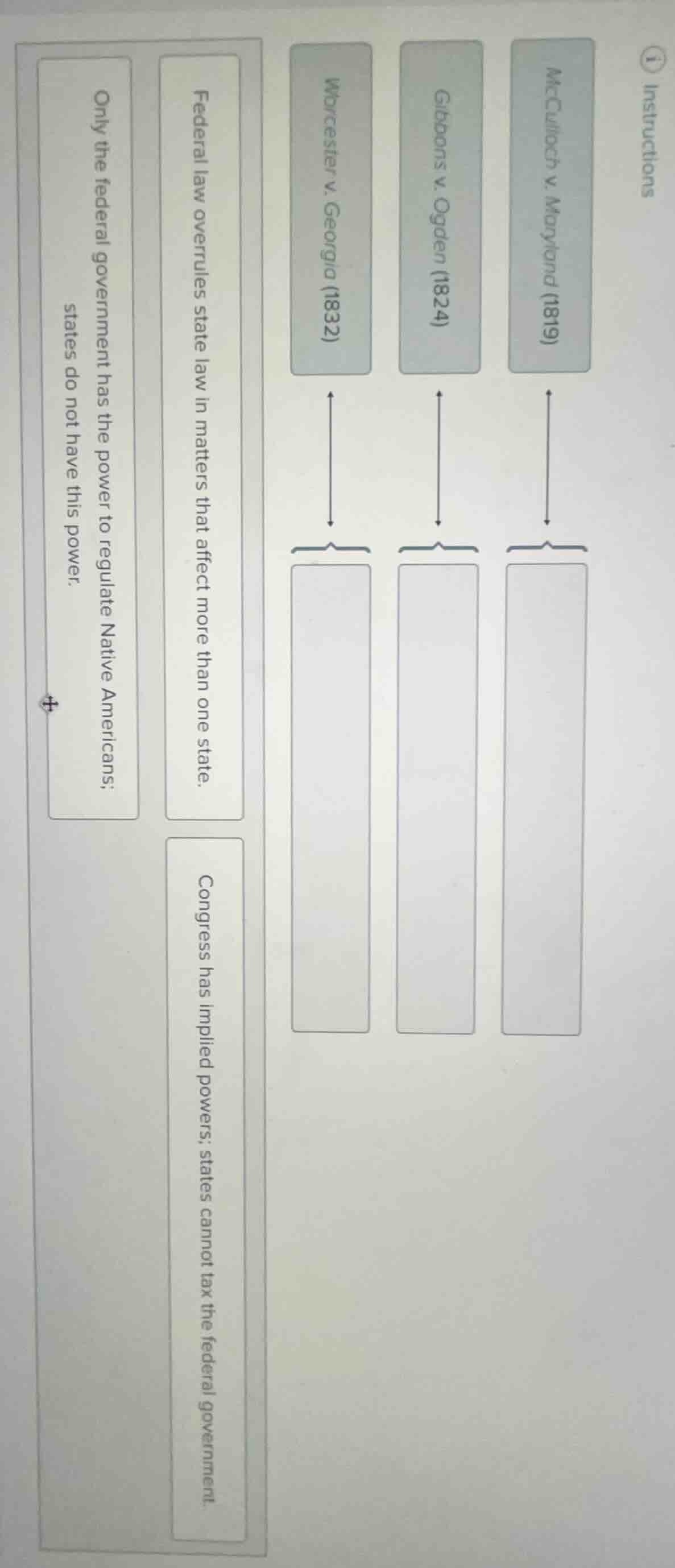
mcculloch v. maryland (1819)
gibbons v. ogden (1824)
worcester v. georgia (1832)
federal law overrules state law in matters that affect more than one state.
congress has implied powers; states cannot tax the federal government.
only the federal government has the power to regulate native americans; states do not have this power.
Brief Explanations
Each Supreme Court case is matched to its core ruling based on U.S. constitutional law precedents:
- McCulloch v. Maryland (1819) established Congress has implied powers under the Necessary and Proper Clause, and states lack authority to tax federal institutions.
- Gibbons v. Ogden (1824) confirmed federal supremacy in regulating interstate commerce, meaning federal law overrules state law in multi-state matters.
- Worcester v. Georgia (1832) held that only the federal government has the power to regulate relations with Native American nations, barring state interference.

Snap & solve any problem in the app
Get step-by-step solutions on Sovi AI
Photo-based solutions with guided steps
Explore more problems and detailed explanations
- McCulloch v. Maryland (1819): Congress has implied powers; states cannot tax the federal government.
- Gibbons v. Ogden (1824): Federal law overrules state law in matters that affect more than one state.
- Worcester v. Georgia (1832): Only the federal government has the power to regulate Native Americans; states do not have this power.