QUESTION IMAGE
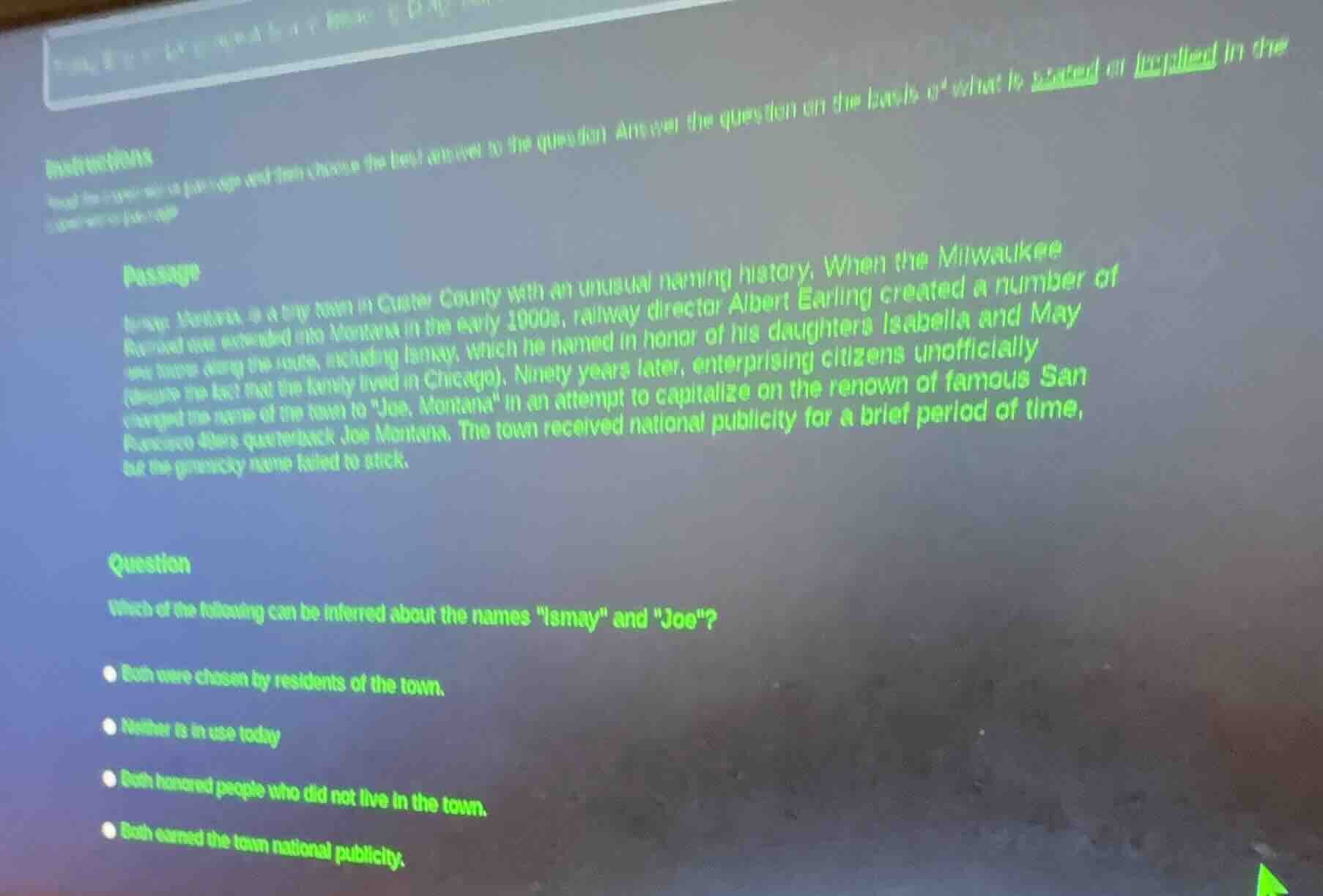
Question
instructions
read the passage and then choose the best answer to the question. answer the question on the basis of what is stated or implied in the passage.
passage
ismay, montana, is a tiny town in custer county with an unusual naming history. when the milwaukee railroad was extended into montana in the early 1900s, railway director albert earling created a number of new towns along the route, including ismay, which he named in honor of his daughters isabella and may (despite the fact that the family lived in chicago). ninety years later, enterprising citizens unofficially changed the name of the town to \joe, montana\ in an attempt to capitalize on the renown of famous san francisco 49ers quarterback joe montana. the town received national publicity for a brief period of time, but the gimmicky name failed to stick.
question
which of the following can be inferred about the names \ismay\ and \joe\?
- both were chosen by residents of the town.
- neither is in use today
- both honored people who did not live in the town.
- both earned the town national publicity.
- Analyze "Ismay": Named by Albert Earling after his daughter (who lived in Chicago, not the town).
- Analyze "Joe": Named after Joe Montana (a 49ers quarterback, not living in the town).
- Check options:
- "Both were chosen by residents" is wrong (Ismay was chosen by Earling, not residents).
- "Neither is in use today" – the passage says the "Joe" name failed to stick, but it doesn't say "Ismay" is not in use now (the town was originally Ismay, so likely still has some connection or use).
- "Both earned the town national publicity" – only the "Joe" name brought brief publicity, not "Ismay".
- "Both honored people who did not live in the town" – Ismay (daughter in Chicago) and Joe (quarterback, not in the town) fit this.

Snap & solve any problem in the app
Get step-by-step solutions on Sovi AI
Photo-based solutions with guided steps
Explore more problems and detailed explanations
C. Both honored people who did not live in the town. (Assuming the option identifiers are A, B, C, D with C being "Both honored people who did not live in the town")