QUESTION IMAGE
Question
instructions
use the graph to answer the questions.
classify graphs
check all that apply.
□ function
□ discrete
□ decreasing
□ increasing
□ linear
□ continuous
Brief Explanations
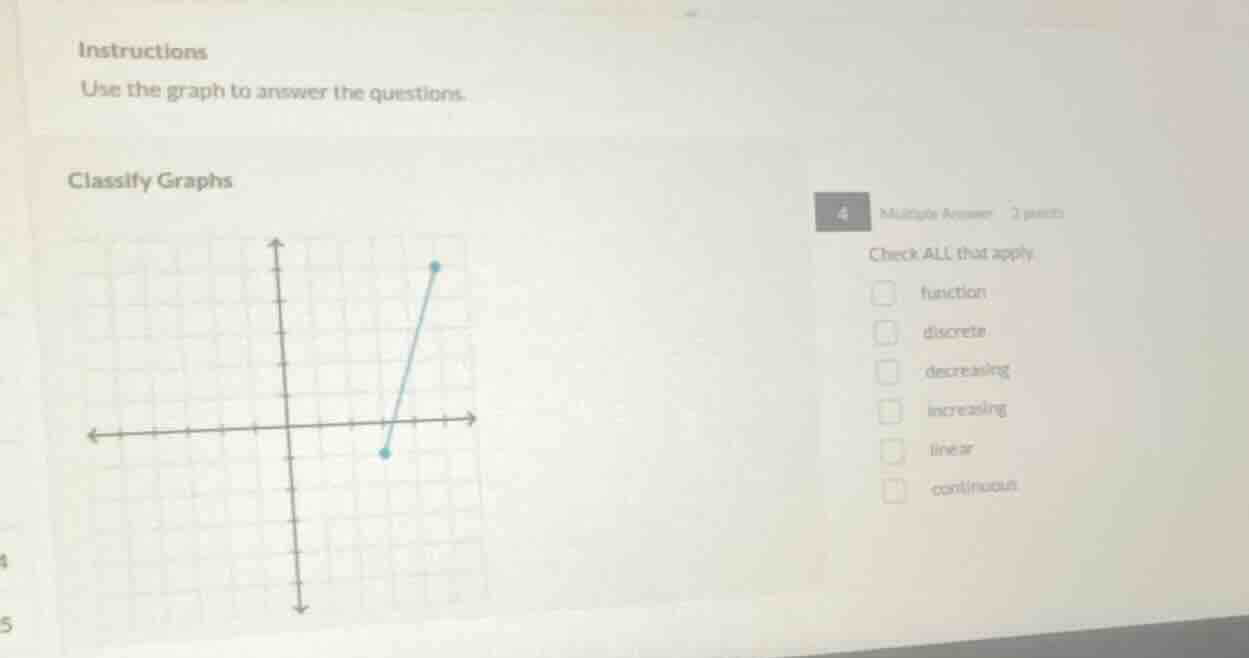
- Function: A graph represents a function if no vertical line intersects it more than once. Here, the graph (a line segment between two points) passes the vertical line test, so it is a function.
- Discrete: The graph consists of distinct points (the two endpoints and the line between them? Wait, no—actually, the graph here is a line segment with two endpoints, but it's a finite segment. However, "discrete" usually refers to a graph with isolated points (like a scatter plot), but this is a line segment. Wait, maybe I misinterpret. Wait, the graph has two endpoints and a line connecting them? Wait, no, looking at the graph: it's a line segment between two points, so it's a linear segment. But "discrete" would be if it's just points with no line, but here there's a line. Wait, maybe the graph is two points with a line between them, so it's a linear, continuous? No, wait, the options: "discrete" is when the graph is a set of distinct points (no connecting lines), "continuous" is when it's a connected graph (like a line or curve). But in this case, the graph has a line segment between two points, so it's a linear, increasing, function, and maybe discrete? Wait, no—let's re-examine:
Wait, the graph shows two points connected by a line. So:
- Function: Passes vertical line test (only one y for each x in the domain), so yes.
- Discrete: If the graph is made of distinct points (even with a line between them? No, discrete is usually points without connecting lines. But maybe in this case, the graph is considered discrete because it's a finite segment with endpoints? Wait, no, "discrete" in functions is when the domain is discrete (like integers), and the graph is points. But here, the line is between two points, so maybe it's a linear, increasing, function, and discrete? Wait, no—let's check the options:
- Increasing: The line has a positive slope (from lower left to upper right), so as x increases, y increases, so it's increasing.
- Linear: The graph is a straight line (segment), so it's linear.
- Function: Yes, as vertical line test passes.
- Discrete: If the graph is made of distinct points (the two endpoints and the line? No, discrete is points without lines. But maybe the graph is two points with a line, so it's a linear, increasing, function, and discrete? Wait, maybe the graph is considered discrete because it's a finite set of points (the two endpoints) with a line, but that's confusing. Wait, maybe the correct options are function, increasing, linear, and discrete? No, wait, "continuous" would be if it's a line without endpoints, but this has endpoints. Wait, maybe the graph is a line segment, so it's linear, function, increasing, and discrete? Wait, no—let's re-express:
Wait, the graph: two points connected by a line. So:
- Function: Yes (vertical line test).
- Discrete: If the graph is a set of distinct points (the two endpoints) with a line, but discrete usually means no connecting lines. Maybe the problem considers it discrete because it's a finite segment with endpoints. Alternatively, maybe "discrete" is not correct, but let's check the other options:
- Decreasing: No, it's increasing.
- Increasing: Yes, slope is positive.
- Linear: Yes, straight line.
- Continuous: A continuous graph has no breaks, but this is a line segment with endpoints. Wait, "continuous" in functions means the graph is connected (no gaps), and this line segment is connected, so it's continuous? But the options include "discrete" and "continuous". Wait, maybe the graph is two points with a lin…

Snap & solve any problem in the app
Get step-by-step solutions on Sovi AI
Photo-based solutions with guided steps
Explore more problems and detailed explanations
- function
- discrete
- increasing
- linear