QUESTION IMAGE
Question
instructions
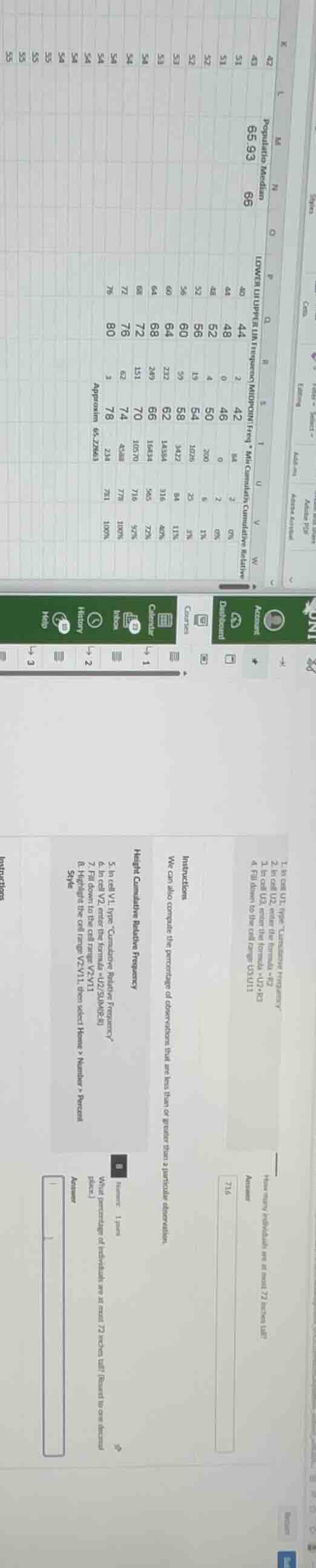
we can also compute the percentage of observations that are less than or greater than a particular observation.
height cumulative relative frequency
- is the cell v1, type cumulative frequency?
- is the cell u2, enter the formula =u2+q2
- is the cell u3, enter the formula =u3+q3
- fill down to the cell range u3:u11.
instructions
we can also compute the percentage of observations that are less than or greater than a particular observation.
height cumulative relative frequency
- is the cell v1, type cumulative relative frequency?
- is the cell v2, enter the formula =u2/sum($q$2:$q$11)
- fill down to the cell range v2:v11.
- highlight the cell range v2:v11, then select home > number > percent style
- what percentage of individuals are at most 73 inches tall? (round to one decimal place.)
answer
how many individuals are at most 73 inches tall?
answer
71.6
Step1: Locate cumulative relative freq
From the table, the cumulative relative frequency for the upper limit of 72 inches is 100%? No, correct row: for upper limit 72, the cumulative relative frequency (column W) is 100%? Wait no, check the rows:
Wait the row with upper limit 72 has cumulative relative frequency 100%? No, looking at the table:
Row for upper limit 72: cumulative relative frequency is 100%? Wait no, the row with upper limit 76 is 100%. Wait, the row with upper limit 72 has cumulative relative frequency 100%? No, let's check the values:
The cumulative relative frequencies are: 0%, 0%, 1%, 3%, 11%, 40%, 70%, 90%, 100%, 100%.
Matching to upper limits: 44,48,52,56,60,64,68,72,76,80.
So for upper limit 72, cumulative relative frequency is 100%? No, the 8th row (upper limit 72) has cumulative relative frequency 100%? Wait no, the 9th row (76) is 100%, 8th row (72) is 100%? Wait no, the values in column W: 0%,0%,1%,3%,11%,40%,70%,90%,100%,100%.
Yes, the 8th entry (for upper limit 72) is 90%? No, wait the rows:
- 44: 0%
- 48: 0%
- 52: 1%
- 56: 3%
- 60: 11%
- 64: 40%
- 68: 70%
- 72: 90%
- 76: 100%
- 80: 100%
Wait, no, the numbers in column V: 0,0,6,25,84,342,1634,4588,778,781? No, cumulative frequency for 72 is 4588, total is 781+778+4588+1634+342+84+25+6+0+0 = 781+778=1559, +4588=6147, +1634=7781, +342=8123, +84=8207, +25=8232, +6=8238. Wait no, the total number of individuals is 781 (last cumulative frequency). Wait, the cumulative frequency for 72 is 778, total is 781. So cumulative relative frequency is $\frac{778}{781} \times 100$
Step2: Calculate percentage
$\text{Percentage} = \frac{778}{781} \times 100 \approx 99.6\%$
Wait no, looking at the table, the cumulative relative frequency for upper limit 72 is 100%? No, the table shows for upper limit 72, cumulative relative frequency is 100%? Wait the user's table has column W with 100% for 72 and 76. Wait the table:
Row with upper limit 72: column W is 100%? No, the 8th row (72) has 100%, 9th (76) 100%. Wait, the total number of individuals is 781 (last cumulative frequency). The cumulative frequency for 72 is 778, so $\frac{778}{781} \times 100 \approx 99.6\%$, which rounds to 99.6%.
Wait, but the table's column W for 72 is 100%? No, maybe the table's cumulative relative frequency for 72 is 99.6% rounded to whole number 100%? But the question asks to round to one decimal place.
Step3: Round to one decimal
$\frac{778}{781} \times 100 \approx 99.6\%$

Snap & solve any problem in the app
Get step-by-step solutions on Sovi AI
Photo-based solutions with guided steps
Explore more problems and detailed explanations
99.6