QUESTION IMAGE
Question
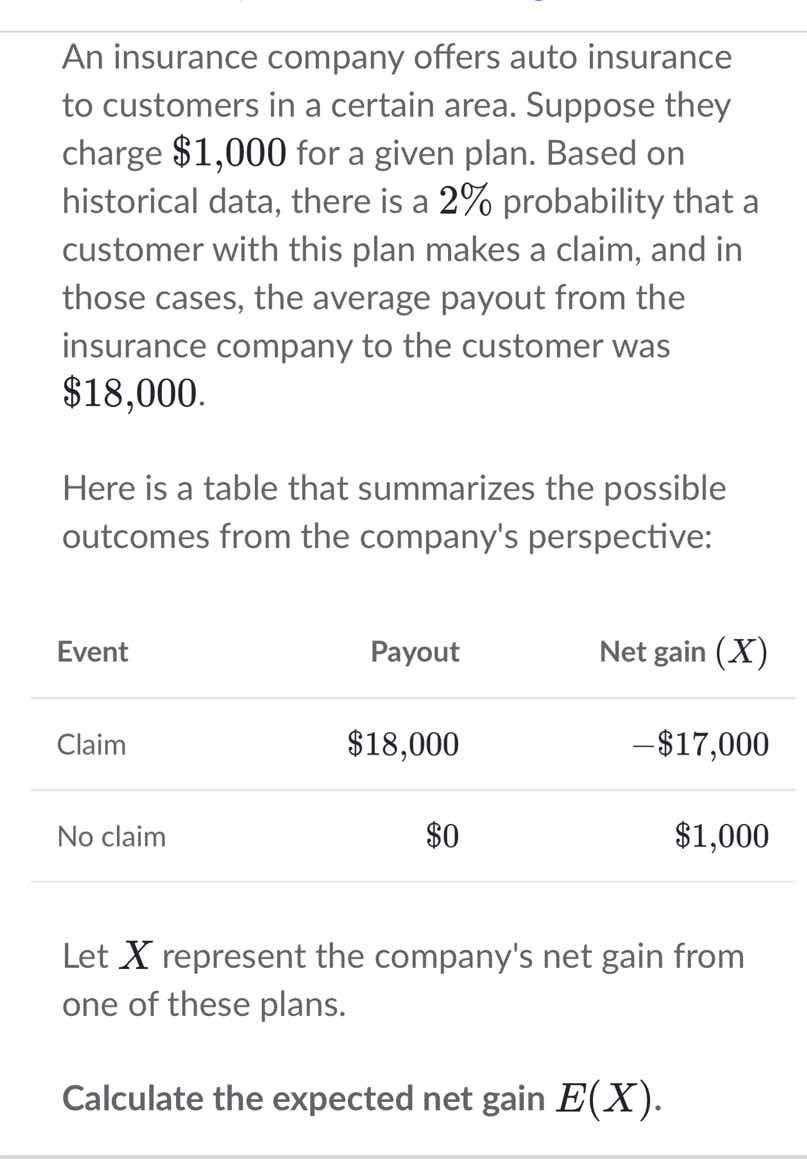
an insurance company offers auto insurance to customers in a certain area. suppose they charge $1,000 for a given plan. based on historical data, there is a 2% probability that a customer with this plan makes a claim, and in those cases, the average payout from the insurance company to the customer was $18,000. here is a table that summarizes the possible outcomes from the companys perspective: event payout net gain (x) claim $18,000 -$17,000 no claim $0 $1,000 let x represent the companys net gain from one of these plans. calculate the expected net gain e(x).
Step1: Identify probabilities and values
The probability of a claim (event "Claim") is \( P(\text{Claim}) = 0.02 \), and the net gain for this event is \( X_{\text{Claim}} = -17000 \). The probability of no claim (event "No claim") is \( P(\text{No claim}) = 1 - 0.02 = 0.98 \), and the net gain for this event is \( X_{\text{No claim}} = 1000 \).
Step2: Use the expected value formula
The formula for the expected value \( E(X) \) of a discrete random variable is \( E(X) = \sum [x_i \cdot P(x_i)] \), where \( x_i \) are the possible values of \( X \) and \( P(x_i) \) are their corresponding probabilities.
Substitute the values into the formula:
\[
\]
Step3: Calculate each term
First term: \( -17000 \cdot 0.02 = -340 \)
Second term: \( 1000 \cdot 0.98 = 980 \)
Step4: Sum the terms
\[
E(X) = -340 + 980 = 640
\]

Snap & solve any problem in the app
Get step-by-step solutions on Sovi AI
Photo-based solutions with guided steps
Explore more problems and detailed explanations
The expected net gain \( E(X) \) is \(\$640\).