QUESTION IMAGE
Question
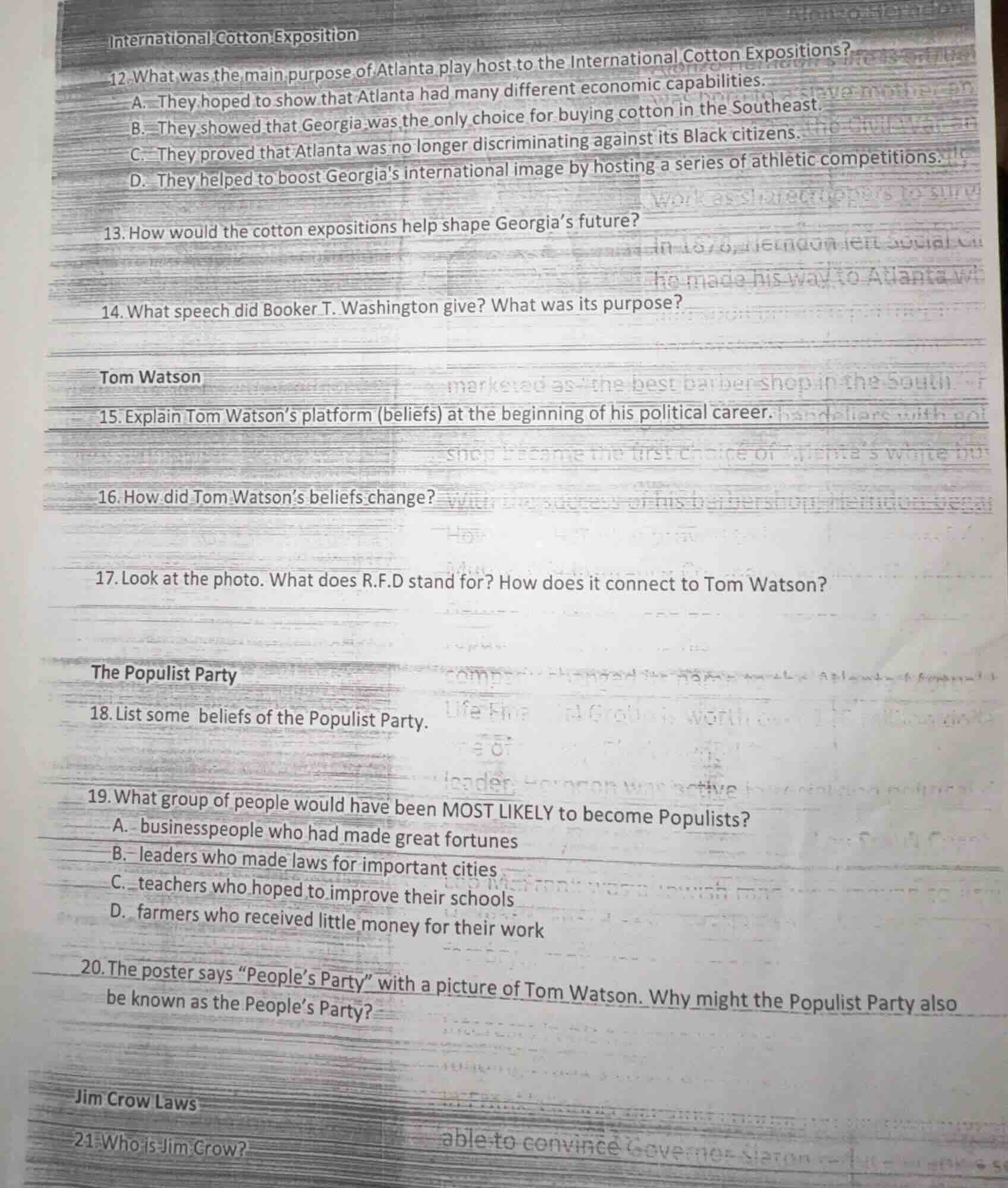
international cotton exposition
- what was the main purpose of atlanta play host to the international cotton expositions?
a. they hoped to show that atlanta had many different economic capabilities.
b. they showed that georgia was the only choice for buying cotton in the southeast.
c. they proved that atlanta was no longer discriminating against its black citizens.
d. they helped to boost georgias international image by hosting a series of athletic competitions.
- how would the cotton expositions help shape georgia’s future?
- what speech did booker t. washington give? what was its purpose?
tom watson
- explain tom watson’s platform (beliefs) at the beginning of his political career.
- how did tom watson’s beliefs change?
- look at the photo. what does r.f.d stand for? how does it connect to tom watson?
the populist party
- list some beliefs of the populist party.
- what group of people would have been most likely to become populists?
a. businesspeople who had made great fortunes
b. leaders who made laws for important cities
c. teachers who hoped to improve their schools
d. farmers who received little money for their work
- the poster says “people’s party” with a picture of tom watson. why might the populist party also be known as the people’s party?
jim crow laws
- who is jim crow?
- The International Cotton Expositions in Atlanta were held to showcase the city's diverse economic potential beyond just cotton, to attract Northern investment and rebuild the region post-Civil War.
- The expositions brought Northern investment, promoted industrialization, and helped shift Georgia's economy from a purely cotton-based system to a more diversified one, laying groundwork for future economic growth.
- Booker T. Washington gave the Atlanta Compromise Speech. Its purpose was to advocate for Black economic advancement and vocational training first, while accepting temporary social segregation to ease racial tensions and gain white support for Black education and economic opportunities.
- Early in his career, Tom Watson was a Populist who advocated for poor white and Black farmers, pushed for economic reforms to help agricultural workers, and supported racial cooperation to challenge elite power.
- Later in his career, Watson abandoned his progressive, racially inclusive views. He became a virulent white supremacist, promoted nativism, and aligned with conservative, segregationist politics to gain broader white support.
- R.F.D stands for Rural Free Delivery, a U.S. Postal Service program that delivered mail directly to rural homes. Tom Watson, as a Populist, advocated for this service to support rural farmers, who were his key base, by improving their access to communication and goods.
- Key beliefs of the Populist Party included: government regulation of railroads and banks to protect farmers, bimetallism (using both gold and silver as currency) to increase the money supply, support for rural and working-class interests, and direct election of U.S. Senators.
- The Populist Party was founded to address the grievances of rural farmers who faced low crop prices, high debt, and exploitation by railroads and banks.
- The Populist Party was called the "People's Party" because it centered the interests of working-class and rural Americans (the "common people") against the wealthy elite, banks, and large corporations that they believed held too much power.
- Jim Crow is not a real person. The term refers to a system of state and local laws in the U.S. South that enforced racial segregation, disenfranchised Black voters, and imposed severe racial discrimination from the late 19th century through the mid-20th century.

Snap & solve any problem in the app
Get step-by-step solutions on Sovi AI
Photo-based solutions with guided steps
Explore more problems and detailed explanations
- A. They hoped to show that Atlanta had many different economic capabilities.
- The expositions attracted Northern investment, spurred industrialization, and diversified Georgia's economy, moving it beyond reliance on cotton and laying the foundation for long-term economic development.
- Speech: Atlanta Compromise Speech; Purpose: To advocate for Black economic/vocational advancement while accepting temporary social segregation to build white support for Black educational and economic opportunities.
- Early on, Watson was a Populist who championed poor white and Black farmers, pushed for pro-agricultural economic reforms, and supported racial cooperation to counter elite power.
- Watson later embraced virulent white supremacy, nativism, and conservative segregationist politics, abandoning his earlier racially inclusive, pro-farmer progressive views.
- R.F.D stands for Rural Free Delivery. Watson, as a Populist advocate for rural farmers, supported this postal service to improve rural access to mail and communication, benefiting his core voter base.
- Populist Party beliefs included: government regulation of railroads/banks, bimetallism, support for rural working-class interests, direct election of U.S. Senators, and debt relief for farmers.
- D. farmers who received little money for their work
- It was called the People's Party because it prioritized the interests of working-class and rural "common people" over the wealthy elite, banks, and large corporate powers.
- Jim Crow is not an actual person; it is the name for the system of state and local racial segregation, disenfranchisement, and discrimination laws enforced in the American South from the late 1800s to the mid-1900s.