QUESTION IMAGE
Question
interpreting function notation
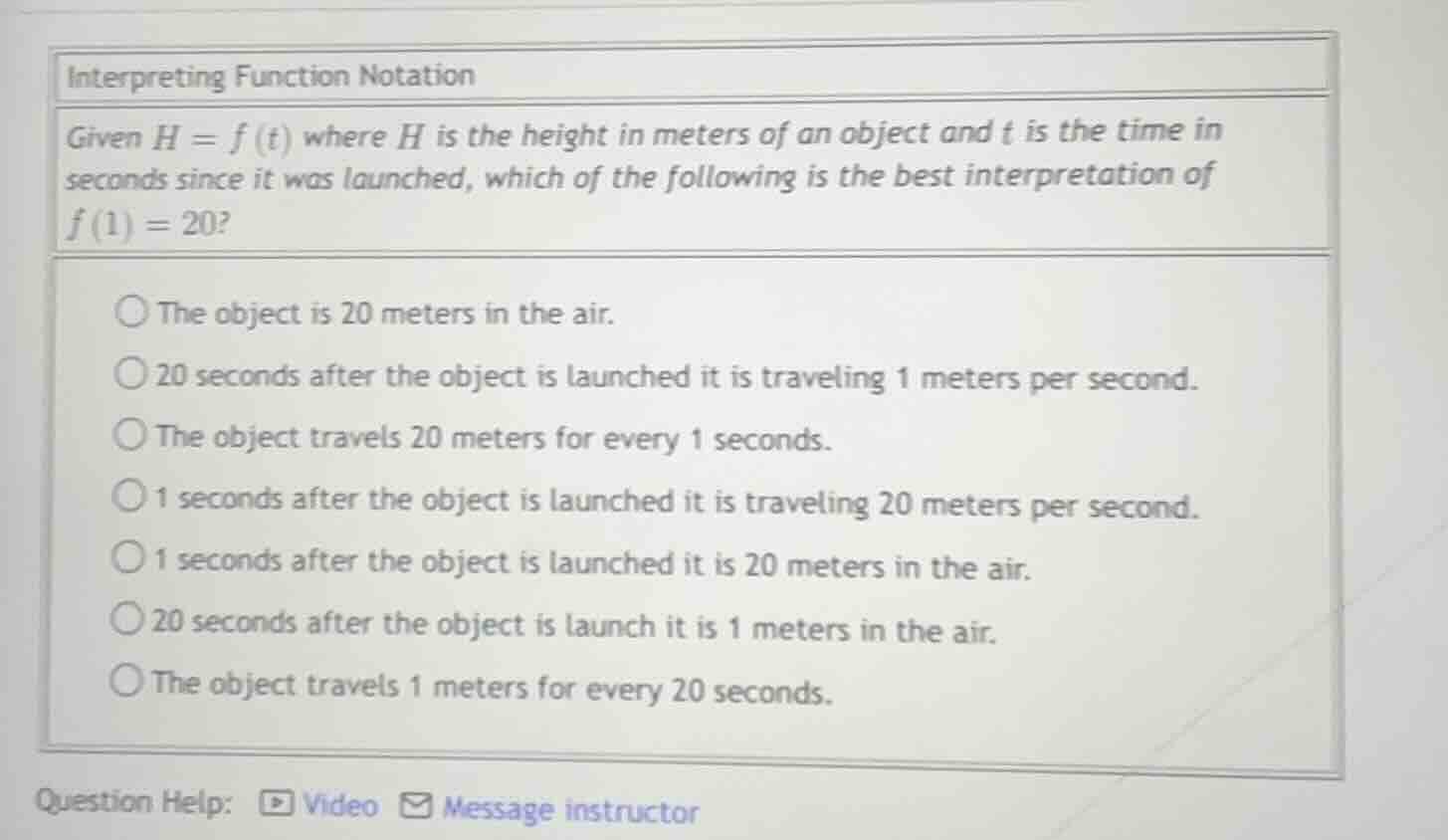
given ( h = f(t) ) where ( h ) is the height in meters of an object and ( t ) is the time in seconds since it was launched, which of the following is the best interpretation of ( f(1) = 20 )?
- the object is 20 meters in the air.
- 20 seconds after the object is launched it is traveling 1 meters per second.
- the object travels 20 meters for every 1 seconds.
- 1 seconds after the object is launched it is traveling 20 meters per second.
- 1 seconds after the object is launched it is 20 meters in the air.
- 20 seconds after the object is launch it is 1 meters in the air.
- the object travels 1 meters for every 20 seconds.
question help: video message instructor
Brief Explanations
Function notation \(H = f(t)\) means \(t\) (input) is time in seconds after launch, and \(f(t)\) (output) is height in meters. For \(f(1)=20\), the input \(t=1\) represents 1 second after launch, and the output 20 represents the height of the object at that time.

Snap & solve any problem in the app
Get step-by-step solutions on Sovi AI
Photo-based solutions with guided steps
Explore more problems and detailed explanations
1 seconds after the object is launched it is 20 meters in the air.