QUESTION IMAGE
Question
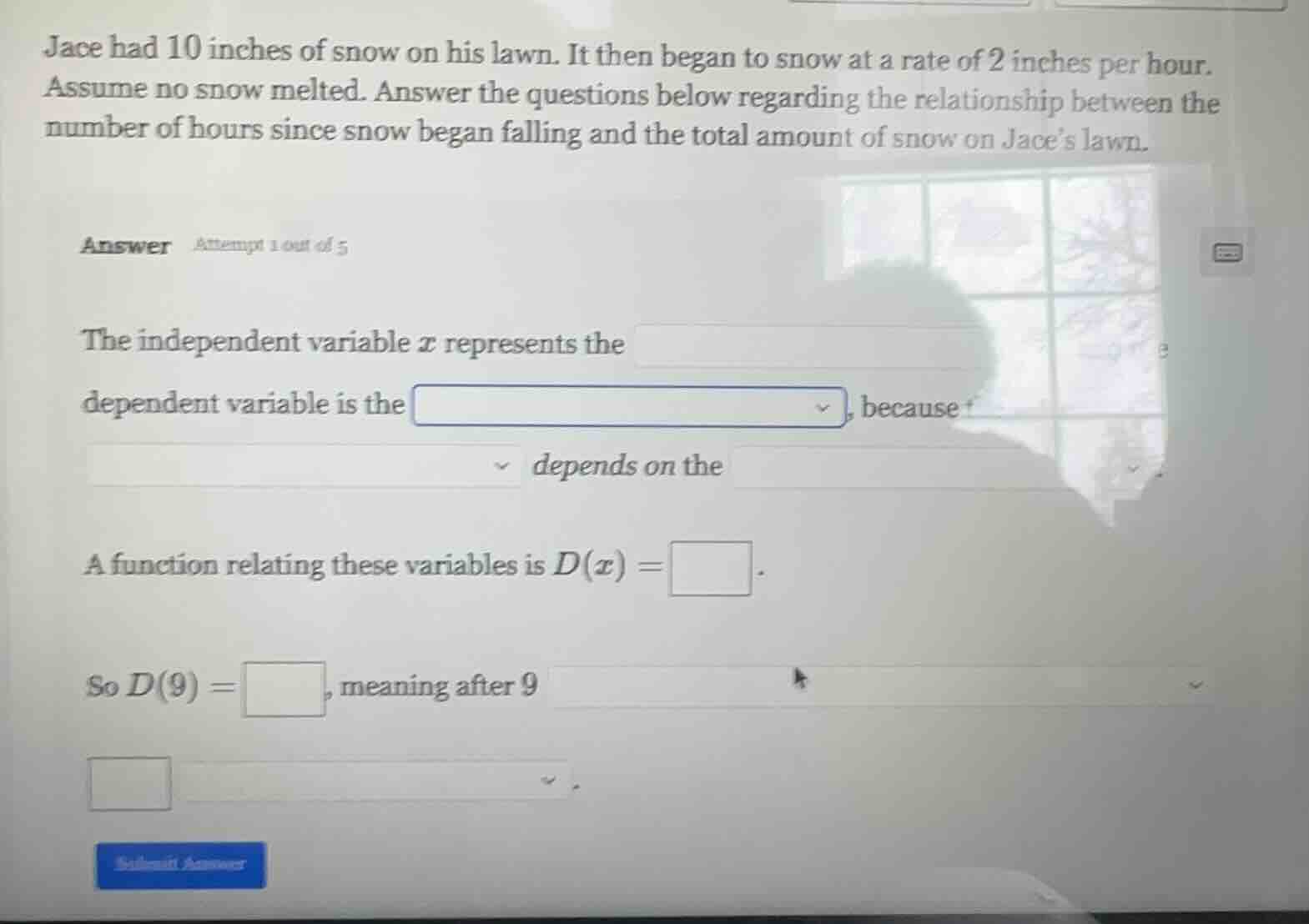
jace had 10 inches of snow on his lawn. it then began to snow at a rate of 2 inches per hour. assume no snow melted. answer the questions below regarding the relationship between the number of hours since snow began falling and the total amount of snow on jaces lawn. answer attempt 1 out of 5 the independent variable x represents the dependent variable is the, because depends on the a function relating these variables is d(x) = . so d(9) =, meaning after 9
Step1: Identify independent variable
The independent variable \( x \) represents the number of hours since snow began falling, as time is the input we can control or observe.
Step2: Identify dependent variable
The dependent variable is the total amount of snow on the lawn, because the total snow depends on the number of hours (time) that have passed.
Step3: Formulate the function
Initially, there are 10 inches of snow, and it snows at 2 inches per hour. So the function \( D(x) \) (total snow) is the initial amount plus the rate times hours: \( D(x)=10 + 2x \).
Step4: Calculate \( D(9) \)
Substitute \( x = 9 \) into the function: \( D(9)=10+2\times9=10 + 18 = 28 \). This means after 9 hours, the total snow is 28 inches.

Snap & solve any problem in the app
Get step-by-step solutions on Sovi AI
Photo-based solutions with guided steps
Explore more problems and detailed explanations
- The independent variable \( x \) represents the number of hours since snow began falling.
- The dependent variable is the total amount of snow on Jace's lawn, because the total amount of snow depends on the number of hours since snow began falling.
- A function relating these variables is \( D(x)=\boldsymbol{10 + 2x} \).
- So \( D(9)=\boldsymbol{28} \), meaning after 9 hours, the total amount of snow on Jace's lawn is 28 inches.