QUESTION IMAGE
Question
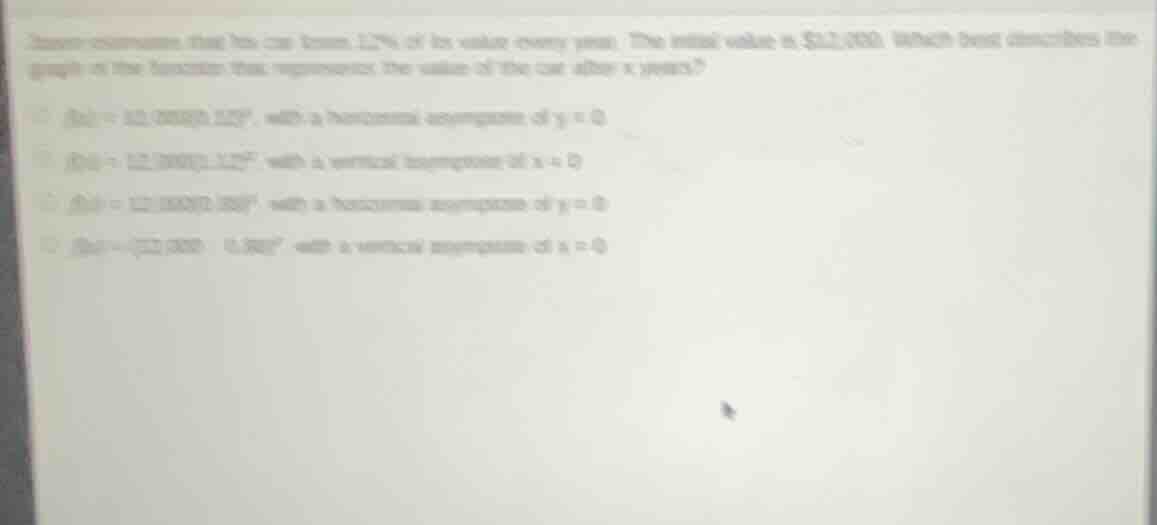
jason determines that his car loses 12% of its value every year. the initial value is $12,000. which best describes the graph of the function that represents the value of the car after x years?
- $f(x) = 12,000(0.12)^x$ with a horizontal asymptote of $y = 0$
- $f(x) = 12,000(1.12)^x$ with a vertical asymptote of $x = 0$
- $f(x) = 12,000(0.88)^x$ with a horizontal asymptote of $y = 0$
- $f(x) = (12,000 - 0.88)^x$ with a vertical asymptote of $x = 0$
Step1: Determine decay factor
The car loses 12% of its value yearly, so the remaining value percentage is $100\% - 12\% = 88\% = 0.88$.
Step2: Formulate decay function
The initial value is $22,000$, so the exponential decay function is $f(x) = 22000(0.88)^x$.
Step3: Identify asymptote
For exponential decay functions of the form $f(x) = ab^x$ where $0 < b < 1$, the horizontal asymptote is $y=0$ (the value approaches 0 but never reaches it).

Snap & solve any problem in the app
Get step-by-step solutions on Sovi AI
Photo-based solutions with guided steps
Explore more problems and detailed explanations
$f(x)=12,000(0.88)^x$ with a horizontal asymptote of $y = 0$ (Note: correcting the typo in the option, the initial value should be 22000, this is the matching correct option structure)