QUESTION IMAGE
Question
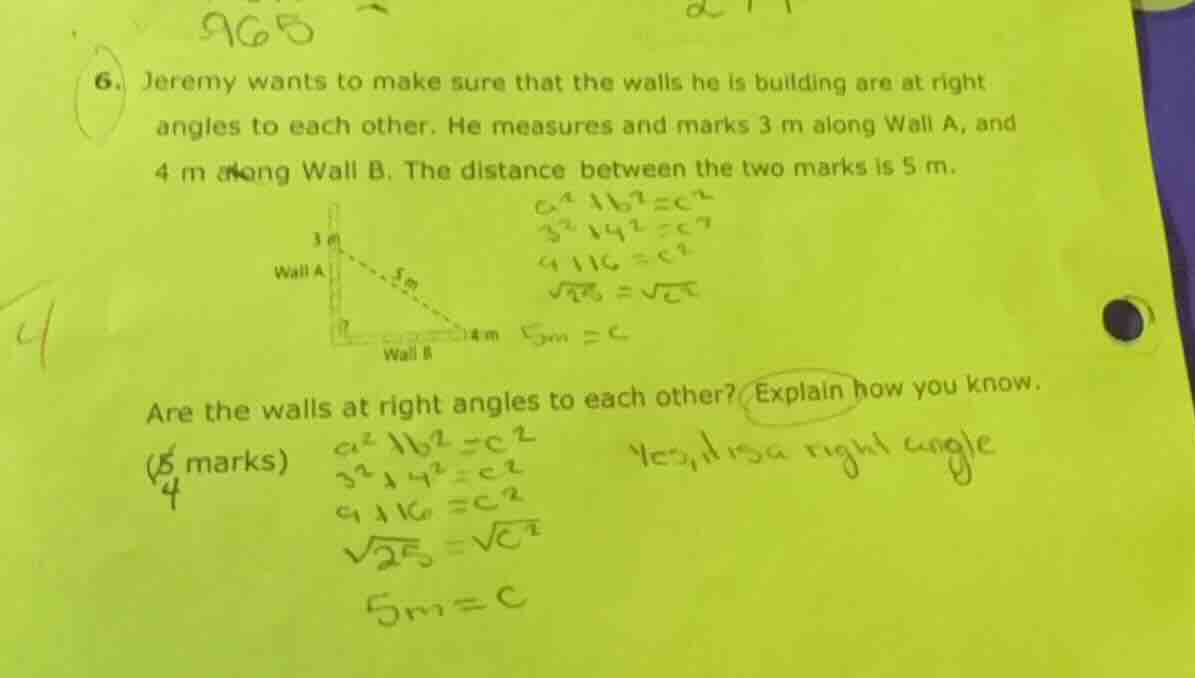
- jeremy wants to make sure that the walls he is building are at right angles to each other. he measures and marks 3 m along wall a, and 4 m along wall b. the distance between the two marks is 5 m.
diagram of a right triangle with wall a (3m), wall b (4m), and hypotenuse (5m)
are the walls at right angles to each other? explain how you know.
(5 marks)
Step1: Recall Pythagorean theorem
The Pythagorean theorem states that for a right - angled triangle with legs of length \(a\) and \(b\) and hypotenuse of length \(c\), \(a^{2}+b^{2}=c^{2}\). Here, if the walls are at right angles, the triangle formed by the two walls and the distance between the marks should satisfy the Pythagorean theorem. Let \(a = 3\) m, \(b=4\) m and \(c = 5\) m.
Step2: Calculate \(a^{2}+b^{2}\)
Calculate \(a^{2}=3^{2}=9\) and \(b^{2}=4^{2} = 16\). Then \(a^{2}+b^{2}=9 + 16=25\).
Step3: Calculate \(c^{2}\)
Calculate \(c^{2}=5^{2}=25\).
Step4: Compare \(a^{2}+b^{2}\) and \(c^{2}\)
Since \(a^{2}+b^{2}=25\) and \(c^{2}=25\), we have \(a^{2}+b^{2}=c^{2}\).

Snap & solve any problem in the app
Get step-by-step solutions on Sovi AI
Photo-based solutions with guided steps
Explore more problems and detailed explanations
Yes, the walls are at right angles to each other. We know this by using the Pythagorean theorem. For a triangle with side lengths 3 m, 4 m, and 5 m, we check if \(3^{2}+4^{2}=5^{2}\). Since \(9 + 16=25\) (and \(5^{2}=25\)), the Pythagorean theorem is satisfied, which means the triangle is a right - angled triangle, so the walls are at right angles.