QUESTION IMAGE
Question
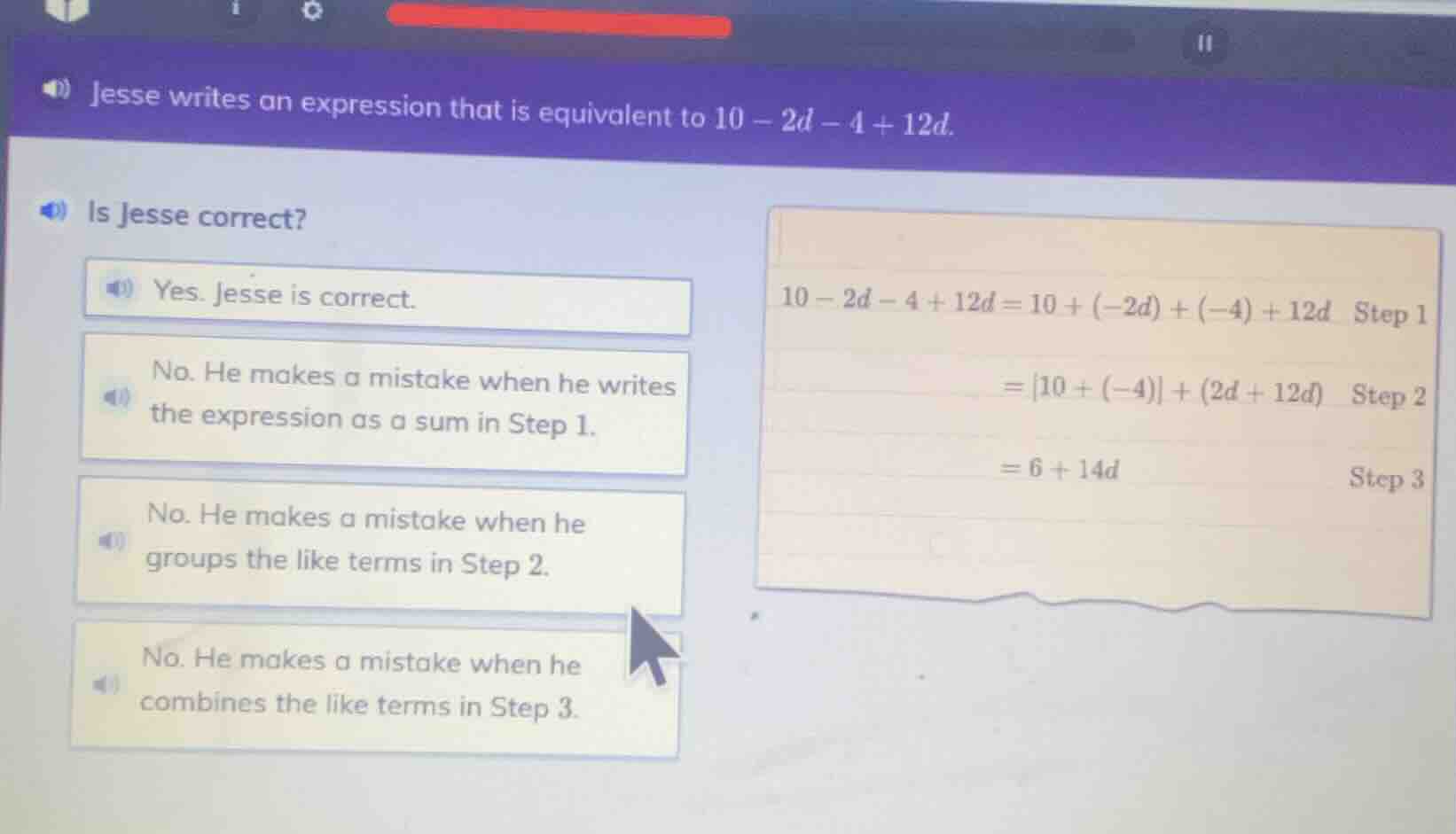
jesse writes an expression that is equivalent to $10 - 2d - 4 + 12d$. is jesse correct? yes. jesse is correct. no. he makes a mistake when he writes the expression as a sum in step 1. no. he makes a mistake when he groups the like terms in step 2. no. he makes a mistake when he combines the like terms in step 3. $10 - 2d - 4 + 12d = 10 + (-2d) + (-4) + 12d$ step 1 $= 10 + (-4) + (2d + 12d)$ step 2 $= 6 + 14d$ step 3
Step1: Analyze Step 1
The original expression is \(10 - 2d - 4 + 12d\). Rewriting subtraction as adding the opposite: \(10 + (-2d)+(-4)+12d\) is correct.
Step2: Analyze Step 2
Like terms are constants and terms with \(d\). The constant terms are \(10\) and \(-4\), and the terms with \(d\) are \(-2d\) and \(12d\). But in Step 2, it groups \(-2d\) as \(2d\), which is a mistake. The correct grouping should be \([10 + (-4)]+[(-2d)+12d]\).
Step3: Analyze Step 3 (due to Step 2 mistake)
Since Step 2 has a mistake in grouping (incorrect sign for \(-2d\)), the combination in Step 3 is also affected, but the main error is in Step 2.

Snap & solve any problem in the app
Get step-by-step solutions on Sovi AI
Photo-based solutions with guided steps
Explore more problems and detailed explanations
No. He makes a mistake when he groups the like terms in Step 2.